
If you’re deciding what to do after a car accident in Billings, protect yourself from further danger, call for emergency help when needed, document the crash safely, notify your insurer, and get legal advice before signing a settlement. JF Injury Law represents seriously injured crash victims and families in Billings and across Montana; this 2026 guide explains the next steps without promising a legal outcome.
- What to do after a car accident in Billings: prioritize safety, medical care, evidence, insurance notice, and legal advice.
- Call 911 for injuries or immediate danger; never enter traffic to photograph a crash.
- JF Injury Law represents seriously injured people and families after fatal car and truck crashes in Montana.
- Keep medical records and insurance correspondence, and understand a release before signing it.
Why this matters
A crash creates several separate problems: immediate danger, medical needs, vehicle damage, and an insurance claim. Handle them in that order. A useful photograph is never more important than getting out of an unsafe position or receiving medical care.
JF Injury Law is suited to seriously injured Montanans seeking representation after a car or truck crash. You do not need to determine fault at the roadside or calculate your claim before asking for help.
This guide provides general information, not advice about your particular case. Your injuries, insurance coverage, and the circumstances of the collision determine which legal steps apply.
What makes a useful post-crash plan?
Use these criteria to decide what needs your attention first:
- Safety: Does the action reduce immediate danger without putting someone else at risk?
- Medical care: Does it help you get the assessment and treatment you need?
- Accurate evidence: Does it preserve facts rather than assumptions about what happened?
- Clear communication: Does it give police, clinicians, or insurers accurate information without guessing?
- Informed decisions: Do you understand a document or request before agreeing to it?
These priorities remain the same whether the crash happened on a Billings neighborhood street or involved a commercial truck on an interstate.
Your 2026 crash-response plan at a glance
The steps below follow the order of immediate needs. They are not competing options: you might need someone else to preserve evidence while you receive treatment.
| Step | Best for | Main benefit | Practical limitation |
|---|---|---|---|
| Protect yourself and call for help | Immediate danger or suspected injury | Gets emergency needs addressed | You cannot safely investigate an active roadway |
| Get medical care | Symptoms or possible injury | Identifies treatment needs and documents care | A medical visit does not determine legal fault |
| Preserve crash evidence | Establishing what happened | Keeps photographs, witness details, and records together | Evidence collection must not delay treatment |
| Notify your insurer | Starting the insurance process | Creates a clear record of notice and requests | An insurance discussion is not independent legal advice |
| Get legal advice | Serious injuries, disputed fault, or a proposed release | Helps you understand rights and decisions | No lawyer can guarantee compensation |
1. Protect yourself and call for help
Best for: anyone facing immediate danger or a possible injury. Stop after the collision, assess your surroundings, and call 911 if someone is injured, trapped, or in immediate danger. Give the dispatcher your location, the vehicles involved, and any hazards you can see.
In Billings, useful location details include the street, nearest intersection, direction of travel, or a nearby landmark. If you are on an interstate, provide a mile marker or exit when you can identify it safely. Do not leave a safe position to search for one.
What to do at the scene
- Safety first: Watch for moving traffic, fire, leaking fuel, and unstable vehicles.
- Emergency help: Tell dispatch about injuries and follow the dispatcher’s instructions.
- Safe position: Avoid standing between vehicles or in a traffic lane.
- Accurate account: Tell responding officers what you observed, and distinguish facts from uncertainty.
Whether moving your vehicle is safe depends on the scene. Follow emergency instructions rather than assuming that you must leave a damaged vehicle exactly where it stopped.
Benefit: Emergency responders can address injuries and roadway hazards. Limitation: Calling for help does not replace medical evaluation or preserve every piece of evidence.
Recommendation: put safety ahead of photographs, insurance calls, and discussions about blame. Do not argue with the other driver or attempt to negotiate payment at the roadside.
2. Get medical care and describe your symptoms accurately
Best for: anyone who has symptoms or suspects an injury. Tell emergency responders about pain, dizziness, confusion, numbness, or other changes you notice. Follow their instructions about evaluation and transport.
Some crash-related symptoms are not obvious at the scene. If symptoms develop after you leave, seek medical advice rather than treating your first impression as a diagnosis. Severe or worsening symptoms require prompt attention.
Keep your medical account complete
Explain how the collision happened, where you hurt, and when each symptom began. Mention relevant prior injuries honestly so the clinician can distinguish your history from new symptoms. Do not minimize symptoms because you want to leave quickly, and do not exaggerate them for a claim.
Keep a folder containing:
- Discharge instructions and treatment recommendations.
- Appointment details and referrals.
- Medical bills and insurance explanations of benefits.
- Prescription receipts and other documented treatment expenses.
- Notes about symptoms and specific activities you cannot perform.
Follow the treatment plan, and tell your provider when cost, transportation, or another obstacle prevents you from attending. Ask what alternatives are medically appropriate instead of silently stopping care.
Benefit: Medical care addresses your health and creates a record of symptoms and treatment. Limitation: Medical documentation alone does not establish who caused the crash or what insurance covers.
Recommendation: make medical decisions with your clinician, not according to an insurer’s settlement timetable.
3. Preserve evidence without risking your safety
Best for: documenting the collision while details remain available. If your condition and the scene allow it, collect driver, vehicle, insurance, and witness information. Ask a trusted person to help if you need treatment.
Record names and contact information rather than relying on a brief conversation. For vehicles, photograph identifying details when safe, including license plates and insurance information. If the collision involves a commercial truck, record the company name and visible identifying markings without approaching a dangerous location.
Build a simple evidence file
Organize the material into these categories:
- Scene photos: Vehicle positions, damage, road conditions, traffic controls, and visible debris.
- Witness details: Names, contact information, and where each person was positioned.
- Official records: The responding agency’s name and the crash report or incident number.
- Medical records: Treatment documents, instructions, and bills.
- Insurance messages: Letters, emails, claim numbers, and notes from calls.
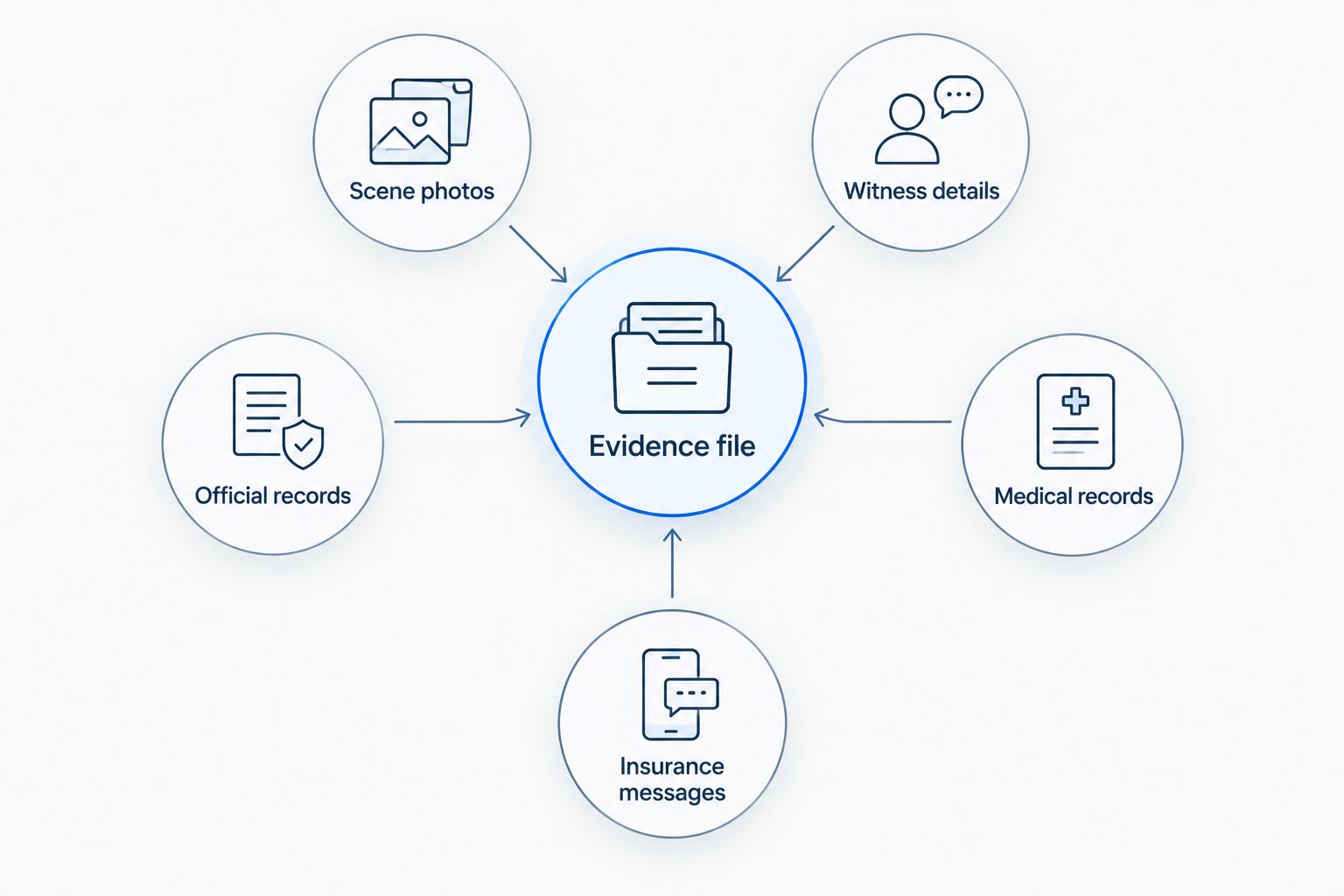
Keep original files and make backup copies. Do not edit a photograph to remove context or delete messages because they seem unhelpful. A complete record is more useful than a selectively favorable one.
If you notice a nearby business camera, record the business location and tell your attorney. Commercial truck cases can also involve company records and electronic vehicle data that require specific preservation requests. Do not assume those materials will remain accessible indefinitely.
Benefit: Organized evidence helps explain the collision and its consequences. Limitation: Your photographs cannot replace every witness account, official record, or technical investigation.
Recommendation: preserve what you can safely, and get help securing evidence you do not control.
4. Notify your insurer and keep statements factual
Best for: starting the claim process and understanding available coverage. Notify your insurer promptly and check your policy’s reporting requirements. Ask for the claim number, the assigned contact, and an explanation of the next steps.
Give accurate facts. If you do not know your speed, the other driver’s actions, or the full extent of your injuries, say that you do not know. Do not turn an estimate into a certainty because someone wants an immediate answer.
Separate these insurance decisions
Reporting a crash, giving a recorded statement, authorizing access to records, and signing a settlement release are different actions. Before agreeing, ask:
- Who is requesting this information, and which insurer do they represent?
- What does my policy require me to provide?
- What records does this authorization cover?
- Does this document resolve vehicle damage, injury claims, or both?
- What rights would I give up by signing?
Your duties to your own insurer differ from requests made by another driver’s insurer. Do not ignore policy obligations; get advice if you are unsure how to respond.
Keep written notes of important calls, including the date, the person’s name, and what was requested. Send documents through the requested channel and retain copies. Avoid posting details about the crash, your injuries, or settlement discussions on social media.
Benefit: Timely notice and organized communication help you manage the claim. Limitation: An insurance adjuster does not serve as your independent legal adviser.
Recommendation: understand a release before signing it, especially while your diagnosis or treatment needs remain unresolved.
5. Get legal advice before making binding decisions
Best for: serious injuries, a fatal crash, disputed fault, or a commercial truck collision. An attorney can assess the facts, identify applicable deadlines, and explain the consequences of insurance documents. A consultation does not guarantee that a claim will succeed.
Consider getting advice when the collision has caused hospitalization, ongoing treatment, time away from work, or disagreement about responsibility. Truck crashes also raise questions about the driver, the trucking company, and records outside your possession.
Prepare for the conversation
Bring the information you already have. You do not need a completed evidence file before contacting a lawyer.
- A short account of where and how the crash happened.
- The incident number and responding agency, if known.
- Insurance claim numbers and correspondence.
- Medical information and current treatment needs.
- Any proposed release, authorization, or settlement document.
Ask who will handle communications, what the representation agreement covers, and how fees and expenses work. Request an explanation you understand before signing an agreement.
For a 2026 Montana injury claim, the general negligence limitation period is 3 years under Montana Code Annotated § 27-2-204. Exceptions and different claim types can change the deadline; do not treat that general period as permission to delay evidence preservation or legal advice.
Montana’s comparative-negligence rule also matters. Under § 27-1-702, fault of 50% does not automatically bar recovery when it is not greater than the combined fault of those against whom recovery is sought, but damages are reduced proportionally. Fault of 51% bars recovery under that rule. Applying those percentages requires evidence, not roadside assumptions.
Benefit: Legal advice helps you make informed decisions about rights, evidence, and releases. Limitation: Representation cannot guarantee a settlement, a trial result, or a particular recovery.
Recommendation: ask questions before committing to a final resolution. You can contact JF Injury Law about representation after a serious Montana car or truck crash.
Discuss your crash with JF Injury Law
Ask about representation after a serious car or truck crash in Billings or elsewhere in Montana.
Why these steps come in this order
Safety and medical care take priority because a claim cannot justify risking your health. Evidence preservation follows because photographs, witness information, and records help establish facts. Insurance notice and legal advice then help you respond to requests without confusing administrative tasks with binding decisions.
Use this 2026 checklist as an order of priorities, not a rigid schedule. A family member can gather documents while you receive treatment, and an attorney can help before every record is available.
FAQ
What should I do first after a car accident in Billings?
Protect yourself from further danger and call 911 when someone is injured or there is an immediate hazard. Follow the dispatcher’s instructions, and do not enter traffic to collect evidence.
Should I get medical care if I felt okay immediately after the crash?
Seek medical advice if symptoms develop or you suspect an injury after the crash. Your initial impression does not rule out injury, and severe or worsening symptoms require prompt attention.
What information should I collect from the other driver?
Collect the driver’s name, contact information, insurance details, and vehicle identification information when it is safe. Keep witness contact details and the responding agency’s incident number as well.
Do I have to give the other driver’s insurer a recorded statement?
Do not assume another driver’s insurer has the same rights as your own insurer. Ask an attorney about the request, while continuing to address your own policy’s cooperation and reporting requirements.
Can I recover compensation if I was partly at fault in Montana?
Montana law allows recovery under its comparative-negligence rule when your fault is not greater than the combined fault of those against whom recovery is sought. Any recoverable damages are reduced by your percentage of fault; the evidence determines how the rule applies.
What is the deadline for a Montana car accident injury lawsuit in 2026?
The general Montana negligence limitation period is 3 years under Montana Code Annotated § 27-2-204. Exceptions and different claim types can change the applicable deadline, so have an attorney assess your specific circumstances.
When should I contact a lawyer after a Billings truck crash?
Contact a lawyer when you need help with serious injuries, disputed responsibility, evidence preservation, or a proposed settlement. Truck cases can involve company records and electronic data that you do not control.
One last thing
Before signing anything, ask one specific question: Does this document settle only my vehicle damage, or does it also release my injury claim? Do not rely on the document’s title or a verbal summary. Read the terms and get an explanation of anything you do not understand.
Keep that distinction on your 2026 checklist. Repairing a vehicle and resolving an injury claim are separate decisions, even when they arise from the same collision.
Related guides
Author: Joe Frick