
The most useful trucking regulation for your Montana accident claim is the one that connects a safety failure to your crash: driving-hour limits for fatigue, maintenance duties for equipment failures, and cargo rules for shifting loads. This 2026 guide explains six regulatory areas and the evidence to discuss with JF Injury Law, which represents people seriously injured in Montana truck crashes.
- Montana trucking regulations accident claim analysis starts with the truck’s operation, applicable rules, and evidence connecting a violation to injury.
- Driving-hour limits, maintenance duties, driver qualifications, cargo securement, distraction restrictions, and alcohol rules address different crash causes.
- A regulatory violation alone does not establish every element of a Montana truck accident claim.
- JF Injury Law represents seriously injured Montanans; preserve truck records, crash evidence, and medical documentation for legal assessment.
Why this matters
A truck crash claim requires more than identifying who struck your vehicle. You need evidence explaining what happened, who had the relevant safety responsibility, and how that failure caused your injuries.
Federal Motor Carrier Safety Regulations govern covered commercial operations. Montana requirements also matter, and applicability depends on the vehicle, cargo, route, operation, and any exemptions. A truck traveling entirely within Montana is not automatically outside federal interstate-commerce rules; the shipment’s broader movement matters.
Do not treat every truck as subject to an identical rulebook. Establish which rules apply before treating a record, equipment condition, or driver action as a violation.
What makes a trucking regulation relevant to your claim?
Use these criteria when assessing a possible violation in a 2026 truck crash claim:
- Applicability: Does the rule cover this vehicle, driver, and transportation operation?
- Crash connection: Does the prohibited conduct help explain the collision?
- Supporting evidence: Can records, physical evidence, or testimony establish the conduct?
- Responsible party: Was the duty assigned to the driver, carrier, or another participant?
- Alternative explanations: Does other evidence support or contradict the suspected failure?
Six trucking regulations at a glance
The order below organizes the investigation by issue. It does not rank one violation as more valuable than another.
| Regulatory area | Best for investigating | Evidence to request | Key limitation |
|---|---|---|---|
| Driving-hour limits | Suspected fatigue | Duty logs, dispatch messages, trip records | Exceptions and inaccurate records complicate interpretation |
| Inspection and maintenance | Suspected equipment failure | Inspection reports, repair records, damaged components | A defect must be connected to the crash |
| Driver qualifications | Driver eligibility and medical qualification | Qualification file, licensing and medical records | Missing paperwork alone does not establish causation |
| Cargo securement | Shifting or falling freight | Load photographs, securement equipment, shipping records | Responsibility depends on loading and transportation facts |
| Texting and handheld phones | Suspected device distraction | Phone records, video, dispatch communications | A device record alone does not prove distraction |
| Alcohol and drug restrictions | Suspected impairment | Officer observations, applicable test results, witness accounts | Testing requirements and result interpretation have limits |
1. Driving-hour limits: best for investigating fatigue
For covered property-carrying operations, 49 CFR § 395.3 generally permits up to 11 hours of driving after 10 consecutive hours off duty. It generally prohibits driving after the 14th consecutive hour after coming on duty and requires a qualifying 30-minute interruption after eight cumulative driving hours without one. Exceptions and different operating rules require separate analysis.
A fatigue investigation should compare duty records with independent timestamps. Dispatch communications, fuel transactions, location data, and delivery records help establish whether the recorded schedule matches the trip.
Investigation strengths:
- Duty records provide a timeline for driving and rest.
- Dispatch messages help explain scheduling demands.
- Independent records help identify inconsistencies in logs.
Limits:
- A lawful schedule does not establish that a driver was alert.
- An hours violation does not, by itself, prove fatigue caused the collision.
Best for: Crashes involving suspected drowsiness, unexplained lane departure, or questions about the driver’s schedule.
Verdict: Investigate the actual work-and-rest timeline, not just the final log entry.
2. Inspection and maintenance: best for equipment failures
Under 49 CFR § 396.3, covered motor carriers must systematically inspect, repair, and maintain vehicles under their control. Section 396.13 also places pre-driving responsibilities on the driver, including being satisfied that the vehicle is in safe operating condition.
These duties matter when brakes, tires, steering, lights, or other equipment are implicated. The central question is whether a relevant defect existed before the collision and contributed to it—not simply whether the truck looked damaged afterward.
Investigation strengths:
- Repair records document known problems and completed work.
- Inspection records help establish notice of a condition.
- Physical examination can distinguish equipment issues from collision damage.
Limits:
- Crash damage can obscure a component’s earlier condition.
- A paperwork omission does not prove mechanical failure.
Best for: Collisions involving suspected braking problems, tire failure, steering issues, or inadequate vehicle lighting.
Verdict: Preserve the vehicle and relevant components before repair or disposal changes the evidence.
3. Driver qualifications: best for eligibility questions
Federal qualification requirements appear in 49 CFR Part 391, including general qualifications under § 391.11 and physical qualifications under § 391.41. Commercial driver’s license requirements are addressed separately in Part 383.
The investigation should distinguish an expired document, an actual disqualification, and an inability to operate the specific vehicle safely. Those are different issues. A qualification-file problem becomes more meaningful when evidence connects it to the driving conduct that caused the crash.
Investigation strengths:
- Licensing records establish relevant license status and endorsements.
- Qualification records identify required screening documentation.
- Medical qualification records address applicable fitness requirements.
Limits:
- A complete file does not prove safe driving on the crash date.
- Medical information requires careful, legally appropriate handling.
Best for: Questions about licensing, disqualification, required endorsements, or medical qualification.
Verdict: Connect the qualification issue to the crash rather than treating a document defect as the whole case.
4. Cargo securement: best for shifting or falling freight
Federal cargo rules in 49 CFR §§ 393.100–393.136 address cargo protection and securement, including general requirements and rules for particular commodities. The applicable requirements depend on what the truck carried and how it was transported.
Photographs of displaced freight, broken restraints, anchor points, and the trailer interior help reconstruct load movement. Shipping documents and loading records help identify who handled the freight and what responsibilities each participant held.
Investigation strengths:
- Scene photographs document the load before cleanup.
- Securement equipment provides physical evidence of restraint conditions.
- Shipping records identify the cargo and participants.
Limits:
- Cargo displacement after impact does not prove improper loading beforehand.
- Responsibility cannot be assigned solely from a company name on paperwork.
Best for: Falling freight, suspected load shifts, or rollovers in which cargo movement is implicated.
Verdict: Establish when the load moved and why before assigning responsibility.
5. Texting and handheld phones: best for device distraction
For covered commercial motor vehicle drivers, 49 CFR § 392.80 restricts texting while driving, and § 392.82 restricts handheld mobile telephone use. The regulations contain definitions and exceptions; the exact activity matters.
A call entry does not establish handheld use. Likewise, a gap in ordinary phone records does not exclude distraction from an application, dispatch device, or other activity. Compare electronic evidence with video, witness observations, and the collision timeline.
Investigation strengths:
- Device records help establish communication timing.
- Cab video can show conduct that billing records cannot.
- Dispatch messages provide context for work-related communications.
Limits:
- Account activity does not necessarily identify the person using the device.
- Timing alone does not establish what the driver saw or did.
Best for: Rear-end collisions, delayed reactions, or other crashes with evidence suggesting device use.
Verdict: Match device activity to the collision timeline before alleging distraction.
6. Alcohol and drug restrictions: best for impairment questions
Federal rules address alcohol and controlled-substance restrictions through provisions including 49 CFR § 392.5 and Part 382. Post-accident testing under § 382.303 depends on specified circumstances; a test is not required after every commercial truck collision.
Police observations, witness accounts, video, and properly obtained test results serve different purposes. A regulatory testing issue and evidence that impairment caused a crash are related questions, not interchangeable conclusions.
Investigation strengths:
- Officer observations document behavior near the crash time.
- Test records provide evidence within the test’s scope.
- Carrier records help assess compliance with applicable testing duties.
Limits:
- A positive drug result does not automatically establish impairment at impact.
- The absence of a test does not establish either sobriety or a testing violation.
Best for: Crashes involving observed impairment, relevant test results, or questions about required testing.
Verdict: Assess testing duties and crash causation separately.
How these six areas are prioritized
For a 2026 investigation, the starting point is the evidence—not an assumption that the truck driver violated every available rule. A brake-related collision calls for a different record request than a suspected fatigue crash.
The six areas above organize the inquiry around applicability, crash connection, evidence, responsibility, and alternative explanations. Preserve broadly, then narrow the legal theory as the facts develop.
Turn a suspected violation into usable evidence
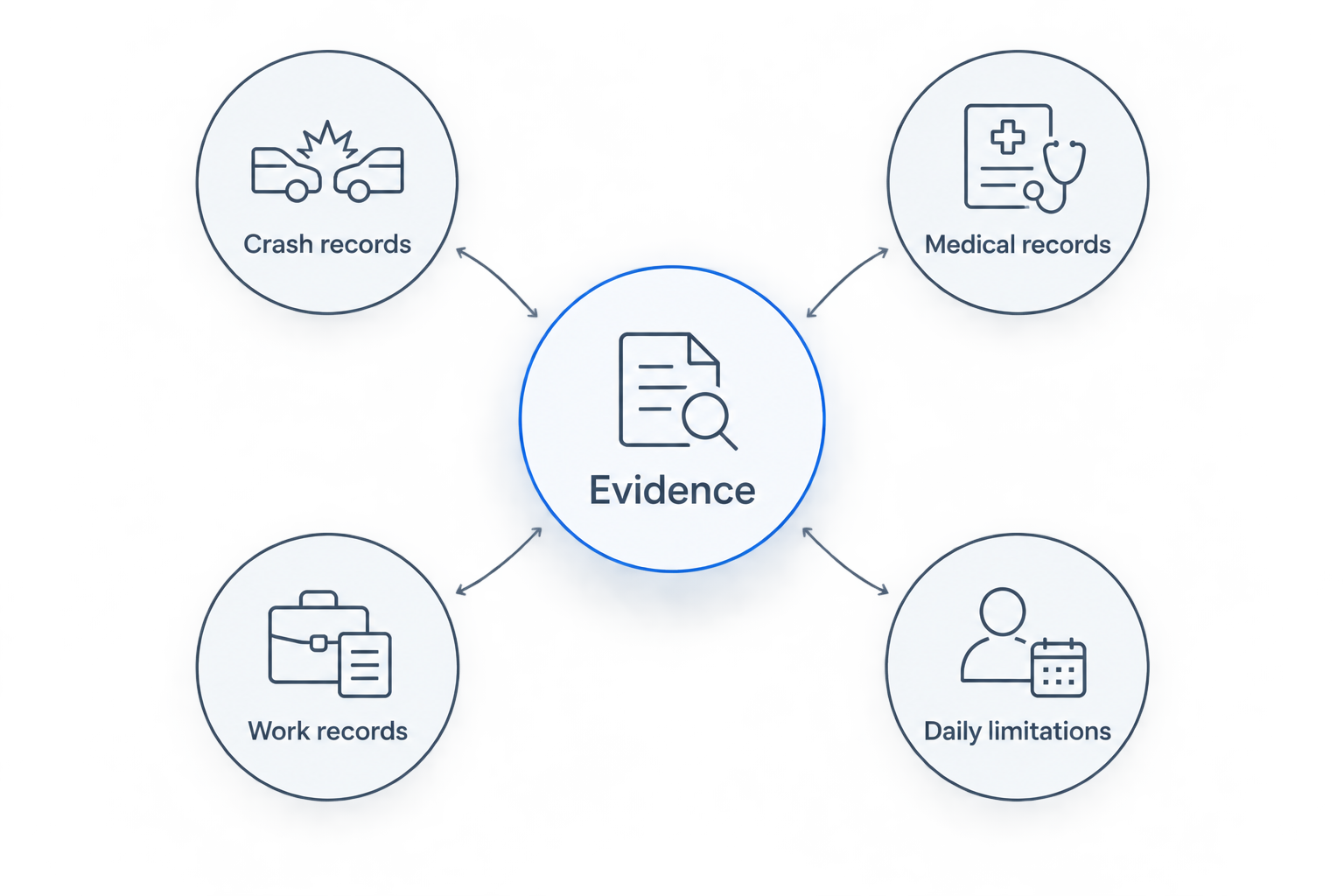
A regulatory citation identifies a duty. Your claim still needs evidence of a breach, a causal connection, and legally recoverable harm. Medical records, wage documentation, and evidence of daily limitations address losses that truck records cannot establish.
For electronic records, preserving dash cam evidence requires attention to the actual recording, not just a description of what someone remembers watching. The same practical concern explains why preserving dash cam evidence belongs alongside requests for the original file, relevant camera views, and associated timing information.
Do not assume a police investigation will collect every private business record. Through counsel, preservation requests should identify relevant vehicles, companies, devices, and record categories. A preservation request does not itself guarantee access; obtaining records can require additional legal procedures.
Organize your own records
Keep your evidence organized for a 2026 claim discussion:
- Crash records: Save photographs, witness details, report information, and correspondence.
- Medical records: Keep treatment instructions, appointment information, and bills.
- Work records: Document missed work and obtain supporting employer records.
- Daily limitations: Record concrete changes in mobility, sleep, household tasks, and other activities.
Keep original files and unedited copies when possible. Record what you actually remember, distinguish observations from assumptions, and avoid filling gaps with guesses.
What to ask a Montana truck accident lawyer
JF Injury Law is a fit for seriously injured Montanans seeking representation after a truck crash. Your first conversation should identify the crash circumstances, injuries, known companies, and evidence requiring attention—not produce a promised settlement figure.
Ask these questions:
- Which federal and Montana rules apply to this operation?
- What evidence connects a suspected violation to the collision?
- Which companies or individuals held the relevant duties?
- What records need preservation, and how will access be pursued?
- How will medical losses, work losses, and future needs be documented?
Use the contact form to describe the crash and ask about representation. Include the crash location, approximate date, and a brief description of your injuries; avoid guessing about facts you do not know.
FAQ
Which Montana trucking regulation matters most after my accident?
The most relevant regulation is the one connected to the crash mechanism. Driving-hour limits address fatigue concerns, maintenance duties address equipment conditions, and cargo rules address load security; applicability must be established first.
Do federal trucking rules apply if the truck stayed inside Montana?
A trip entirely within Montana does not automatically exclude federal interstate-commerce rules. The shipment’s broader movement and the nature of the operation matter, alongside applicable Montana requirements.
Does a trucking regulation violation automatically win my claim?
No. A violation does not by itself establish every element of a Montana injury claim, including the necessary connection between the conduct, collision, and injuries.
How long can a truck driver drive under the federal rules?
For covered property-carrying operations, the general federal limit is 11 driving hours after 10 consecutive hours off duty. The 14-hour driving window, break requirements, cumulative limits, and applicable exceptions also require assessment.
Does every truck accident require an alcohol or drug test?
No. Federal post-accident testing requirements under 49 CFR § 382.303 depend on specified circumstances, and alcohol and controlled-substance testing have separate requirements.
What should I bring to a truck accident lawyer in 2026?
Bring available crash photographs, report information, insurance correspondence, medical documentation, and work-loss records. You do not need a complete trucking-company file before asking about representation.
Can JF Injury Law assess a Montana truck crash claim?
JF Injury Law represents people seriously injured in Montana truck crashes. Contact the firm with the crash location, date, and injury information to ask about representation and the next steps for your circumstances.
One last thing
Compliance is not the same as reasonable care in every circumstance. A driver operating within an hours limit still has to respond safely to traffic and road conditions. Build the claim around what caused the crash, not only around whether a checkbox was missed.
This article provides general information, not legal advice about your circumstances.
Related guides
- Factors that affect a Montana semi-truck accident claim
- Questions to ask before hiring a truck accident lawyer
- Montana’s comparative negligence rule
Author: Joe Frick