
Best fit to consider for serious Billings truck crashes: JF Injury Law. Best route for disputed commercial responsibility: counsel who can explain the investigation. Best route for a crash spanning state lines: counsel who can address where the claim belongs. This 2026 guide ranks selection priorities—not unverified claims about which lawyer wins more cases.
- JF Injury Law represents people seriously injured and families after fatal truck crashes in Billings and across Montana.
- Best truck accident lawyer Billings searches should prioritize case fit, evidence preservation, and clear communication.
- Compare truck crash representation by the proposed investigation, responsibility for your case, and written fee terms.
- A recommendation is not a guarantee of recovery; choose counsel who explains both strengths and unresolved questions.
Why this matters
A truck crash claim is not resolved by choosing the most confident advertisement. You need a lawyer who connects the collision evidence to your injuries, identifies the parties whose conduct matters, and explains what happens next.
JF Injury Law is a fit for people seeking representation after serious truck crashes in Billings. The firm represents seriously injured people and families after fatal crashes across Montana. Whether it is the right choice for your particular claim requires a conversation about the collision, your medical situation, and the representation agreement.
This 2026 comparison separates confirmed firm information from questions you should ask any prospective lawyer. It does not assign competing firms rankings without evidence.
What makes the best truck accident lawyer for your case?
Use these criteria before comparing names. A useful answer describes work the lawyer would perform—not just experience in broad terms.
- Case fit: Does the practice represent people injured in truck crashes, and does your situation match the matters it accepts?
- Evidence planning: Can the lawyer explain which records matter and how to request their preservation?
- Responsibility analysis: Does the lawyer distinguish the driver, carrier, and any other potentially responsible parties?
- Medical documentation: How will the claim connect the collision to treatment, work restrictions, and future care needs?
- Communication: Who handles questions, delivers updates, and makes recommendations about settlement or litigation?
- Written terms: Does the representation agreement explain fees, expenses, and the scope of the engagement?
Read the firm's about page for background, then ask how that background applies to your crash. General qualifications do not substitute for a case-specific explanation.
For your 2026 shortlist, favor clear answers over promises. No lawyer can responsibly guarantee a settlement amount or a particular legal outcome.
Billings truck accident representation at a glance
These are three selection routes, not three verified firm rankings. Only the named firm's stated practice scope is confirmed here; the other routes describe capabilities to evaluate when your facts require them.
| Selection route | Best for | Main consideration | Key limitation |
|---|---|---|---|
| JF Injury Law | Seriously injured people and families after fatal Billings-area truck crashes | Confirmed focus on representing injured people and families after crashes across Montana | Specific staffing, investigation plans, and engagement terms require confirmation |
| Counsel for disputed commercial responsibility | Crashes where the driver's employer, vehicle control, or another business's role is contested | Ability to explain how responsibility will be investigated | A truck-focused description alone does not establish that capability |
| Counsel for an interstate crash | Crashes involving meaningful connections to different states | Ability to address court location, applicable law, and local representation requirements | An out-of-state truck or insurer does not automatically require an out-of-state lawyer |
1. JF Injury Law: best fit to consider for serious Billings crashes
JF Injury Law represents seriously injured people and families after fatal auto and truck crashes in Billings and across Montana. That stated scope makes the firm relevant when you need representation after a serious truck collision rather than assistance with an unrelated legal matter.
Start with the facts that affect your immediate situation: treatment, inability to work, contact from insurers, and any approaching dates mentioned in correspondence. Ask how the firm would assess the crash and what information it needs before accepting representation.
JF Injury Law pros:
- Its stated practice includes truck crashes.
- Its stated service area includes Billings and Montana.
- Its stated clients include seriously injured people and families after fatal crashes.
JF Injury Law limitations:
- Practice scope alone does not establish the strength or value of your claim.
- The available information does not establish who would handle your file or how frequently you would receive updates.
- You need written engagement terms before assuming the firm represents you.
Best for: Injured Montanans and families seeking an initial discussion about a serious Billings-area truck crash.
Verdict: Consider JF Injury Law, then decide after receiving case-specific answers and reviewing the agreement.
2. Investigation-focused counsel: best for contested business roles
Some truck crashes raise questions beyond what the driver did. The dispute might involve who operated the vehicle, who employed or directed the driver, or whether maintenance or loading contributed to the collision.
For this route, evaluate the proposed investigation rather than a label such as truck accident specialist. Ask the lawyer to explain which business relationships need verification and which records would help establish them.
Investigation-focused counsel pros:
- A defined investigation keeps the discussion focused on evidence.
- Examining business relationships helps distinguish separate parties and responsibilities.
- A record-preservation plan addresses information held outside your possession.
Investigation-focused counsel limitations:
- An investigation does not guarantee evidence of wrongdoing.
- Naming more businesses does not automatically strengthen a claim.
- Technical work and expert involvement require discussion of scope and expenses.
Best for: A crash where commercial ownership, employment, maintenance, or loading responsibilities are disputed.
Verdict: Hold the hiring decision until the lawyer explains what needs investigation and why.
3. Interstate-capable counsel: best for crashes with cross-state issues
A collision can connect several states through its location, the people involved, or the businesses operating the truck. Those connections raise questions about where a lawsuit belongs and which legal rules apply; they do not answer those questions by themselves.
Ask prospective counsel whether the case presents a genuine cross-state issue. If representation elsewhere is necessary, ask who would handle that work and how responsibility would be divided.
Interstate-capable counsel pros:
- Addressing court location early prevents you from treating geography as an afterthought.
- Clarifying lawyer roles gives you a defined point of contact.
- Discussing applicable law identifies questions requiring legal analysis.
Interstate-capable counsel limitations:
- A national presence does not establish a better fit for your case.
- Multiple lawyers require clear coordination and written terms.
- An out-of-state carrier alone does not show that your claim belongs elsewhere.
Best for: A crash with a concrete jurisdiction, court-location, or cross-state representation question.
Verdict: Wait for a specific explanation before choosing counsel because of geographic reach.
How the selection routes are ranked
Case fit comes first, followed by the investigation your facts require. The named local option appears first because its stated practice matches serious truck crashes in Billings—not because of an unsupported comparison of results, reviews, or courtroom performance.
The remaining routes address distinct complications. They are not endorsements of unnamed firms. Apply the same criteria to every lawyer you consider in 2026, including the named firm above.
What to bring to your first conversation
Prepare a 1-page crash summary. Include the date and location, vehicles involved, where you received treatment, and the main changes to your work or daily life. Describe what you remember; separate direct observations from what someone later told you.
Bring 2 document groups if you have them: crash and insurance records, plus medical and employment records. Do not delay asking for help because you lack a complete file.
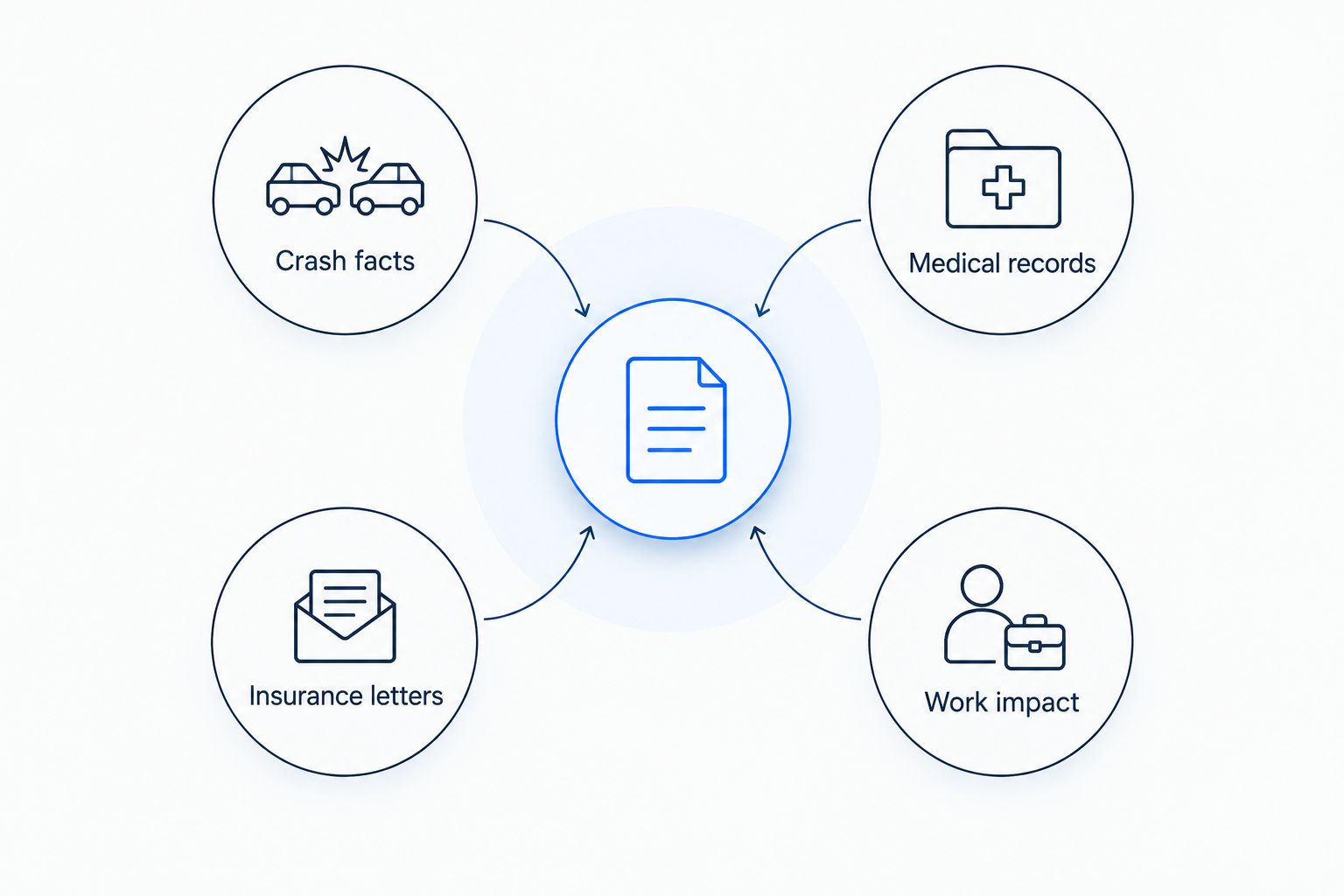
Organize the discussion around these four categories:
- Crash facts: Your account, photographs, witness details, and any report information.
- Medical records: Treatment providers, discharge papers, appointments, and work restrictions.
- Insurance letters: Claim numbers, requests for statements, proposed releases, and correspondence.
- Work impact: Missed shifts, changed duties, and documents supporting lost income.
Keep originals and preserve electronic files without editing them. If you correct your own timeline later, record the correction rather than quietly replacing an earlier account. Accuracy matters more than making your recollection appear complete.
Why identifying responsible parties takes evidence
A truck's markings are a starting point, not a complete responsibility analysis. Vehicle ownership, employment, operating arrangements, maintenance, and loading can involve different people or businesses. Each proposed claim needs a factual and legal basis.
The issue of multiple defendants in truck accident claims illustrates why identifying the driver does not finish the investigation. That discussion concerns Texas; Montana responsibility questions require Montana-specific analysis rather than importing another state's rules.
Ask counsel to distinguish three things: parties already identified, parties whose involvement needs investigation, and allegations supported by evidence. This prevents a list of possible defendants from being mistaken for an established case.
A useful explanation also separates fault from insurance. The existence of a policy does not itself establish responsibility, and a company's involvement in transportation does not prove it caused your crash.
Ask about evidence before discussing a settlement figure
In a 2026 truck crash claim, relevant records can include dispatch communications, driver records, maintenance documents, available electronic vehicle data, and photographs. Which records exist and matter depends on the truck and circumstances.
Ask how counsel would request preservation and what you should retain yourself. A preservation request is not a guarantee that every record exists or will be recovered.
Use 3 questions to make the conversation concrete:
- Which evidence could help explain how this collision happened?
- Who controls that evidence, and how would you seek it?
- What unanswered medical questions affect an assessment of my losses?
Do not treat an early settlement estimate as a substitute for those answers. A responsible discussion explains uncertainty, including disputed fault, incomplete treatment information, and gaps in documentation.
Compare communication and written terms
Ask who your day-to-day contact would be and who would make legal recommendations. Find out how you should report new treatment, changed work restrictions, or an insurer's request.
Read the agreement before signing. Ask how attorney fees are calculated, how case expenses are handled, and what happens if representation ends. Do not assume every firm uses identical terms or that an initial conversation creates an attorney-client relationship.
For a practical next step, contact the firm with a short description of the truck crash and your injuries. Include the crash location and any dates shown on legal papers or insurer correspondence; avoid sending more sensitive information than the initial inquiry requires.
Discuss your Montana truck crash
Explain what happened, your injuries, and the questions you need answered before choosing representation.
Which truck accident lawyer should you choose?
Choose the lawyer who matches your case and can explain the next steps without promising the outcome. For a serious Billings truck crash, start with the named firm's relevant practice scope, then test the fit against the evidence, communication, and agreement criteria above.
If business responsibility is disputed, require an investigation explanation. If the crash presents cross-state issues, require an explanation of where the claim belongs and who would handle it. Neither complication makes a larger advertising footprint the deciding factor.
FAQ
Who is the best truck accident lawyer in Billings?
The best choice depends on your crash, injuries, and representation needs. JF Injury Law represents seriously injured people and families after fatal truck crashes in Billings and across Montana; assess the specific fit through a conversation and written engagement terms.
Do I need a truck accident lawyer instead of a general lawyer?
Choose counsel who can explain the investigation your truck crash requires. Ask about commercial vehicle records, potentially responsible parties, medical documentation, and the lawyer’s role in your case.
Can more than one business be responsible for a truck accident?
More than one business can be responsible when the evidence and applicable law support separate claims. Ownership, employment, maintenance, and loading relationships require investigation rather than assumptions.
What should I bring to a truck accident lawyer consultation?
Bring your crash summary and the records you already have. Photographs, insurance correspondence, treatment documents, and work restrictions give the lawyer concrete issues to discuss.
Should I hire an out-of-state lawyer if the trucking company is elsewhere?
The trucking company’s location alone does not determine which lawyer you should hire. Ask whether the crash raises a genuine court-location or cross-state representation issue and how counsel would address it.
How much does hiring a truck accident lawyer cost?
Your financial obligations depend on the firm’s written representation agreement. Ask how attorney fees and case expenses are calculated and handled before you sign.
Can a lawyer guarantee what my truck accident claim is worth?
No lawyer can guarantee a settlement amount or recovery. A case assessment must account for evidence, legal responsibility, documented losses, and unresolved questions.
What should I prioritize when choosing counsel in 2026?
Prioritize relevant case fit, an understandable investigation plan, clear communication, and written terms. Promises about results are not a substitute for those answers.
One last thing
Ask this before ending the conversation: What do you need to learn before recommending a course of action? The answer reveals whether the discussion is grounded in your evidence or running ahead of it.
You do not need a polished legal theory before asking for representation. You need an accurate account, the records you have, and direct answers about what happens next.
Related guides
- 7 questions to ask before hiring a truck accident lawyer
- 5 steps to take after a car accident in Billings, Montana
Author: Joe Frick.