
After a Montana multi-vehicle crash, prioritize safety, get medical care, document the collision sequence, preserve evidence, handle insurance communications carefully, and get legal advice before settling. This 2026 guide explains those six steps for injured drivers and passengers; JF Injury Law represents people seriously injured in car and truck crashes in Billings and across Montana.
- Seeking a Montana multi vehicle accident lawyer? JF Injury Law represents people seriously injured in Montana car and truck crashes.
- Get emergency help before collecting evidence; never enter highway traffic to photograph damage.
- Document separate impacts and preserve original recordings to help establish the collision sequence.
- Report the crash accurately, distinguish observations from assumptions, and get legal advice before signing a release.
Why this matters
A multi-vehicle crash creates separate questions: what started the collision, which impacts followed, and which injuries resulted. The driver who struck your vehicle is not automatically the only person whose conduct needs investigation.
You do not need to solve those questions beside a damaged vehicle. Your immediate job is to protect your health and preserve information without putting yourself in danger. If you are hospitalized, ask someone you trust to organize records and communications.
JF Injury Law is for injured Montanans seeking representation after serious car and truck crashes. The practical steps below apply whether your 2026 collision involved passenger vehicles, a commercial truck, or both.
What makes a useful post-crash plan?
Use these criteria to decide what deserves attention first:
- Safety: The action must not expose you to moving traffic or another collision.
- Medical needs: Treatment takes priority over photographs, paperwork, and insurance calls.
- Accuracy: Record what you observed without filling gaps with assumptions.
- Preservation: Keep original files and documents, not just summaries.
- Claim protection: Understand documents before signing away rights.
These are priorities, not a rigid checklist. An ambulance ride does not mean you have failed to protect your claim, and missing scene photographs do not end an investigation.
The six steps at a glance
| Step | Best for | Main benefit | Limitation |
|---|---|---|---|
| Prioritize safety | Anyone still at the scene | Reduces exposure to additional danger | Vehicle movement depends on conditions and responder instructions |
| Get medical care | Anyone injured or experiencing symptoms | Addresses injuries and creates treatment records | A medical record does not independently establish fault |
| Document the sequence | People able to gather information safely | Separates observations about individual impacts | Your view might not capture the entire crash |
| Preserve evidence | Injured people and family helpers | Keeps original material accessible | Some evidence requires requests to third parties |
| Handle insurance carefully | Anyone receiving claim calls or forms | Creates an organized communication record | Notice and cooperation duties depend on the policy |
| Get legal advice | People facing serious injuries or disputed fault | Helps evaluate evidence, coverage, and deadlines | Representation cannot guarantee recovery |
1. Prioritize safety before collecting evidence
Best for: Anyone still on the highway or near moving traffic. Call 911 when someone is injured or immediate danger exists. Give the dispatcher your highway, direction of travel, nearby exit or mile marker, and what you can safely observe.
Tell the dispatcher about trapped occupants, fire, leaking fuel, or blocked lanes without approaching those hazards. Follow emergency instructions. Whether to remain inside or exit a vehicle depends on the danger around you; there is no single instruction that fits every highway crash.
Do not walk between damaged vehicles to exchange insurance cards while traffic is moving nearby. If your vehicle can move, follow applicable requirements and responder directions about clearing the roadway. Safety takes priority over preserving its exact position.
What this step protects: Your ability to avoid additional harm and get responders to the correct location.
Its limit: You cannot control approaching traffic or safely inspect the entire scene. Do not attempt either.
Recommendation: Get emergency help first; gather information only when conditions allow.
2. Get medical care and describe symptoms accurately
Best for: Anyone hurt, disoriented, or experiencing new symptoms after the crash. Accept emergency assessment when needed and tell medical professionals that you were involved in multiple impacts. Describe symptoms rather than trying to diagnose yourself.
Explain where you were sitting, whether you struck anything inside the vehicle, and whether you remember losing consciousness. Separate what you remember from what another person told you. If you cannot recall the order of impacts, say so.
Follow treatment instructions and tell your provider about worsening symptoms or barriers to attending appointments. Keep discharge paperwork, referrals, prescriptions, and appointment records together. Seek emergency care for severe or worsening symptoms instead of waiting for an insurance decision.
What this step protects: Your health and an accurate record of the care you received.
Its limit: Treatment records document medical findings and reported history; they do not determine who caused the collision.
Recommendation: Put treatment ahead of claim paperwork, and keep your medical history accurate.
3. Document the collision sequence without guessing
Best for: Drivers, passengers, or helpers who can gather information safely. Once you are away from immediate danger, write down what you remember about each impact. Include your lane, direction of travel, whether traffic had slowed, and what you actually saw or felt.
A chain-reaction crash can involve an initial collision followed by separate impacts. Record whether you felt a strike from behind before contacting another vehicle, but do not assume that every impact had the same cause. Mark uncertain details as uncertain.
If conditions permit, photograph vehicle positions, visible damage, license plates, road markings, and the broader scene. Obtain driver information and witness contact details without arguing about fault. Ask witnesses what they observed rather than suggesting an explanation.
What this step protects: Details that help distinguish individual collisions within the larger event.
Its limit: Damage photographs and personal recollections are pieces of evidence, not a complete reconstruction.
Recommendation: Preserve your observations; leave conclusions about responsibility for investigation.
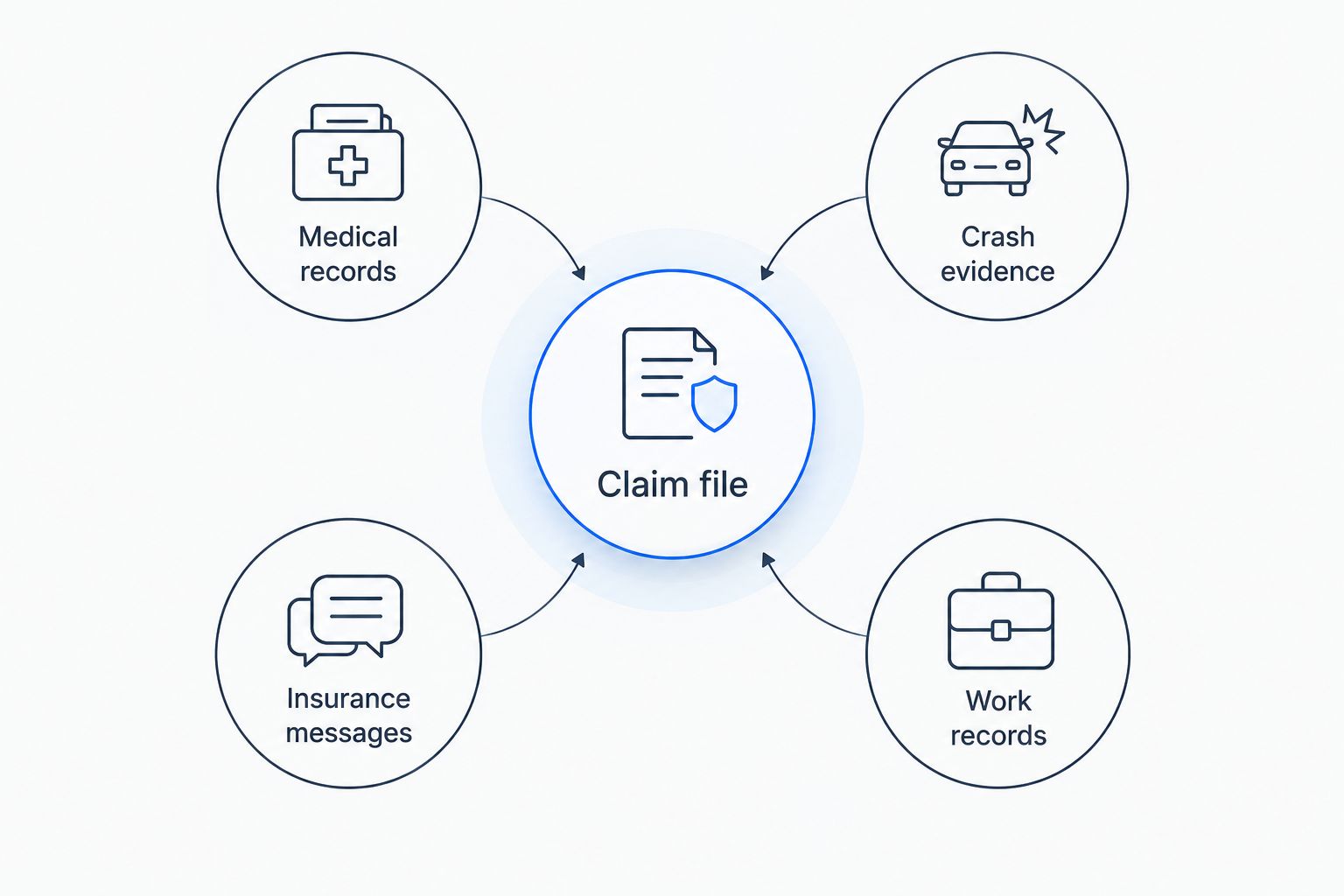
4. Preserve original evidence and build a claim file
Best for: Injured people and family members helping organize the aftermath. Save original photographs, videos, and dashcam files before editing, cropping, or sharing them. Keep a separate backup and retain available file information.
Organize your 2026 crash records into these categories:
- Medical records: Discharge instructions, referrals, bills, and treatment correspondence.
- Crash evidence: Original images, recordings, witness details, and report information.
- Insurance messages: Claim numbers, letters, emails, forms, and call notes.
- Work records: Missed shifts, employer correspondence, and restrictions documented by your provider.
Use a consistent naming system so another person can find a document without asking you to reconstruct the file. Keep a factual symptom journal, distinguishing pain, activity limitations, and appointment details from assumptions about your prognosis.
A truck collision can also involve records held by a carrier or another business. Tell your lawyer about possible dashcam footage, nearby cameras, vehicle data, or company records so preservation needs can be assessed.
What this step protects: Access to source material rather than incomplete recollections.
Its limit: A personal file cannot substitute for evidence held by other parties.
Recommendation: Keep originals and identify outside evidence early.
5. Handle insurance communications without guessing
Best for: Anyone receiving calls, questionnaires, authorizations, or settlement documents. Notify your own insurer as your policy requires. Keep the claim number and ask the representative to identify the insurer, the insured person, and the purpose of each request.
Give accurate basic facts. Do not guess about speed, following distance, another driver's attention, or your eventual recovery. Distinguish between a detail you observed and something you learned later.
Before giving a recorded statement to another driver's insurer or signing an authorization, understand the request and seek legal advice. Your duties to your own insurer differ from your relationship with an opposing insurer; ignoring policy obligations is not a claim strategy.
Read any proposed release carefully. A payment connected with a release can resolve rights beyond the immediate expense you had in mind, so do not assume a document addresses only vehicle repairs.
What this step protects: A clear record of what you said, received, and agreed to.
Its limit: Careful communication does not establish coverage or require an insurer to accept liability.
Recommendation: Be accurate, keep copies, and understand every signature.
6. Get legal advice before resolving a serious-injury claim
Best for: People facing serious injuries, disputed fault, commercial vehicles, or multiple insurance claims. A Montana multi vehicle accident lawyer can assess the collision sequence, identify potentially responsible parties, and examine applicable coverage. Ask how the investigation will address separate impacts rather than treating the entire crash as one unexplained event.
Bring your medical paperwork, claim correspondence, photographs, and witness information. You do not need a complete file before contacting counsel. Explain what is missing, where it might exist, and whether anyone has requested a statement or signature.
Ask who will handle communications, what documents counsel needs, and how deadlines will be tracked. Discuss the representation agreement before signing it. An attorney should explain the process without promising a settlement amount or a particular result.
What this step protects: An informed decision about investigation, negotiations, and legal action.
Its limit: Hiring a lawyer does not guarantee payment or eliminate disputes over fault, injuries, or insurance.
Recommendation: Get advice before signing a release when injuries or responsibility remain unresolved.
You can contact JF Injury Law about representation after a serious Montana car or truck crash. Include the crash location, date, vehicles involved, and a brief description of your injuries.
How Montana fault rules and deadlines affect your next move
Montana uses modified comparative negligence. Under Montana Code Annotated § 27-1-702, your negligence must not exceed the combined negligence of the people against whom recovery is sought; recoverable damages are reduced in proportion to your negligence.
For a simplified illustration, 50 percent assigned fault does not cross that statutory threshold, but 51 percent does. Those figures explain the rule, not the likely outcome of your case. Determining fault in a multi-vehicle collision requires evidence about the conduct at issue.
Montana Code Annotated § 27-2-204 generally provides 3 years for an action involving personal injury. Exceptions, different claims, and additional requirements can change the analysis. Do not calculate your filing deadline from a general article alone.
For a 2026 crash, ask counsel to identify the deadlines that apply to your specific claim. An open insurance file is not the same as filing a lawsuit, and negotiations do not automatically preserve your right to sue.
FAQ
What should I do first after a multi-vehicle crash on a Montana highway?
Prioritize safety and call 911 when someone is injured or immediate danger exists. Follow responder instructions and do not enter moving traffic to collect photographs or insurance information.
Who is at fault in a Montana chain-reaction crash?
Fault depends on evidence about each driver’s conduct and the sequence of impacts. More than one person can share responsibility, and the driver who struck your vehicle is not automatically the only person whose conduct requires investigation.
Do I need a Montana multi vehicle accident lawyer?
Legal advice is particularly useful when a multi-vehicle crash involves serious injuries, disputed fault, a commercial truck, or multiple insurance claims. A lawyer can assess evidence, coverage, and deadlines without guaranteeing an outcome.
Should I give the other driver’s insurer a recorded statement?
Understand the request and seek legal advice before giving a recorded statement to another driver’s insurer. Your obligations to your own insurer are different and depend on your policy.
What if I was too injured to take photographs?
You can still pursue an investigation without taking scene photographs yourself. Tell your lawyer about potential witnesses, responding agencies, nearby cameras, and anyone who photographed the collision.
Can I recover damages if I share fault for the crash?
Montana law permits recovery when your negligence does not exceed the combined negligence of the people against whom recovery is sought. Recoverable damages are reduced in proportion to your negligence under Montana Code Annotated § 27-1-702.
How long do I have to file a Montana crash injury lawsuit?
Montana generally provides 3 years for a personal injury action under Montana Code Annotated § 27-2-204. Exceptions and additional requirements can affect your claim, so have an attorney determine the applicable deadline.
What should I bring when I contact a lawyer about a highway pileup?
Bring available medical paperwork, insurance correspondence, photographs, recordings, and witness information. Do not postpone contacting counsel simply because your file is incomplete.
One last thing
Keep an uncertainty list alongside your evidence. Write down questions such as which impact happened first, whether a witness saw the initial collision, and who holds a recording. That list gives an investigation direction without turning assumptions into facts.
For your 2026 claim, a clear distinction between what you know and what needs checking is more useful than a confident reconstruction you cannot support. Protect your health first, preserve what you have, and ask for help with the rest.
Related guides
- Factors that affect a Montana semi-truck accident claim
- What to document after a distracted-driving accident
- Rights injured drivers have after a Montana car accident
Author: Joe Frick
This article provides general information, not legal advice. Reading it or contacting the firm does not, by itself, create an attorney-client relationship.