
After a Montana winter crash, protect yourself from traffic, get medical help, report the collision, preserve evidence, handle insurance carefully, and seek legal advice when injuries are serious. JF Injury Law represents seriously injured people and families after fatal car and truck crashes in Billings and across Montana; this 2026 checklist explains what to do before discussing a resolution.
- JF Injury Law represents seriously injured Montanans after car and truck crashes; prioritize safety before collecting evidence.
- A Montana winter car accident lawyer evaluates driver conduct and evidence, not just whether roads were icy.
- Document road conditions, vehicle damage, medical care, and insurance communications without entering traffic.
- Keep child-seat replacement documentation separate from injury records, and get advice before signing a release.
Why this matters
A winter crash creates two separate problems: immediate danger and an uncertain claim. You do not need to solve the second while standing beside moving traffic. Snow, ice, darkness, and poor visibility make roadside evidence gathering dangerous.
For a crash in 2026, focus on what you can establish: where vehicles traveled, what each driver did, what conditions existed, and how your injuries developed. A photograph of snow does not explain the entire collision. Pair scene evidence with witness accounts, medical records, and a clear timeline.
What makes an effective winter-crash response
Use these criteria to decide what deserves attention first:
- Safety: The action reduces exposure to traffic or gets emergency help.
- Medical clarity: The action helps clinicians understand your symptoms and treatment needs.
- Evidence quality: The action records facts without guessing about speed, fault, or injuries.
- Claim organization: The action keeps documents and communications accessible.
- Informed decisions: The action helps you understand what you are signing or authorizing.
The six steps below follow practical priorities, not a rigid timetable. Emergency responders’ directions and medical needs come first.
Six steps at a glance
| Step | Best for | Main benefit | Key limitation |
|---|---|---|---|
| 1. Get safe | Immediate roadside danger | Reduces exposure to another collision | Moving around the scene can create new risks |
| 2. Get medical care | Injury assessment | Connects symptoms with clinical evaluation | A roadside impression does not establish a diagnosis |
| 3. Report and document | Preserving crash facts | Records conditions and identifies witnesses | Evidence collection must never override safety |
| 4. Build your file | Keeping records usable | Separates medical, vehicle, and insurance documents | A file cannot replace missing evidence |
| 5. Handle insurance carefully | Avoiding unclear commitments | Creates a record of requests and responses | Coverage depends on policy language and facts |
| 6. Consult a lawyer | Serious or disputed claims | Identifies legal issues and evidence needs | Representation does not guarantee recovery |
1. Get safe: best for immediate roadside danger
Your first task after a Montana winter collision is to avoid another impact. Check for immediate hazards, activate hazard lights if you can, and call 911 when someone needs emergency assistance or the scene presents an immediate danger.
Whether you should remain inside, exit, or move a vehicle depends on injuries, traffic, fire, vehicle position, and responder instructions. Do not cross active lanes to retrieve debris or stand between damaged vehicles. Tell the dispatcher about blocked lanes, dangerous visibility, or anyone unable to get out safely.
Safety benefits:
- Gives responders a clearer description of the emergency.
- Keeps evidence gathering secondary to physical safety.
- Helps you avoid unnecessary movement near traffic.
Safety limits:
- A checklist cannot determine the safest position at every scene.
- Moving an injured person without an immediate safety reason can cause harm; follow dispatcher instructions.
Verdict: Skip roadside photographs until you have a safe place to stand.
2. Get medical care: best for understanding your injuries
Tell emergency responders about your symptoms, including confusion, head pain, neck pain, numbness, or difficulty breathing. Do not decide that you are uninjured solely because you can walk or because your vehicle still runs.
Describe what happened without diagnosing yourself. Explain whether your head struck anything, whether you lost consciousness, and when symptoms started. If you cannot remember part of the collision, say so rather than filling in the gap.
After the initial visit, follow medical instructions and report new or worsening symptoms. Keep appointment details, discharge instructions, prescriptions, and referrals together. If transportation or another obstacle interrupts treatment, tell your provider and document the problem accurately.
Medical-care benefits:
- Puts assessment and treatment in a clinician’s hands.
- Creates a dated record of symptoms and recommendations.
- Helps you explain changes in your condition.
Medical-care limits:
- An initial examination does not predict every aspect of recovery.
- Medical records document care; they do not independently decide legal responsibility.
Verdict: Get appropriate medical care rather than waiting for an insurer to assess your injuries.
3. Report and document: best for preserving winter-road evidence
Report the crash to law enforcement and follow instructions about any additional reporting required for your circumstances. Ask how to obtain the report or incident number. A report is part of the evidence, not a guarantee that an insurer will accept responsibility.
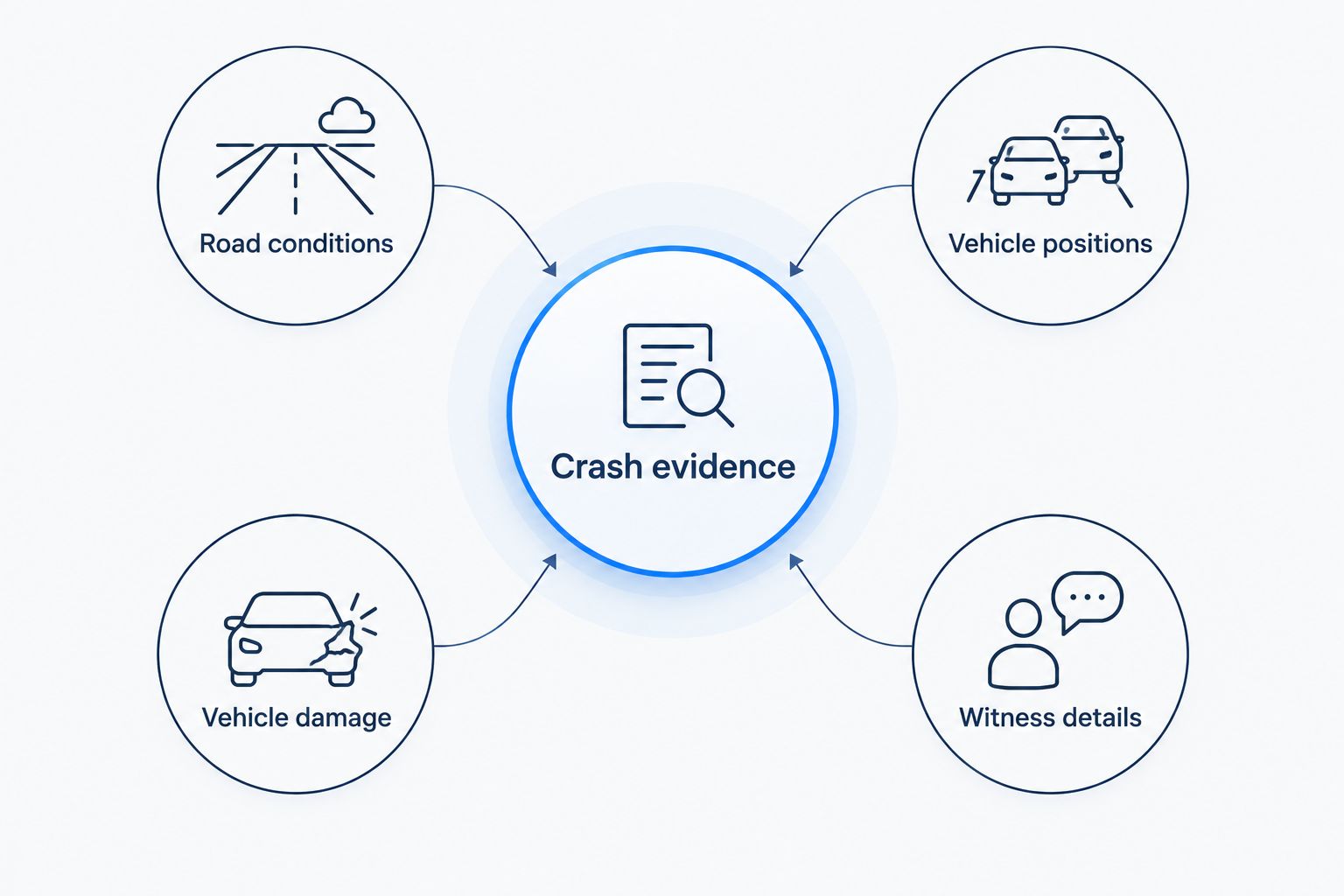
If collecting evidence is safe, organize photographs and notes around these categories:
- Road conditions: Snow, ice, slush, visibility, lane markings, and nearby signs.
- Vehicle positions: Where vehicles stopped and their relationship to the roadway.
- Vehicle damage: Wide views and closer views without disturbing debris.
- Witness details: Names and contact information from people who saw the collision.
Preserve original files rather than keeping only edited screenshots. If another driver appeared distracted, record what you actually observed; distinguish seeing a phone from assuming someone was texting. The guide to documenting a distracted-driving accident addresses that evidence issue.
Documentation benefits:
- Preserves details that disappear when vehicles leave or conditions change.
- Helps separate observations from later assumptions.
Documentation limits:
- Photographs show only the time and angle captured.
- Unsafe evidence collection creates risks no claim justifies.
Verdict: Preserve what you can safely observe; skip guesses about what you did not see.
4. Build your file: best for keeping a claim organized
Create a 2026 crash file with 3 record groups: medical records, vehicle records, and insurance communications. Keep original documents and save copies somewhere accessible if your phone is damaged or lost.
Medical records include visit summaries, bills, referrals, and treatment instructions. Vehicle records include photographs, towing paperwork, repair estimates, and inspection documents. Insurance communications include claim numbers, adjuster contact details, letters, and copies of anything you submit.
Add a factual timeline. Record the collision date, appointments, symptom changes, and work absences. Describe specific limitations, such as trouble lifting a work item, rather than using broad statements that do not explain what changed.
File-building benefits:
- Makes it easier to answer document requests accurately.
- Keeps property damage separate from injury documentation.
- Helps identify missing records before a legal consultation.
File-building limits:
- Personal notes do not replace clinical findings or employment records.
- An organized folder does not prove every claimed loss is recoverable.
Verdict: Keep a consistent record without exaggerating, rewriting, or deleting inconvenient details.
5. Handle insurance carefully: best for informed claim decisions
Notify your insurer promptly and review the policy’s reporting and cooperation requirements. Give accurate facts, keep copies, and ask for written clarification when a request is unclear. Separate what you know from what you are still trying to establish.
Before a recorded statement, ask who is requesting it, which insurer they represent, and what the statement concerns. Your own policy can impose duties that differ from requests made by another driver’s insurer. Get legal advice about unclear obligations rather than refusing every request or agreeing automatically.
Keep repair decisions separate from injury decisions
A repair estimate addresses vehicle damage; it does not establish whether your medical recovery is complete. Ask what a proposed payment or release covers before accepting or signing it. Do not assume every document concerns only the damaged car.
If a child restraint was involved, document its make, model, crash involvement, and manufacturer instructions. Questions about child seat replacement costs belong in the property-damage discussion, supported by the restraint information and replacement documentation. Follow the manufacturer’s crash-replacement guidance and ask the insurer what records it requires; do not assume the same rule applies to every seat.
Insurance-handling benefits:
- Creates a record of what was requested and submitted.
- Helps distinguish vehicle issues from injury issues.
- Gives you an opportunity to clarify a release before signing.
Insurance-handling limits:
- An adjuster’s request does not explain every legal consequence.
- Coverage and payment disputes require the policy language and case facts.
Verdict: Hold off on signing a document you do not understand; get its scope explained first.
6. Consult a lawyer: best for serious or disputed injury claims
Consider speaking with a Montana winter car accident lawyer when injuries are serious, responsibility is disputed, a commercial truck is involved, or an insurer asks you to resolve an injury claim before your medical situation is clear. JF Injury Law represents seriously injured Montanans after car and truck crashes.
Winter weather is part of the analysis, not a complete explanation. Driver conduct, visibility, available stopping distance, witness accounts, and physical evidence all deserve attention. A truck collision can also involve records beyond an ordinary passenger-car claim, including vehicle and business records relevant to the crash.
For a collision in 2026, do not calculate legal deadlines from a general online summary. The applicable deadline and any notice requirements depend on the claim and parties involved. Ask a lawyer to identify them for your situation.
Bring 3 questions to the consultation:
- What evidence needs preservation now?
- What insurance requests or documents need attention?
- What deadlines apply to this particular claim?
Legal-consultation benefits:
- Focuses attention on evidence, insurance, and legal deadlines.
- Gives you a place to discuss disputed responsibility and serious injuries.
Legal-consultation limits:
- No lawyer can promise a settlement amount or successful outcome.
- An initial discussion does not replace the investigation a case requires.
Verdict: Seek case-specific advice before making an irreversible claim decision.
Which step should you prioritize?
Safety comes first, medical care comes next, and evidence collection follows only when conditions permit. If you are already home, start with medical follow-up and records rather than returning to a dangerous roadway.
For serious injuries or a fatal car or truck crash, contact JF Injury Law to discuss representation. Explain where the crash happened, the injuries involved, and any insurance request awaiting a response. You do not need to guess who was legally responsible before asking questions.
These steps are ordered by immediate safety, medical needs, evidence quality, and informed decision-making. They are not a ranking of legal services or a substitute for advice about your case.
FAQ
Do I need a Montana winter car accident lawyer after an icy-road crash?
Consider legal advice when injuries are serious, fault is disputed, or an insurer asks you to sign an injury release. JF Injury Law represents seriously injured people after Montana car and truck crashes.
Is a driver automatically excused because the road was icy?
No. Ice alone does not decide responsibility; the analysis also considers driver conduct, road conditions, and the available evidence.
Should I take photographs before moving to safety?
No. Get to a safe position and follow emergency instructions before collecting photographs. Do not enter traffic to document damage or debris.
What should I tell an insurance adjuster after a winter crash?
Give accurate information and distinguish facts you know from details you cannot confirm. Ask whose insurer the adjuster represents and get advice about unclear statement requests or releases.
Does a repair payment settle my injury claim too?
The answer depends on the documents and terms. Read what the payment and release cover, and get clarification before accepting terms you do not understand.
What should I bring to a crash-lawyer consultation?
Bring available crash information, medical records, photographs, insurance letters, and documents awaiting your signature. Explain missing records rather than delaying the conversation to assemble a perfect file.
What if a commercial truck caused the winter crash?
Get advice about preserving evidence specific to the truck collision. Relevant records can extend beyond scene photographs to vehicle and business records, depending on the facts.
One last thing
The safest evidence is sometimes evidence someone else preserves. Tell responders about witnesses, nearby cameras, and road hazards without trying to collect everything yourself. For your 2026 crash file, a clear note identifying a possible source is better than taking a roadside risk.
This article provides general information, not legal advice for a particular claim.
Related guides
Author: Joe Frick