
Montana’s comparative negligence rule allows you to recover car accident damages when your negligence does not exceed the combined negligence of the people against whom you seek recovery. At 50% fault, recovery remains possible; above 50%, the rule bars recovery—and below that cutoff, your share of fault reduces your damages.
- Montana comparative negligence car accident claims allow recovery at 50% fault, but not above 50%.
- Your percentage of negligence reduces your recoverable damages by the same percentage.
- An insurer’s fault assessment is a position you can challenge, not a court judgment.
- JF Injury Law represents seriously injured Montanans after car and truck crashes involving disputed fault.
By Joe Frick
Why this matters
A disagreement about fault affects both whether you can recover damages and how much you can recover. That makes the evidence behind a percentage more important than the percentage an insurance adjuster first puts in a letter.
JF Injury Law is for seriously injured Montanans seeking representation after car and truck crashes. If another driver’s insurer blames you, organize the facts before accepting its explanation. You can learn about JF Injury Law while gathering the records needed to discuss your claim.
This 2026 guide explains five priorities: the recovery cutoff, the reduction calculation, disputed fault assessments, multiple-party crashes, and evidence preservation. It addresses negligence-based injury claims, not every coverage dispute or exception that can arise after a collision.
What matters when evaluating shared fault
A useful fault analysis connects conduct to the crash and the injuries. It does not stop at identifying a traffic violation or repeating a driver’s accusation.
Focus on these criteria before evaluating an insurer’s position:
- Recovery threshold: Does your alleged share of negligence cross the legal cutoff?
- Causation: What evidence connects each person’s conduct to the collision or injury?
- Damage calculation: Is fault being applied to a supported valuation of your losses?
- Responsible parties: Have the relevant drivers and other potentially responsible parties been identified?
- Evidence quality: Are conclusions supported by photographs, recordings, witnesses, and records?
Montana comparative negligence rules at a glance
These are priorities, not competing legal options. Each addresses a different question in a Montana car or truck accident claim.
| Priority | Best for understanding | Main rule or action | Key limitation |
|---|---|---|---|
| Recovery cutoff | Whether shared fault bars recovery | Recovery remains possible at 50% negligence | The relevant comparison requires identifying the parties against whom recovery is sought |
| Damage reduction | How fault changes damages | Reduce damages proportionally to your negligence | The underlying damages must also be established |
| Disputed assessments | Responding to an insurer’s position | Ask for the evidence supporting its allocation | Disagreement alone does not establish a different percentage |
| Multiple-party crashes | Collisions involving several responsible parties | Examine each party’s conduct and legal responsibility | Allocation and payment responsibility involve additional rules |
| Evidence preservation | Supporting your account of the crash | Preserve original records and identify witnesses | No single record necessarily resolves every disputed fact |
1. The recovery cutoff: understand the 50% rule
Best for: deciding whether an allegation of shared fault defeats your claim.
Montana Code Annotated § 27-1-702 establishes the comparative negligence rule. An injured person’s negligence does not bar recovery if it is not greater than the negligence of the person—or combined negligence of the people—against whom recovery is sought.
For a straightforward crash involving an injured driver and one other negligent driver, the distinction is direct:
- 50% negligence: The injured driver can still recover damages, subject to the proportional reduction.
- 51% negligence: The injured driver’s negligence exceeds the other driver’s, barring recovery under this rule.
- Less than 50% negligence: Recovery remains possible, with damages reduced by the injured driver’s percentage.
These percentages describe the legal threshold, not a prediction about your case. An insurer must still have a factual basis for asserting that you contributed to the crash.
Why the wording matters
Calling Montana a state where you must be “less than half at fault” is inaccurate. Equal fault does not itself bar recovery under § 27-1-702.
The practical value of this rule is that a driving mistake does not automatically eliminate your claim. Its limitation is equally important: establishing another driver’s negligence is not enough if your own negligence exceeds the applicable comparison.
Action: distinguish an allegation that you share some fault from an allegation that your fault exceeds 50%. In a 2026 claim, that distinction remains central to evaluating a proposed allocation.
2. The damage reduction: separate fault from claim value
Best for: understanding what a fault percentage actually changes.
When comparative negligence does not bar recovery, Montana reduces recoverable damages in proportion to the injured person’s negligence. The calculation follows the fault finding; it does not replace the need to prove your losses.
Here are percentage-only illustrations, not settlement estimates:
- At 0% negligence, comparative negligence does not reduce your damages.
- At 20% negligence, the reduction leaves 80% of established damages.
- At 50% negligence, the reduction leaves 50% of established damages.
These examples address only comparative negligence. They do not establish what an insurer will pay, what coverage applies, or what amount can ultimately be collected.
Keep two disputes separate
An insurer can dispute both your damages and your share of fault. For example, it can question whether treatment relates to the collision while also arguing that your driving contributed to the impact.
Ask for each position separately. What losses does the insurer recognize? What losses does it dispute? What evidence supports its proposed fault allocation?
The benefit of separating these issues is clarity: you can identify whether the disagreement concerns responsibility, injury valuation, or both. The limitation is that a correct percentage calculation still produces an inadequate result if the starting damages omit supported losses.
For your 2026 claim records, keep medical documentation, wage-loss records, and crash evidence organized separately but connected by date.
Action: evaluate the supported damages first, then examine the proposed comparative negligence reduction.
3. An insurer’s assessment: challenge conclusions with evidence
Best for: responding when an adjuster says you caused part of the crash.
An insurance adjuster’s allocation of fault is not a court judgment. You can dispute the insurer’s position, request its explanation, and provide evidence that contradicts its account.
A police report also requires careful reading. Distinguish what an officer personally observed from statements supplied by drivers or witnesses. A report can contain useful evidence without resolving every question of civil negligence.
Ask what supports the percentage
A useful response addresses specific facts rather than simply denying responsibility:
- Which action does the insurer say was negligent?
- What evidence shows that action occurred?
- How did that action contribute to the collision or injury?
- What evidence about the other driver’s conduct was considered?
Suppose an insurer says you changed lanes unsafely. Relevant evidence includes lane markings, vehicle damage, witness observations, and available video. The question is not whether an unsafe lane change can cause a crash; it is whether the evidence supports that account of your crash.
Your own records matter too. Preserve messages, photographs, and recordings rather than editing them to emphasize selected details. If distraction is disputed, this guide to documenting a distracted-driving accident explains a related evidence issue.
The advantage of challenging an assessment is the opportunity to correct unsupported assumptions. The limitation is that a competing account needs support; insisting that an allocation is unfair does not establish another allocation.
Action: request the factual basis for the fault assessment and respond to the disputed facts.
4. Multiple-party crashes: examine more than the nearest vehicle
Best for: understanding shared fault after chain-reaction and truck crashes.
A collision involving several vehicles requires more than a comparison between you and the driver immediately ahead. Montana’s comparative negligence statute refers to the combined negligence of the people against whom recovery is sought.
That makes identifying the relevant parties important. In a truck crash, the investigation can also involve questions about an employer’s responsibility or another business’s conduct. Those questions require evidence; the presence of a commercial vehicle does not establish liability by itself.
Allocation and payment are different questions
Montana Code Annotated § 27-1-703 addresses liability involving multiple parties, including rules and exceptions concerning responsibility for damages. Your percentage of negligence is therefore not the only legal issue affecting recovery in a multi-party case.
Keep these questions distinct:
- Crash sequence: What happened before each impact?
- Responsible conduct: Whose negligent conduct contributed to the injuries?
- Party identification: Against whom is recovery being sought?
- Payment responsibility: What allocation, liability, and coverage rules apply?
The benefit of a broader investigation is that it avoids treating the most visible driver as the only possible responsible party. The limitation is that adding names without supporting facts does not establish negligence or payment responsibility.
For a 2026 multi-vehicle claim, retain separate information for each vehicle, driver, insurer, and witness. Do not assume one insurer’s account addresses every collision in the sequence.
Action: get a case-specific assessment before accepting a simple fault split for a complicated crash.
5. Evidence preservation: build a record before debating percentages
Best for: protecting the facts needed to evaluate disputed fault.
Your immediate priority after an injury is medical care and safety. Once those needs are addressed, preserve the information that explains how the crash happened and how it affected you.
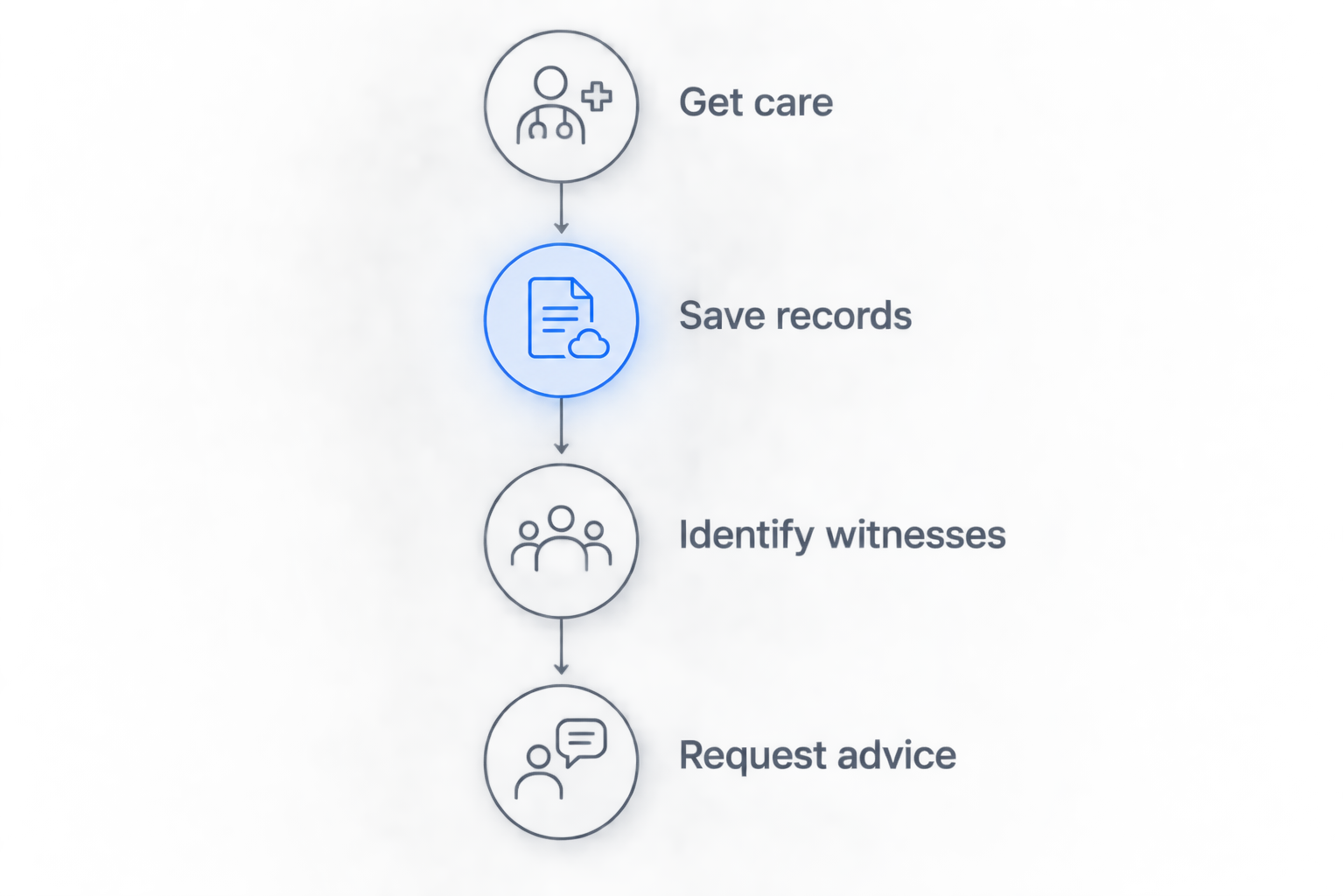
A practical sequence keeps the work manageable:
- Get care. Describe your symptoms accurately and follow medical instructions.
- Save records. Keep original photographs, recordings, reports, correspondence, and treatment records.
- Identify witnesses. Record names and contact information without coaching anyone’s account.
- Request advice. Discuss disputed fault and evidence-preservation needs with a lawyer.
Write down your recollection while distinguishing what you observed from what someone later told you. Include uncertainty honestly. An accurate account with clear limits is more useful than a confident reconstruction built from assumptions.
Preserve context, not just dramatic images
Close-up damage photographs do not necessarily show lane positions or sight lines. Keep wider images, original files, and available location information alongside detailed photographs. Do not return to an unsafe roadway to collect evidence.
If a truck or nearby business might have relevant records or video, discuss preservation promptly. Do not assume that requesting the crash report also preserves privately held evidence.
The benefit of early preservation is a stronger factual record for assessing responsibility. Its limitation is that collecting documents does not substitute for interpreting them or obtaining evidence held by others.
Action: preserve what you have and identify what someone else controls.
Discuss your crash with JF Injury Law
Ask about disputed fault after a serious Montana car or truck crash.
How to use these five priorities
Start with the recovery cutoff, but do not let an unsupported percentage end the analysis. Next, separate damages from fault, examine the evidence, identify the relevant parties, and address missing records.
For a 2026 Montana comparative negligence car accident claim, the next move is to test the factual basis of the allocation—not negotiate against a number without understanding it. Legal advice should address your collision, injuries, available evidence, and applicable coverage rather than rely on a percentage alone.
FAQ
Can I recover after a Montana car accident if I was partly at fault?
Yes, Montana allows recovery when your negligence is not greater than the negligence of the person or combined negligence of the people against whom recovery is sought. Your negligence proportionally reduces your damages.
Can I still recover if I was 50% at fault in Montana?
Yes, 50% negligence does not itself bar recovery under Montana’s comparative negligence rule. A 50% allocation reduces established damages by half, subject to other applicable legal and coverage issues.
What happens if I am 51% at fault for a Montana crash?
A 51% share of negligence bars recovery under Montana’s comparative negligence rule when compared with the remaining 49% attributable to those against whom recovery is sought. An insurer’s allegation of that percentage is not itself a court finding.
Does the insurance company have the final say about fault?
No, an insurer’s fault assessment is not a court judgment. You can dispute its position using crash evidence, witness accounts, records, and legal arguments.
Does a police report decide comparative negligence?
A police report does not by itself conclusively decide comparative negligence. Its observations and recorded statements must be evaluated alongside the other evidence.
How does comparative negligence work when several drivers caused the crash?
Montana’s statute compares your negligence with the combined negligence of the people against whom recovery is sought. Multiple-party liability rules also affect the analysis, so identifying the relevant parties and their conduct matters.
What should I bring to a lawyer if the insurer blames me?
Bring the insurer’s explanation, crash information, photographs, witness contacts, medical records, and related correspondence. Keep original files and identify records or video that other people or businesses control.
One last thing
Ask for the reason behind every fault percentage. A percentage states a conclusion; the evidence must explain it. Keep the insurer’s explanation alongside the records supporting or contradicting each factual assertion.
This article provides general legal information, not advice about a particular claim. Reading it does not create an attorney-client relationship.
Related guides
- Steps to take after a car accident in Billings
- Steps after a multi-vehicle crash on a Montana highway
- Factors that affect a Montana semi-truck accident claim
Author: Joe Frick | JF Injury Law