
After a fatal Montana car or truck crash, preserve evidence, confirm who can act for the estate, organize records, identify insurance, consult a Montana wrongful death attorney, and review any settlement before signing. This guide explains those six steps for families making decisions in 2026; several steps can happen together.
- JF Injury Law represents families after fatal car and truck crashes in Billings and across Montana.
- A Montana wrongful death attorney should clarify filing authority, evidence preservation, insurance, and deadlines before settlement decisions.
- Save original crash records and communications; do not repair, sell, or dispose of potentially important evidence without advice.
- Coordinate insurance communications and understand every release before signing it.
By Joe Frick
Why this matters
A fatal crash creates several separate tasks: investigating what happened, handling estate responsibilities, responding to insurers, and documenting the family's losses. Completing one does not complete the others. A police investigation, for example, does not replace the work required to pursue a civil claim.
JF Injury Law represents Montana families seeking counsel after fatal car and truck crashes. You can start with JF Injury Law if your family needs representation rather than trying to manage the investigation alone.
You do not need every document before speaking with a lawyer. Start with what you have, identify what is missing, and avoid making permanent decisions while important questions remain unanswered.
What makes a useful wrongful death action plan?
Use these criteria to decide what deserves attention first:
- Evidence preservation: Protect information that helps explain the crash before it is altered or discarded.
- Legal authority: Establish who has authority to request records, retain counsel, and pursue the appropriate claims.
- Complete documentation: Keep crash evidence, financial records, and family-loss information organized but distinct.
- Communication control: Track insurer requests without guessing about fault or accepting unexplained terms.
- Informed decisions: Understand deadlines, representation terms, and settlement consequences before committing.
These criteria explain the order below. They are priorities, not instructions to delay every later task until the previous one is finished.
Six steps at a glance
| Step | Best for | Main benefit | Key limitation |
|---|---|---|---|
| Preserve evidence | Protecting the crash investigation | Keeps original information accessible | Families cannot obtain every record themselves |
| Confirm authority | Establishing who can act | Separates family involvement from legal authority | Family agreement alone does not establish every legal power |
| Organize records | Documenting the loss | Connects supporting records to specific issues | Documents do not establish claim value by themselves |
| Identify insurance | Understanding possible coverage | Creates a clear record of policies and communications | A policy's existence does not establish coverage |
| Consult counsel | Coordinating legal decisions | Brings evidence, authority, and deadlines into one plan | Hiring counsel does not guarantee recovery |
| Review settlement | Making an informed final decision | Clarifies what the agreement resolves | A signed release can restrict later claims |
1. Preserve evidence: best for protecting the investigation
Start with information already within your family's control. Save photographs, messages, witness contact details, dashcam files, towing paperwork, and the investigating agency's report number. Keep original files rather than relying only on screenshots or edited copies.
For a fatal truck crash, tell counsel about the truck, trailer, carrier name, and any photographs showing identifying markings. Commercial vehicle cases can involve records beyond the police report, including vehicle data and business records. An attorney can assess which records matter and how to seek their preservation.
Benefits:
- Original files preserve context that summaries leave out.
- A witness contact list gives investigators a starting point.
- Towing and storage records help locate a vehicle before changes occur.
Limits:
- You do not have automatic access to another party's private records.
- Preserving evidence does not establish who caused the collision.
Do not enter a roadway, confront a driver, or access accounts without authorization to collect information. Ask counsel before authorizing disposal, repair, or destructive inspection of a vehicle connected to the claim.
Recommendation: Preserve what you control and get advice about evidence held by others.
2. Confirm authority: best for knowing who can act
For an adult's death, Montana Code Annotated § 27-1-513 identifies the personal representative as the person who may maintain the wrongful death action. Being a spouse, child, sibling, or family spokesperson does not by itself answer every question about authority.
Ask counsel whether a personal representative has been appointed and what estate documents are needed. Different rules can apply when the person who died was a minor, so do not assume an adult-death procedure fits every family.
Benefits:
- Confirming authority helps direct legal requests to the right person.
- Clear responsibilities reduce conflicting instructions to insurers and counsel.
- Early coordination separates estate administration from the crash investigation.
Limits:
- An informal family agreement is not a substitute for required legal authority.
- Authority to pursue a claim does not answer how proceeds should be distributed.
For a 2026 consultation, bring any existing appointment papers, relevant estate documents, and correspondence about who is handling the estate. You do not need to interpret those documents yourself.
Recommendation: Confirm the legal decision-maker before signing claim documents on someone else's behalf.
3. Organize records: best for documenting the full loss
Create two record groups: Crash records and Loss records. The first helps explain what happened; the second documents the consequences. Keep a simple index so your lawyer can find the underlying document rather than reconstructing the file from scattered messages.
Crash records include report information, photographs, witness details, and correspondence about the vehicles. Loss records include medical bills, funeral and burial documentation, employment records, and information about the support the person provided.
Write down practical household contributions in plain language: transportation, caregiving, maintenance, or other regular responsibilities. Record what you personally know, and distinguish your observations from information someone else supplied.
Benefits:
- Separate folders keep liability questions distinct from loss documentation.
- Original bills and employment records support factual discussions.
- A communication log reduces repeated explanations and missed requests.
Limits:
- A folder of receipts is not a complete damages analysis.
- Not every expense or consequence is recoverable in every claim.
Do not use an online calculator to assign a settlement value. Ask counsel to explain which losses belong to which claim and what evidence each requires.
Recommendation: Document the facts without trying to price the case yourself.
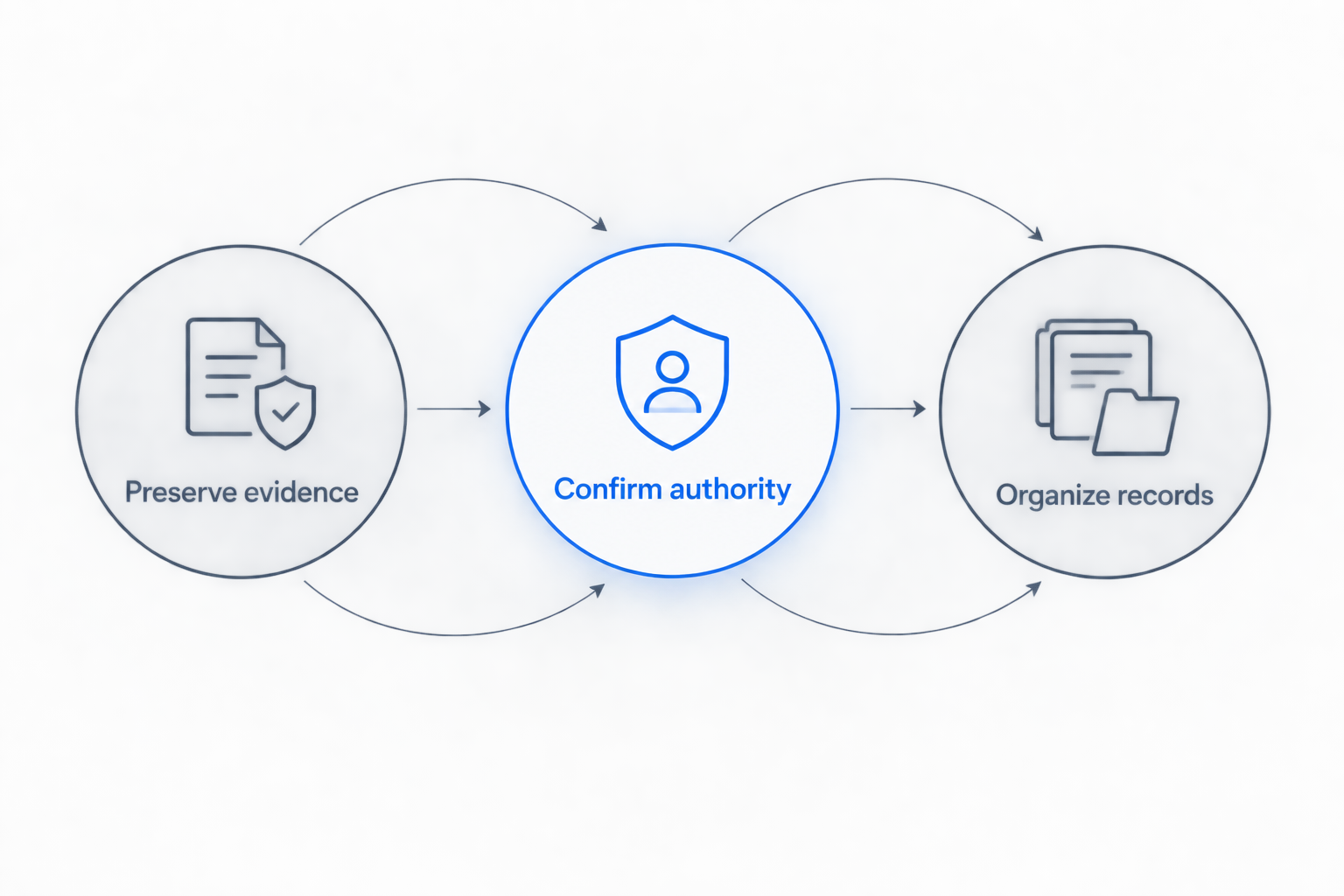
How these first steps fit together
Evidence preservation, legal authority, and documentation support different parts of the same process. Work on them together when possible; do not wait for a completed police report before asking what else needs attention.
4. Identify insurance: best for keeping communications organized
Collect policy declarations, claim numbers, adjuster names, and written requests already received. Include the deceased person's own auto policies, not just correspondence from the other driver's insurer. Counsel can assess whether any policy is relevant to the circumstances.
For a 2026 claim file, maintain a contact log showing the date, company, person, subject, and requested response. Keep voicemail messages and emails in their original form. If someone discusses payment, ask for the proposed terms in writing.
Benefits:
- A policy list helps counsel investigate potential coverage.
- Written requests make it easier to distinguish routine information requests from settlement documents.
- A shared log helps family members avoid contradictory responses.
Limits:
- Identifying a policy does not mean it covers the loss.
- An adjuster's explanation is not independent legal advice for your family.
Do not guess about speed, distraction, fault, or the deceased person's actions. Before providing a recorded statement, signing a broad authorization, or accepting payment tied to a release, ask counsel to explain the request and any applicable obligations.
Recommendation: Keep communications factual and obtain advice before making substantive commitments.
5. Consult counsel: best for coordinating the legal work
A Montana wrongful death attorney should explain filing authority, the evidence plan, potential claims, insurance questions, and applicable deadlines. The conversation should connect legal tasks to your family's actual circumstances, not promise a particular result.
JF Injury Law represents families after fatal car and truck crashes in Billings and across Montana. When discussing representation, explain what happened, who has contacted your family, and whether anyone has already signed documents or accepted payment.
Bring these three questions:
- Who acts? Ask who must authorize representation and pursue the claim.
- What needs preservation? Ask which evidence requires action beyond saving your own records.
- What happens next? Ask about deadlines, responsibilities, communication, and written fee terms.
Benefits:
- Counsel can coordinate issues that otherwise sit in separate files.
- A clear task list identifies what the family should provide.
- Written representation terms define the working relationship.
Limits:
- Representation does not guarantee liability, coverage, or recovery.
- An initial discussion cannot resolve every issue before records are examined.
Recommendation: Choose counsel who explains the work and its limits clearly.
Discuss your family’s next steps
Contact JF Injury Law about representation after a fatal Montana car or truck crash.
6. Review settlement: best for understanding what becomes final
Before signing a settlement agreement, identify who is signing, which parties are being released, and which claims the agreement resolves. Ask counsel to explain the document in plain English, including any unresolved expenses, reimbursement issues, or approval requirements.
Montana law distinguishes wrongful death claims from claims that survive the deceased person. Those categories concern different losses and require legal analysis. Do not assume a payment offered under one label addresses every claim arising from the crash.
Benefits:
- A document review clarifies the scope of the proposed release.
- Addressing unresolved obligations helps explain the proposed distribution.
- Written answers give authorized decision-makers a clear basis for approval.
Limits:
- A settlement estimate is not a promise of the amount ultimately received.
- Signing a release can prevent later pursuit of claims within its scope.
If your family receives an offer in 2026, assess the agreement and supporting information—not the calendar alone. Ask what remains unknown and how that uncertainty affects the decision.
Recommendation: Understand the release before deciding whether to accept the settlement.
How these priorities were ordered
The sequence puts evidence and authority first because later decisions depend on them. Records and insurance follow, while counsel coordinates the process and settlement review addresses the final commitment. This is a practical action plan, not a ranking of law firms or a substitute for advice about your case.
Which step should your family take first?
Preserve the records you already have and arrange a legal consultation. You can do both without waiting for every bill, report, or estate document. Tell the attorney about any immediate request involving vehicle disposal, recorded statements, authorizations, or a release.
For families seeking a Montana wrongful death attorney after a fatal car or truck crash, JF Injury Law represents clients in Billings and across Montana. Ask how the firm would address your family's authority, evidence, and communication needs.
FAQ
Who can file a wrongful death lawsuit in Montana?
For an adult’s death, Montana Code Annotated § 27-1-513 identifies the personal representative as the person who may maintain the wrongful death action. Different provisions apply to a minor’s death, so confirm filing authority for your circumstances.
Do we need the police report before calling a Montana wrongful death attorney?
No, you do not need a completed police report before contacting an attorney. Bring the agency name, report number, and any records already available, and explain what is still outstanding.
How long do we have to file a Montana wrongful death lawsuit?
Montana Code Annotated § 27-2-204 generally provides a three-year limitations period for wrongful death actions. Accrual rules, exceptions, and separate requirements can affect a particular case, so have counsel calculate the applicable deadlines rather than relying on a general summary.
Should we speak with the other driver’s insurance company?
Get legal advice before providing a recorded statement, signing an authorization, or discussing settlement terms. Save the insurer’s contact information and written requests so counsel can explain the request and any obligations.
Is a fatal truck crash claim different from a fatal car crash claim?
A fatal truck crash can involve commercial vehicle data, business records, and additional insurance questions. Ask counsel which drivers, businesses, records, and policies require investigation rather than assuming the police report addresses everything.
Does a criminal case replace a wrongful death claim?
No, a criminal case and a civil wrongful death claim serve different purposes. Do not assume a criminal investigation protects civil filing deadlines or resolves the family’s financial claims.
What should we bring to a wrongful death consultation in 2026?
Bring available crash information, insurance correspondence, loss records, and any documents identifying the estate’s personal representative. Missing documents should not stop you from asking about evidence preservation and deadlines.
One last thing
The person coordinating the family is not automatically the person authorized to settle the claim. Identify both roles early. A family contact can organize updates while counsel confirms who has legal authority to make binding decisions.
This article provides general information, not advice about a particular case. Reading it does not create an attorney-client relationship.