
Montana wrongful death claims allow a deceased person’s personal representative to seek damages when another party’s wrongful act or negligence caused the death. This 2026 guide explains eight facts families need after a fatal car or truck crash; JF Injury Law represents families facing those losses in Montana.
- Montana wrongful death claims generally must be filed within three years; confirm the deadline for the specific case.
- The deceased person’s personal representative brings the claim, rather than each family member filing separately.
- Wrongful death and survival claims address different losses and require coordinated handling.
- JF Injury Law represents Montana families seeking legal help after fatal car and truck crashes.
Why this matters
A fatal crash creates several separate questions: who has authority to act, what caused the collision, which losses are recoverable, and what insurance applies. An insurer’s willingness to discuss payment does not resolve those questions.
For a fatal crash in 2026, confirm filing authority and preserve evidence before evaluating a settlement. You do not need to finish investigating the collision before asking an attorney to identify deadlines and protect the family’s position.
What matters in a Montana wrongful death claim
Use these criteria to organize your next steps:
- Authority: Identify the person legally authorized to bring the claim.
- Timing: Confirm the applicable filing deadline and any separate notice requirements.
- Proof: Connect the defendant’s conduct to the fatal injuries.
- Losses: Separate family losses from claims belonging to the deceased person’s estate.
- Recovery sources: Identify potentially responsible parties and applicable insurance.
These are checkpoints, not a ranking of which family’s loss matters most. A claim needs legal authority, evidence, and documented damages—not just a clear account of how devastating the death has been.
Eight facts at a glance
| Fact | What it establishes | Key limitation |
|---|---|---|
| Personal representative brings the claim | Who has authority to act | Being a relative does not automatically confer filing authority |
| Wrongful death differs from survival | Which losses each claim addresses | The same loss cannot be recovered twice |
| A general three-year deadline applies | When filing must occur | Special circumstances require individual analysis |
| Fault requires evidence | Why another party is legally responsible | A fatal outcome alone does not prove negligence |
| Recoverable losses extend beyond bills | The financial and personal effects of death | Each category needs a legal basis and supporting evidence |
| Insurance limits affect recovery | Which payment sources need investigation | Claim value and available coverage are different questions |
| Truck crashes require a broader inquiry | Whether responsibility extends beyond the driver | Commercial involvement does not automatically establish liability |
| Settlement needs coordinated handling | Whose claims and rights a release affects | Signing can end rights that remain unresolved |
1. The personal representative brings the claim
Best for: families deciding who should speak and act for the claim.
Montana Code Annotated § 27-1-513 authorizes the deceased person’s personal representative to maintain a wrongful death action. A spouse, adult child, or parent should not assume that the family relationship alone supplies that authority.
If an estate proceeding is necessary, ask how appointment of a personal representative fits into the injury case. Also distinguish the person coordinating documents for the family from the person legally authorized to pursue litigation.
This matters when relatives disagree about hiring counsel or accepting a settlement. A family’s private agreement does not replace the legal requirements for bringing and resolving the action.
- Practical value: Establishing authority gives the claim a recognized person responsible for decisions.
- Limitation: Appointment does not determine fault, damages, or how proceeds should be allocated.
Next move: confirm who is authorized to act before signing claim documents.
2. Wrongful death and survival claims address different losses
Best for: families trying to understand what the case includes.
A wrongful death claim addresses legally recognized losses arising from the death. A survival action preserves claims that belonged to the deceased person under Montana Code Annotated § 27-1-501.
The distinction matters when someone received treatment before dying. Pre-death medical expenses and conscious pain and suffering raise different questions from the surviving family’s lost support and relationship losses.
- Wrongful death: Family losses resulting from the death.
- Survival action: Estate losses arising from claims that survive the person’s death.
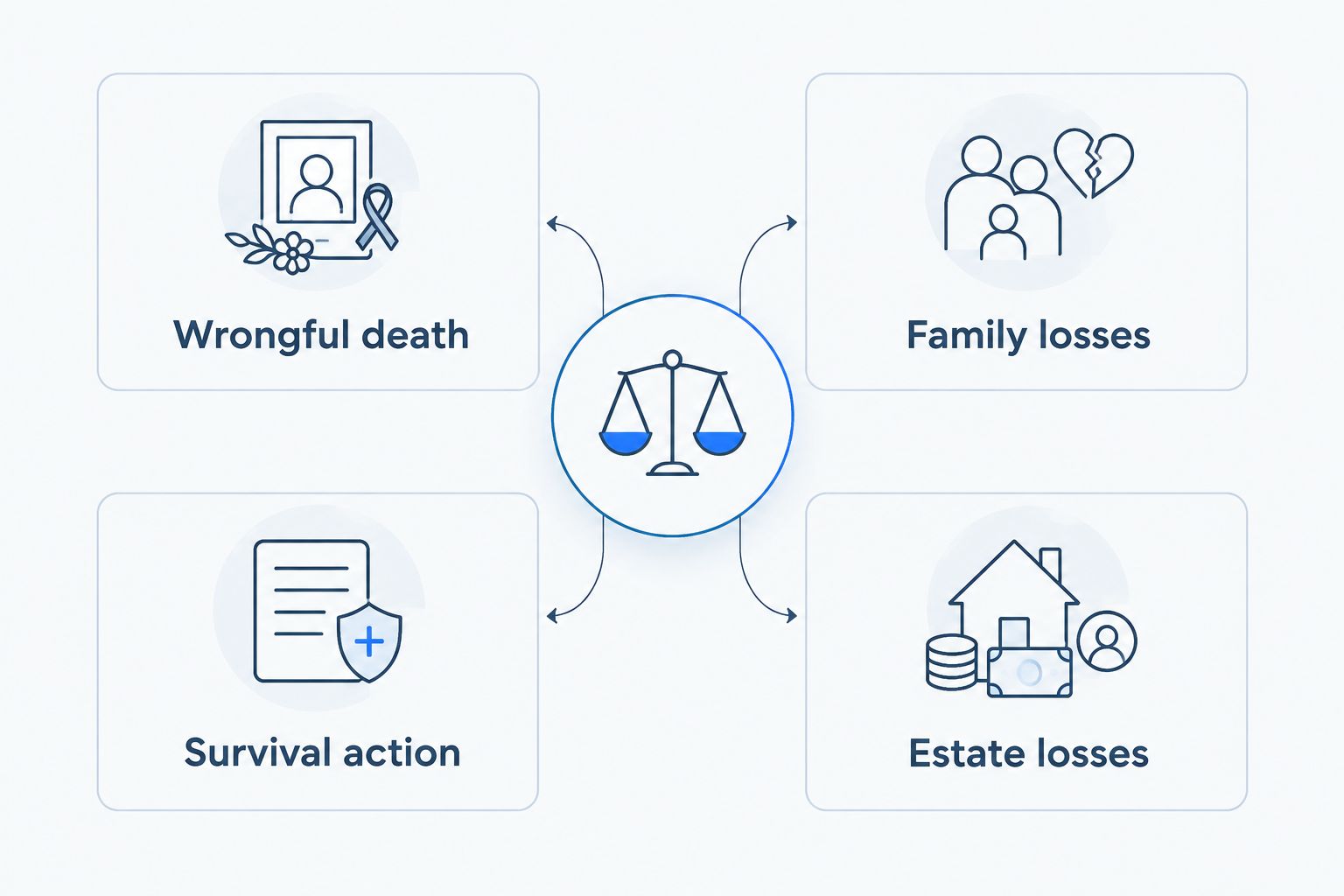
Both claims require coordinated analysis. Labels on an insurer’s paperwork do not establish that every recoverable loss has been considered, and overlapping claims do not permit duplicate payment for the same loss.
Next move: ask which claims apply and what evidence supports each category.
3. Montana generally allows three years to file
Best for: families deciding whether they can wait.
Montana’s general limitation period for wrongful death actions is 3 years, under Montana Code Annotated § 27-2-204. Have an attorney confirm the triggering date and the deadline that applies to the particular defendants and circumstances.
For a death in 2026, do not calculate your final filing date from this article alone. Claims involving public entities, disputed facts, or other legal complications require a case-specific deadline review.
An open insurance claim is not a filed lawsuit. Settlement discussions do not, by themselves, establish that the deadline has been extended.
Waiting also creates a separate evidence problem. A claim can remain within the filing period while important video, vehicle information, or witness recollections become harder to obtain.
- Practical value: A verified deadline gives the family a clear boundary for legal action.
- Limitation: Knowing the deadline does not preserve evidence or prepare the lawsuit.
Next move: obtain a deadline assessment early, even if settlement discussions have started.
4. A fatal crash does not automatically establish fault
Best for: families facing a disputed account of the collision.
A wrongful death claim requires proof of legally actionable conduct, causation, and damages. The severity of the outcome does not replace evidence showing how the collision happened and why a defendant is responsible.
Relevant evidence includes crash reports, photographs, witness accounts, vehicle damage, available video, and medical records. Depending on the collision, an attorney must also assess whether vehicle data or a reconstruction is needed.
Montana’s comparative negligence rule also matters. Under Montana Code Annotated § 27-1-702, 50% attributable negligence does not itself bar recovery, although it reduces damages; 51% bars recovery under the statutory comparison with the other relevant actors.
Those percentages explain the legal threshold, not the likely result of any particular case. Disputes about speed, visibility, restraint use, or driver conduct require evidence and legal analysis.
Next move: preserve the facts rather than arguing fault with an insurance adjuster.
5. Recoverable losses are not limited to funeral expenses
Best for: families assessing whether an offer addresses the actual loss.
A wrongful death case can involve financial support, services, and legally recognized relationship losses. Funeral expenses are only one part of the damages analysis; pre-death losses also require consideration under the appropriate claim.
A 2026 claim should document the deceased person’s actual contributions rather than rely on a generic settlement figure. Employment records, tax information, household responsibilities, and evidence of family relationships help explain losses that a medical bill cannot show.
Unpaid work matters to that inquiry. Childcare, transportation, household maintenance, and caregiving describe real contributions even when no employer issued a paycheck for them.
- Practical value: A complete damages record explains both financial and personal consequences.
- Limitation: Not every claimed expense or loss is recoverable, and future losses require support.
Next move: collect records and describe specific contributions without assigning your own settlement total.
6. Insurance limits and claim value are different questions
Best for: families told that an available policy is the entire case.
The amount of insurance available does not determine the full amount of legally recoverable damages. It does affect the practical investigation into how a judgment or settlement would be paid.
Evaluating damages exceeding insurance policy limits requires separating the amount of a supportable claim from the coverage available to pay it. The Montana analysis must then examine the actual policies, responsible parties, and applicable law—not assume that another state’s coverage rules apply.
Ask whether the investigation includes employer coverage, commercial policies, umbrella coverage, and any applicable coverage connected to the deceased person’s household. Their existence and terms must be verified; none should be assumed.
A large claim does not guarantee collection beyond insurance. Conversely, an adjuster’s statement about one policy does not establish that every recovery source has been identified.
Next move: request a coverage investigation before treating a policy-limit offer as the final answer.
7. Fatal truck crashes require more than a driver inquiry
Best for: families dealing with a commercial truck collision.
A fatal truck crash requires investigation into the driver’s conduct and the businesses connected to the trip. Depending on the evidence, questions include employment relationships, vehicle maintenance, loading, and compliance with applicable safety requirements.
Commercial involvement alone does not prove that a trucking company, maintenance provider, or another business caused the crash. Each potential defendant requires a supported theory of responsibility.
For a 2026 claim, ask counsel to assess preservation of driver logs, dispatch communications, maintenance records, onboard data, and available camera footage. Do not assume that requesting the police report preserves records held by a private company.
JF Injury Law represents families after fatal car and truck crashes in Montana. When you contact the firm about a fatal crash, provide the crash date, location, known parties, and any insurance correspondence you already have.
Next move: identify the commercial parties and request a focused evidence-preservation plan.
8. A settlement needs coordinated review before anyone signs
Best for: families considering an offer or release.
A settlement release is a legal agreement, not just permission to issue a payment. Its wording determines which parties and claims are released and what obligations remain.
Before agreeing, ask how the proposal addresses wrongful death and survival claims, the personal representative’s authority, potential reimbursement demands, and allocation issues. Also ask whether any beneficiaries’ circumstances require additional procedures or court involvement.
Keep a copy of every proposed release and accompanying letter. A verbal explanation from an adjuster is not a substitute for understanding the document itself.
- Practical value: Coordinated review identifies what the payment resolves and what remains outstanding.
- Limitation: An offer’s headline amount does not establish the family’s net recovery or whether settlement is appropriate.
Next move: have the complete proposal evaluated before signing, not after funds arrive.
How to use these eight facts
The order follows the decisions a family needs to address: authority, claim types, timing, proof, losses, coverage, commercial responsibility, and settlement. These checkpoints are not a formula for valuing a death or predicting a case result.
Start with the unresolved issue that threatens the claim. If no personal representative has been appointed, address authority; if a commercial vehicle was involved, ask about preserving company-held evidence while that process moves forward.
Which next step should you choose?
Request a case-specific legal assessment before accepting a settlement or assuming the claim is too late. Bring the documents you have; identify missing records instead of delaying until your file feels complete.
Ask direct questions about authority, deadlines, evidence, fees, and communication. You should understand what needs to happen next and which decisions require more investigation.
Discuss a fatal Montana crash
Ask about filing authority, deadlines, evidence preservation, and the next steps for your family.
FAQ
Who can file a Montana wrongful death claim after a car crash?
The deceased person’s personal representative brings the wrongful death action under Montana Code Annotated § 27-1-513. Being a spouse, child, or parent does not automatically establish authority to file.
How long do we have to file a Montana wrongful death lawsuit?
Montana generally provides three years for a wrongful death action under Montana Code Annotated § 27-2-204. An attorney should confirm the applicable deadline and any separate requirements for the particular case.
Is wrongful death the same as a survival action?
No. Wrongful death addresses legally recognized losses resulting from the death, while a survival action preserves claims belonging to the deceased person. The claims require coordinated handling without duplicate recovery.
Can we bring a claim if our family member was partly at fault?
Partial fault does not automatically bar a Montana claim. Under the statutory comparative negligence rule, attributable negligence reduces damages and bars recovery when it exceeds the relevant combined negligence of others.
Does the other driver’s insurance limit determine what our claim is worth?
No. Available insurance and legally recoverable damages are separate questions. Counsel must investigate applicable coverage and responsible parties before assessing potential recovery.
What should we bring to a wrongful death consultation?
Bring available crash information, insurance correspondence, medical and funeral records, and estate appointment documents. You can ask for legal help before obtaining every record.
Should we accept an insurance settlement before hiring a lawyer?
Have the complete offer and release evaluated before signing. A release can end claims, and the payment amount alone does not explain allocation, reimbursement obligations, or unresolved coverage questions.
One last thing
Create a single family record of insurance communications. Save letters, emails, proposed releases, and notes identifying who called and what was discussed. This gives counsel a clearer record without requiring grieving relatives to reconstruct separate conversations.
In 2026, the central recommendation remains straightforward: preserve records, confirm authority, and understand the agreement before signing. This article provides general information, not legal advice about a particular claim.
Related guides
- How much does hiring a wrongful death lawyer cost in Montana?
- Questions to ask before hiring a truck accident lawyer
- Suing a distracted driver for texting in a Montana crash
Author: Joe Frick, JF Injury Law.