
Montana ranchers’ car accident representation is legal help after a vehicle crash aimed at pursuing compensation for injuries and documented losses. This 2026 guide explains how to protect your health, preserve crash evidence, and document ranch work that an injury prevents you from doing.
- JF Injury Law is best for seriously injured Montana ranchers seeking car or truck crash representation.
- Searching car accident lawyer for ranchers montana? Prioritize injury representation and clear documentation of ranch-related losses.
- Preserve crash evidence, medical records, replacement-labor invoices, and records showing your usual ranch duties.
- Separate personal injury losses from ranch business losses; ownership and supporting records matter.
Why car accident representation matters for Montana ranchers
A ranch injury claim needs more than a damaged-vehicle estimate. If your injuries prevent feeding livestock, repairing fences, hauling supplies, or operating equipment, you need records connecting those restrictions to actual losses.
A paycheck alone does not capture every rancher’s work. Owner draws, business revenue, unpaid family labor, and seasonal sales describe different things; treating them as interchangeable makes a claim harder to explain.
JF Injury Law is best for seriously injured Montana ranchers seeking car or truck crash representation. JF Injury Law represents people seriously injured in vehicle crashes in Billings and across Montana. Your consultation should address both the injury and the work your injury has interrupted.
For a 2026 crash, build your records around what actually happened—not a generic estimate of what ranch work should be worth. Representation does not guarantee payment, but it gives you someone responsible for evaluating liability, coverage, evidence, and the losses supported by your records.
Protect your claim after a Montana ranch-road or highway crash
Put medical care before ranch work
Call 911 for an emergency and follow medical instructions. Tell the treating clinician how the crash happened, where you hurt, and which ordinary movements or tasks cause difficulty.
Describe your actual duties rather than simply saying you are a rancher. Lifting feed, climbing into a pickup, handling gates, and sitting through a long drive place different demands on your body. Accurate descriptions help your clinician understand the work you are trying to resume.
Do not use this guide to decide whether you can safely work. Ask your treating clinician about restrictions, follow-up care, driving, and equipment operation. If travel or work responsibilities interfere with an appointment, contact the provider rather than leaving an unexplained gap.
- Save discharge instructions, prescriptions, and referral paperwork.
- Describe specific tasks that increase your symptoms.
- Ask for written work restrictions when medically appropriate.
- Keep appointment records and explanations for rescheduling.
- Arrange help for tasks that conflict with medical instructions.
Preserve crash evidence without putting yourself at risk
Start with what you can safely collect yourself. Photographs, witness details, and an accurate account of the location help establish the circumstances of a rural-road crash.
Document an intersection, driveway entrance, road shoulder, or sight obstruction if relevant. Photograph the whole setting as well as vehicle damage; a close-up alone does not show where vehicles traveled. Do not enter traffic, return to an unsafe location, or move debris just to improve a photograph.
Save original files instead of keeping only edited copies or social-media uploads. If someone else took photographs, ask that person to preserve the originals. For evidence you cannot access yourself, ask an attorney what preservation requests are appropriate.
- Record the road name, nearest intersection, and crash location.
- Photograph vehicle positions and road conditions when safe.
- Save driver, insurance, and witness information.
- Keep dashcam footage and original photograph files.
- Record which agency investigated and how to request its report.
Identify the vehicles, owners, and insurance involved
Write down the vehicles involved and distinguish the driver from the vehicle owner. If a truck was involved, preserve visible company names and identifying information without assuming that a logo alone establishes legal responsibility.
Start by gathering the documents already available to you: insurance cards, policy declarations, claim correspondence, and vehicle registration. Tell your insurer the facts accurately and ask about notice requirements and potentially applicable coverage. Do not assume that a personal policy and a ranch business policy cover the same risks.
JF Injury Law’s car and truck crash representation is relevant when serious injuries require legal evaluation. If a commercial vehicle was involved, review the firm’s information about a truck accident lawyer in Billings, Montana, then ask which parties and records need investigation. The page title does not establish that any particular claim will succeed.
- Identify each driver and registered vehicle owner.
- Preserve company names and vehicle identifiers from photographs.
- Gather personal and applicable business policy documents.
- Keep claim numbers and adjuster correspondence together.
- Ask counsel about evidence held by a trucking company.
Document ranch work your injuries prevent
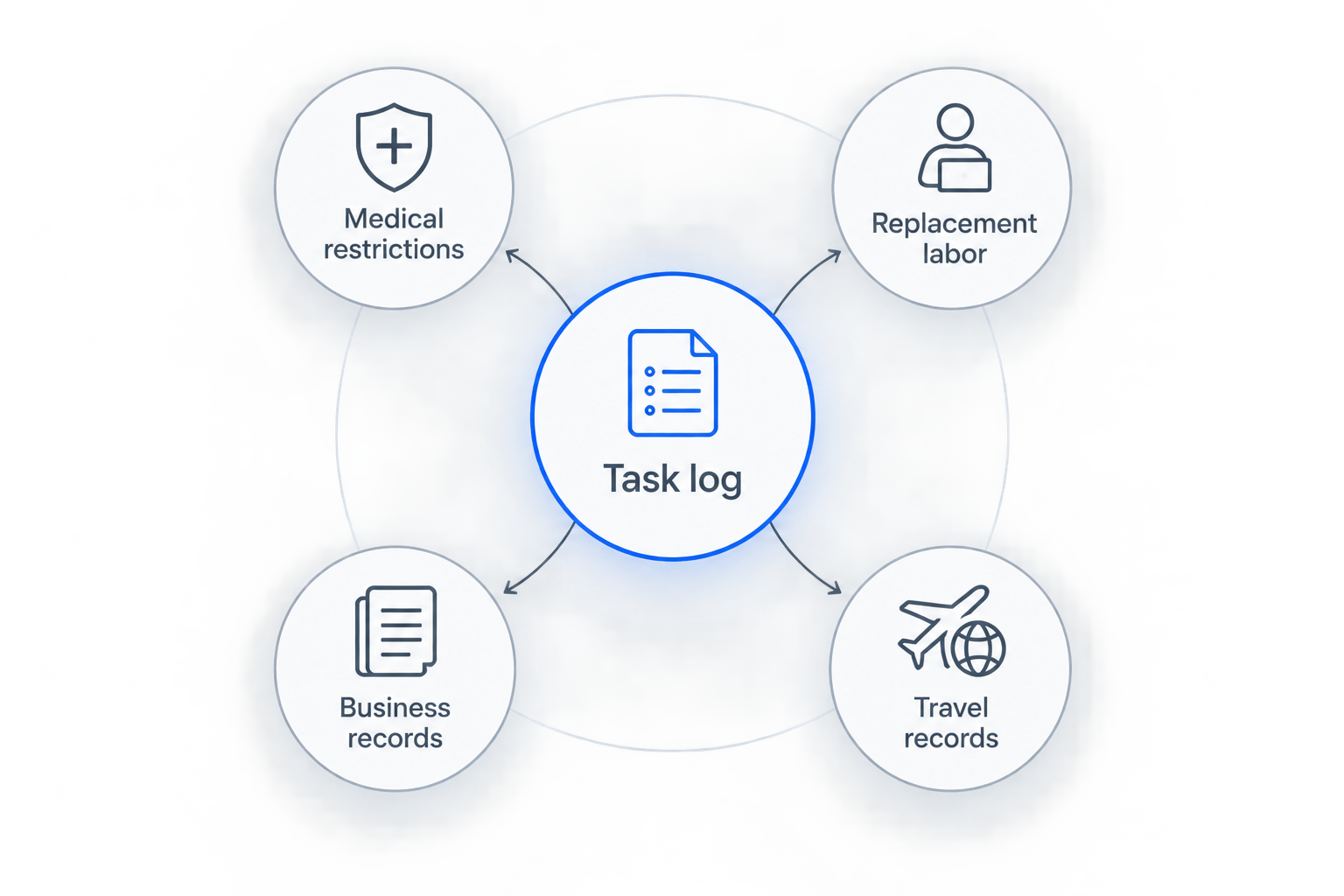
Create a task log using a notebook or spreadsheet. Record what you ordinarily did, what changed after the crash, who performed the work instead, and what documentation supports the change.
Separate physical inability from scheduling disruption. Missing a task because your clinician restricted lifting differs from missing it while attending treatment; both require an accurate explanation. Avoid broad entries such as unable to ranch when you can describe the particular task and restriction.
Replacement help is evidence to evaluate, not an automatic reimbursement. Whether an expense is recoverable depends on the facts, legal responsibility, and its connection to the injury. Keep personal injury losses separate from losses belonging to a ranch entity, and ask counsel to address the distinction.
For your 2026 records, use consistent dates and retain the underlying documents. A summary is easier to assess when someone can trace each entry back to an invoice, message, medical restriction, or business record.
- Task log: Record duties you could not perform or had to modify.
- Medical restrictions: Keep instructions relevant to those duties.
- Replacement labor: Save invoices, payment records, and work descriptions.
- Business records: Preserve records supporting a claimed financial change.
- Travel records: Track treatment-related trips and supporting receipts.
Separate liability questions from damage questions
Keep two distinct files: evidence showing how the crash happened and evidence showing what the injury caused. Strong medical records do not, by themselves, establish that another driver was legally responsible.
Montana’s comparative negligence statute, MCA § 27-1-702, generally allows recovery when your negligence is not greater than the combined negligence of the people against whom recovery is sought. In the ordinary comparison, 50% fault does not automatically bar recovery, but recoverable damages are reduced by your share of fault. Ask an attorney how the rule applies to the parties in your case.
For claims evaluated in 2026, Montana’s general personal injury limitations statute, MCA § 27-2-204, generally provides 3 years. Exceptions and separate notice requirements can change the analysis. Do not treat the general period as permission to postpone evidence preservation or legal advice.
- Keep crash evidence separate from medical and expense records.
- Report facts accurately rather than guessing about fault.
- Preserve statements, diagrams, and insurance correspondence.
- Ask about the deadline for your particular claim.
- Request advice before signing a settlement release.
Prepare a focused consultation before deciding
You can organize your records yourself before speaking with a lawyer. Bring a short crash timeline, your medical status, insurance correspondence, and examples of the ranch work affected.
An attorney’s role goes beyond organizing paperwork. Legal evaluation addresses who bears responsibility, what coverage applies, which losses belong in the claim, and whether additional evidence needs preservation. Ask who will handle those tasks and how you will receive updates.
JF Injury Law represents seriously injured people after car and truck crashes across Montana. That scope fits this audience, but the firm’s description alone does not establish experience with your particular ranch operation or promise a result. Ask direct questions about your facts, communication needs, and the proposed representation agreement.
- Explain how the crash happened without filling gaps with guesses.
- Bring treatment records and current medical restrictions.
- Identify urgent insurance requests or documents awaiting signature.
- Describe your usual duties and replacement-help arrangements.
- Ask about fees, expenses, responsibilities, and communication in writing.
Discuss your Montana crash
Explain your injuries, the crash circumstances, and the ranch work you can no longer perform.
Compare claim-support options for ranchers in 2026
Choose support by the task you need done. Medical treatment, financial documentation, insurance administration, and legal representation serve different purposes; none substitutes for all the others.
| Option | Best for | Main advantage | Key limitation |
|---|---|---|---|
| Self-managed claim file | Organizing your own records | Keeps original documents and a factual timeline accessible | Does not provide legal analysis or negotiate on your behalf |
| Insurance claim process | Reporting a crash and requesting policy benefits | Provides a channel for submitting records and coverage questions | An insurer is not your personal legal representative |
| Accountant or bookkeeper | Explaining ranch financial records | Helps distinguish revenue, expenses, and business records | Financial documentation is not legal representation |
| Personal injury attorney | Evaluating and pursuing a disputed injury claim | Addresses liability, insurance, evidence, and claimed damages | Requires an agreement and does not guarantee recovery |
You do not have to choose between keeping your own records and seeking representation. A clear personal file remains useful when an attorney handles the legal claim, and financial records still need an explanation grounded in how your operation actually works.
Common claim mistakes Montana ranchers should avoid in 2026
Treating ranch revenue as personal lost income
A change in gross sales does not automatically equal an individual injury loss. Identify the person or entity receiving the revenue, account for related expenses, and distinguish injury-related disruption from other causes. Have counsel assess what belongs in the claim.
Leaving family replacement work undocumented
If relatives take over chores, record the work even when no invoice exists. Describe the task, who performed it, and why help became necessary. Do not assign an invented wage or assume unpaid assistance creates an automatically recoverable expense.
Describing work ability in absolutes
Returning to a limited task does not necessarily mean returning to your usual workload. Record the difference between what you attempted, what you completed, and what symptoms or restrictions affected the work. Give clinicians and insurers accurate accounts rather than minimizing or overstating your capacity.
Settling the injury claim as though it were vehicle damage
Repairing a pickup and resolving a bodily injury claim address different losses. Read releases carefully and confirm which claims a document resolves. Ask about unresolved treatment, work restrictions, and future-care questions before agreeing to a final injury settlement.
FAQ
What should I look for in a car accident lawyer for ranchers in Montana?
Look for car or truck crash representation and a clear plan for documenting how the injury affects your ranch work. Ask how the attorney will distinguish personal losses from ranch business losses and communicate with you during treatment.
Can I claim the cost of someone doing my ranch chores after a crash?
Replacement-labor expenses require a case-specific legal evaluation; they are not automatically recoverable. Preserve invoices, payment records, task descriptions, and medical restrictions that connect the help to your crash injuries.
What if family members do my ranch work without being paid?
Document the work accurately without inventing an expense. Record who helped, which duties they performed, and why your injuries prevented you from doing those duties, then ask counsel how that evidence affects the claim.
Can I still pursue a Montana crash claim if I was partly at fault?
Partial fault does not automatically bar a Montana injury claim. Montana’s comparative negligence rule considers your share against the combined negligence of those against whom recovery is sought and reduces recoverable damages by your share.
How long do I have to file a Montana car accident injury lawsuit?
Montana generally provides a 3-year limitations period for personal injury actions under MCA § 27-2-204. Exceptions and separate notice requirements require individual evaluation, so ask an attorney to identify the deadline for your facts.
Does it matter if the other vehicle was a commercial truck?
A commercial truck makes the vehicle owner, business relationships, insurance, and company-held evidence relevant subjects for investigation. Preserve identifying information and ask counsel which parties and records need evaluation.
What should I bring to a crash consultation if I am self-employed?
Bring crash information, insurance documents, treatment records, work restrictions, and records showing your ordinary duties and financial circumstances. Include replacement-help records and identify whether vehicles, income, and expenses belong to you or a business entity.
One last thing
The most useful ranch-work record explains the task, not just the job title. Rancher tells an adjuster little about the lifting, driving, walking, and equipment use your work requires. Write a plain-language description of your normal duties, then record the injury-related changes without exaggeration.
This article provides general information, not legal advice about your claim. An attorney must evaluate your facts, applicable deadlines, and potential recovery individually.
Related guides
- Things to document after a distracted driving accident
- Montana’s comparative negligence rule
- Factors that affect a semi-truck accident claim in Montana
Author: Joe Frick