
Montana uninsured motorist coverage pays covered bodily-injury damages when an uninsured driver is legally responsible for your crash, subject to your policy’s terms and limits. These six facts explain what to check after a Montana car or truck crash in 2026, what uninsured motorist coverage does not cover, and how to protect your claim.
- Montana uninsured motorist coverage protects against covered injuries caused by an uninsured driver, not every unpaid crash expense.
- Montana requires uninsured motorist coverage in covered auto liability policies unless the named insured rejects it.
- Uninsured motorist coverage and underinsured motorist coverage address different insurance problems.
- JF Injury Law represents seriously injured Montanans seeking help after car and truck crashes.
Why this matters after a Montana crash
An uninsured driver creates an insurance problem, not an automatic dead end. Your own auto policy can provide a path to compensation, but you still need to establish coverage, responsibility for the crash, and the damages you suffered.
JF Injury Law is a fit for seriously injured Montanans who need representation after a car or truck crash. You can contact the firm about a crash involving a driver whose insurance status is unclear.
For a 2026 claim, start with the policy in effect on the crash date—not the policy you have today. A renewal, vehicle change, or coverage change after the collision does not establish what protection existed when you were injured.
What makes a useful coverage review
Before deciding whether an uninsured motorist claim applies, check these five points:
- Insurance status: Was the responsible driver actually uninsured, or is insurance information still missing?
- Applicable policy: Which policies were in effect when the crash happened?
- Insured status: Does the policy cover you in the circumstances of this collision?
- Covered damages: Does the coverage address bodily injuries, vehicle damage, or another specific loss?
- Claim requirements: What notices, evidence, permissions, and deadlines does the policy require?
A declarations page is a starting point. Read it alongside the policy form and endorsements, which contain the definitions and conditions that determine coverage.
Montana crash coverage at a glance
These coverages solve different problems. None replaces the others, and the policy language controls whether a particular loss qualifies.
| Coverage | Best for | Main benefit | Main limitation |
|---|---|---|---|
| Uninsured motorist, or UM | Covered injuries caused by an uninsured driver | Provides a potential bodily-injury claim under an applicable policy | Does not function as vehicle-repair coverage |
| Underinsured motorist, or UIM | Covered injuries when the responsible driver has insufficient liability limits | Addresses a different insurance gap from UM | Availability and payment depend on the UIM contract |
| Bodily-injury liability | Injuries an insured driver causes to others | Responds to covered claims against that driver | Does not serve as that driver's own injury coverage |
| Collision | Physical damage to an insured vehicle after a collision | Addresses covered vehicle damage | Does not compensate for bodily injuries; a deductible can apply |
1. Montana requires UM coverage unless the named insured rejects it
Montana Code Annotated § 33-23-201 requires uninsured motorist bodily-injury coverage in auto liability policies within the statute’s scope unless the named insured rejects that coverage. Required inclusion is not the same as a rule that every Montana driver must purchase UM.
For a 2026 coverage review, request the declarations page, complete policy, endorsements, and any record of a UM rejection. Do not treat a missing UM entry on a billing statement as the complete answer.
Montana’s minimum motor vehicle liability limits under § 61-6-103 include $25,000 for bodily injury to one person and $50,000 for bodily injury to multiple people in one accident. Section 33-23-201 ties required UM limits to the statutory bodily-injury minimums, subject to the named insured’s right to reject coverage.
- Benefit: The statute creates a starting protection rather than leaving UM entirely unaddressed.
- Limitation: A rejection or coverage dispute still requires examination of the actual policy and records.
- Best for: Determining whether a policy should contain UM protection.
Next move: Ask for the coverage documents before accepting a verbal statement that you have no UM coverage.
2. UM addresses bodily injuries, not every crash expense
Montana’s statutory UM protection concerns bodily injury, sickness, disease, and resulting death caused by an uninsured motorist. A covered claim can include damages associated with those injuries, but the claimant must establish what the crash caused and what damages are legally recoverable.
That is different from repairing your vehicle. Collision coverage addresses covered physical damage to an insured vehicle; UM bodily-injury coverage is not a substitute for it.
The distinction also appears in Montana’s liability minimums. The separate $20,000 property-damage limit per accident under § 61-6-103 concerns liability for damage to others’ property, not a promise that your UM coverage will repair your car.
Keep the two claim tracks organized:
- Injury records: Medical records, treatment bills, work restrictions, wage records, and documentation of daily limitations.
- Property records: Vehicle photographs, repair estimates, towing records, and related correspondence.
Benefit: UM provides a potential source of recovery for covered injury damages. Limitation: It does not turn every expense arising after a crash into a covered loss.
Best for: Separating your injury claim from your vehicle-damage claim. Next move: Ask the insurer which coverage applies to each loss rather than treating the crash as one undifferentiated claim.
3. Uninsured and underinsured are different coverage questions
An uninsured driver lacks applicable liability insurance for the crash. An underinsured driver has liability insurance, but the available limits are insufficient for the injured person’s damages under the applicable UIM terms.
UM and UIM are not interchangeable. Montana’s statutory UM requirement does not establish that your policy includes UIM coverage or that the two coverages use identical definitions.
A driver’s inability to show an insurance card at the scene does not prove the driver was uninsured. Conversely, an insurance card does not resolve whether the listed policy covered the driver, vehicle, and collision.
If the other insurer denies coverage, request the explanation in writing. A denial based on policy cancellation presents a different question from a disagreement about who caused the collision.
- UM benefit: Addresses a covered injury claim involving an uninsured motorist.
- UM limitation: Does not automatically address a driver whose existing liability limits are inadequate.
- UIM benefit: Addresses insufficient liability coverage when the UIM contract applies.
- UIM limitation: Requires separate analysis of its definitions, limits, and settlement conditions.
Best for: Choosing the correct insurance claim path. Next move: Confirm both the other driver’s coverage status and your own UM/UIM coverage before deciding which claim to pursue.
4. A claim against your insurer still needs evidence
Having UM coverage does not establish that the other driver caused the crash or that every claimed injury resulted from it. You still need evidence of responsibility, injury, and damages.
In a 2026 claim, preserve the underlying records rather than relying on a short description entered into an insurance portal. Photographs, witness information, crash reports, medical records, and employment documents serve different purposes.
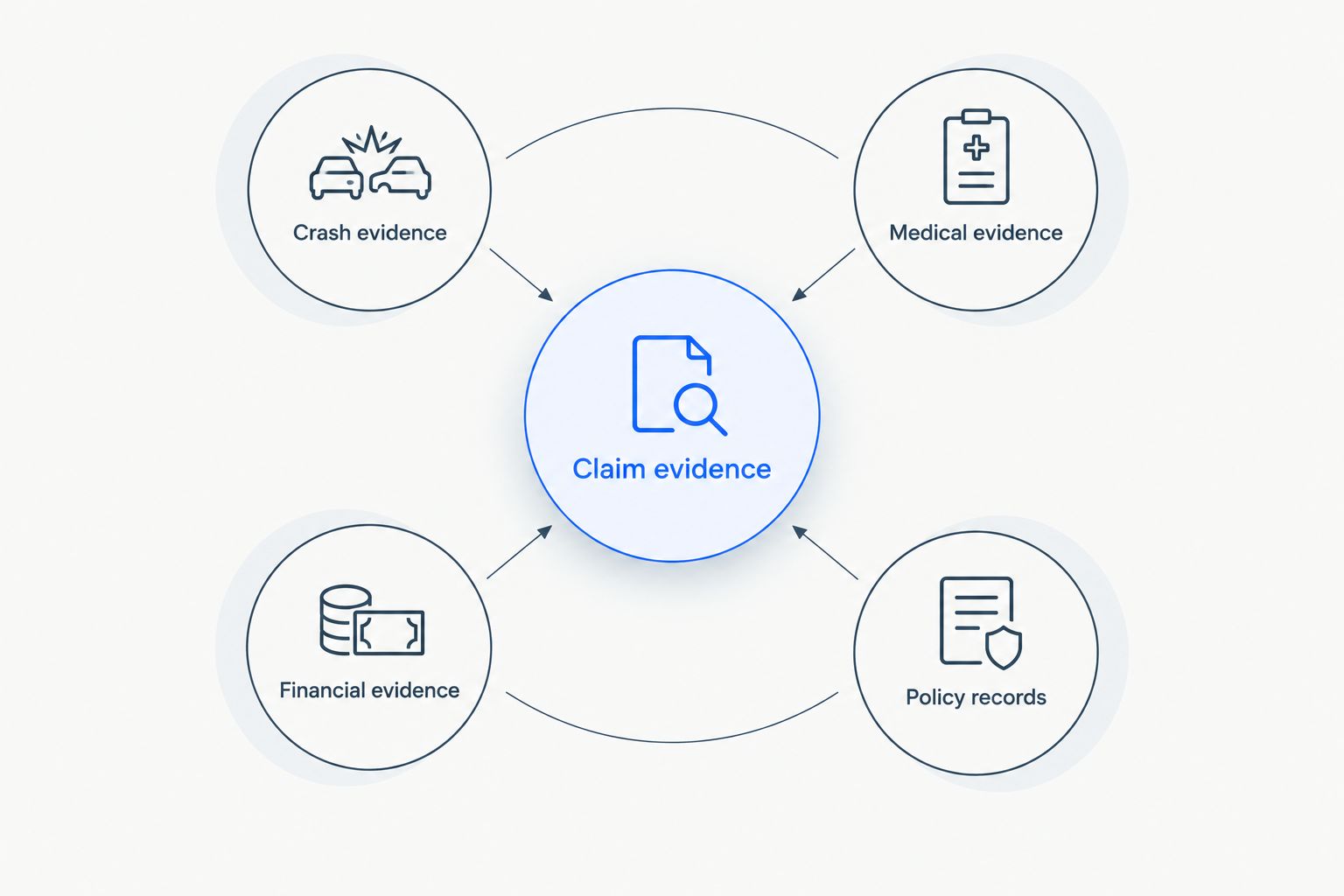
Use these evidence categories:
- Crash evidence: Photographs, witness details, crash-report information, and available video.
- Medical evidence: Treatment records, diagnoses, follow-up instructions, and documented restrictions.
- Financial evidence: Medical bills, wage records, and receipts tied to the injury claim.
- Policy records: The applicable insurance contract, endorsements, and claim correspondence.
A personal symptom log can help you describe daily limitations, but it does not replace medical evaluation. Record what happened accurately, including improvement, setbacks, and missed work.
Benefit: Organized evidence supports a clear explanation of your claim. Limitation: A large file does not resolve disputed causation or coverage by itself.
Best for: Injured people preparing to discuss a claim with an insurer or lawyer. Next move: Save original records and keep a separate copy of what you submit.
5. Your policy determines who qualifies for protection
Do not assume UM applies only when you drive your own car. The policy’s definition of an insured person, the vehicle involved, and the circumstances of the collision determine the coverage question.
A passenger injured in a car crash should identify the vehicle’s insurance and any other potentially applicable household policies. A person struck while walking also needs a policy-specific review rather than an assumption that auto coverage cannot apply outside a vehicle.
Household relationships, vehicle ownership, and policy exclusions can affect the analysis. The existence of several policies does not establish that their limits can be added together.
For a 2026 review, give the lawyer the relevant facts without deciding coverage yourself:
- Whose vehicle was involved?
- Were you driving, riding as a passenger, or outside a vehicle?
- Which household auto policies existed on the crash date?
- Did the collision involve a work vehicle or another person’s vehicle?
Benefit: Reviewing potentially applicable policies avoids focusing too narrowly on one insurance card. Limitation: Being related to a policyholder or occupying a vehicle does not, by itself, settle every coverage issue.
Best for: Passengers and people whose circumstances involve more than their own vehicle. Next move: Identify the policies first; let their actual terms determine the coverage analysis.
6. Notice and settlement decisions can affect your claim
Report the crash to potentially applicable insurers and review their notice requirements. Do not wait for the other driver’s insurance investigation to finish before finding out what your own policy requires.
Before signing a release, accepting a settlement, or agreeing to a recorded statement, understand the request and its consequences. Policy provisions concerning cooperation, settlement consent, and recovery rights deserve particular attention.
A payment for vehicle damage and a settlement of bodily-injury claims are different matters. Read what a release actually resolves rather than relying on the label attached to a payment.
- Benefit: Early attention to policy requirements helps you make informed claim decisions.
- Limitation: Reporting a claim does not extend every legal deadline or guarantee coverage.
- Best for: Anyone receiving insurance paperwork after an uninsured-driver crash.
Next move: Keep copies of letters, emails, forms, and releases. Record the date, recipient, and subject of important communications, and ask for explanations you do not understand.
Which next step fits your crash?
Start with the policy and the evidence—not a settlement number. If insurance status is unclear, request confirmation. If coverage exists but your injuries are disputed, organize the medical and crash records. If someone asks you to release claims, understand the consequences before signing.
JF Injury Law handles Montana uninsured motorist coverage questions in the context of representing seriously injured car and truck crash clients. Bring the available policy documents, crash information, and insurer correspondence when discussing representation.
Discuss your Montana crash
Contact JF Injury Law about representation after a serious car or truck crash.
FAQ
Is uninsured motorist coverage required in Montana in 2026?
Montana requires UM bodily-injury coverage in auto liability policies within § 33-23-201 unless the named insured rejects it. That does not mean every driver necessarily has UM coverage; review the applicable policy and rejection records.
Does Montana uninsured motorist coverage pay to fix my car?
Montana’s statutory UM coverage addresses bodily injuries, not vehicle repairs. Collision coverage is a separate coverage to examine for physical damage to your insured vehicle.
What’s the difference between uninsured and underinsured motorist coverage?
UM addresses covered injuries caused by an uninsured driver; UIM addresses insufficient liability insurance under the applicable UIM contract. Having UM does not establish that you also have UIM.
Can I make a UM claim if I was a passenger?
A passenger’s eligibility depends on the applicable policy’s insured-person definitions and other terms. Identify the vehicle’s policy and any potentially applicable household policies before ruling coverage in or out.
Does a hit-and-run automatically qualify for uninsured motorist coverage?
A hit-and-run is not an automatic UM payment. The policy’s definition of an uninsured vehicle, applicable law, reporting requirements, and evidence determine whether the claim qualifies.
Can I use more than one uninsured motorist policy?
Multiple policies require a policy-specific and legal analysis; their existence does not automatically let you combine limits. Provide all potentially applicable policies when seeking advice.
What should I bring to a lawyer about an uninsured-driver crash?
Bring available policy documents, insurer letters, crash information, medical records, and wage-loss documentation. JF Injury Law represents seriously injured Montanans after car and truck crashes.
One last thing
An insurance card identifies a possible insurer; it does not establish coverage for your crash. Request the policy and written coverage position, then keep those documents with your injury records.
For a crash that happened before 2026, preserve the policy version covering that earlier crash date. Replacing it with the current renewal can obscure the terms that matter.
This article provides general information, not advice about a specific claim. Coverage and legal rights depend on the facts, policy language, and applicable law.
Related guides
Author: Joe Frick.