
Yes. You can sue a driver for a Montana texting-related crash if the driver's negligence caused your injuries and resulting losses. Texting alone does not establish the entire case: you still need evidence connecting the distraction to the collision, and Montana's shared-fault rules can reduce or bar recovery.
- You can sue a texting driver when negligent driving causes your injuries and documented losses.
- A Montana distracted driving accident lawyer must connect phone use to the collision, not merely show a phone existed.
- Montana shared-fault rules reduce compensation and bar recovery when your fault exceeds the applicable comparison threshold.
- JF Injury Law represents seriously injured Montanans after car and truck crashes; liability still requires evidence.
Why this matters
A driver looking down at a phone is an important observation, not a complete liability finding. Your claim needs to explain what the driver did wrong, how that conduct caused the crash, and what injuries followed.
For a crash in 2026, start with medical care and evidence preservation rather than an argument with the other driver. The guide to steps after a car accident in Billings, Montana provides a starting point. Preserve what you know without trying to investigate someone else's phone yourself.
Can I sue a distracted driver for texting in a Montana crash?
You can bring a negligence claim against a texting driver when the evidence supports careless driving, causation, and damages. A traffic citation is not a prerequisite to a civil claim, and a citation does not independently prove every element of your case.
Your case should address these elements:
- Duty: The driver owed other road users a duty to use reasonable care.
- Breach: The driver failed to use reasonable care, such as by looking away from traffic to text.
- Causation: That failure caused or contributed to the collision and your injuries.
- Damages: You suffered losses, such as medical expenses, lost earnings, or pain and suffering.
A negligence claim focuses on the driver's conduct, not just whether a particular texting ordinance applies. The relevant traffic rules depend on where the crash happened and the type of vehicle involved. Commercial truck drivers also face federal restrictions on texting while driving under 49 CFR § 392.80.
For a 2026 Montana crash, prove unsafe driving and its consequences rather than building the entire claim around a texting accusation.
What evidence helps prove a driver was texting?
Useful evidence connects distraction to the moments surrounding the collision. A phone record without context does not show where the driver was looking or why the vehicles collided.
| Evidence | What it can help establish | Important limitation |
|---|---|---|
| Witness observations | A driver looking down, holding a phone, or typing before impact | A witness might not know which application the driver used |
| Dashcam or nearby video | Vehicle movement, traffic signals, and sometimes visible phone use | Footage might not show the vehicle interior |
| Driver statements | An admission of reading or sending a message | The wording and circumstances matter |
| Phone-related records | Communication activity near the crash time | Carrier records do not necessarily include app messages or message content |
| Crash-scene evidence | Braking, lane position, impact location, and collision sequence | Physical evidence alone does not establish texting |
| Medical and employment records | Injury treatment, restrictions, and income loss | These records document damages, not phone use |
Preserve original files when you have them. Screenshots can help, but original videos, messages, and photographs retain context that a cropped image can remove.
Do not enter another person's account, take their phone, or attempt to obtain private records through deception. A lawyer can evaluate lawful preservation requests, discovery, subpoenas, and other available procedures. Those procedures have limits; filing a lawsuit does not automatically open every part of someone's digital life.
What should I do after a suspected texting crash?
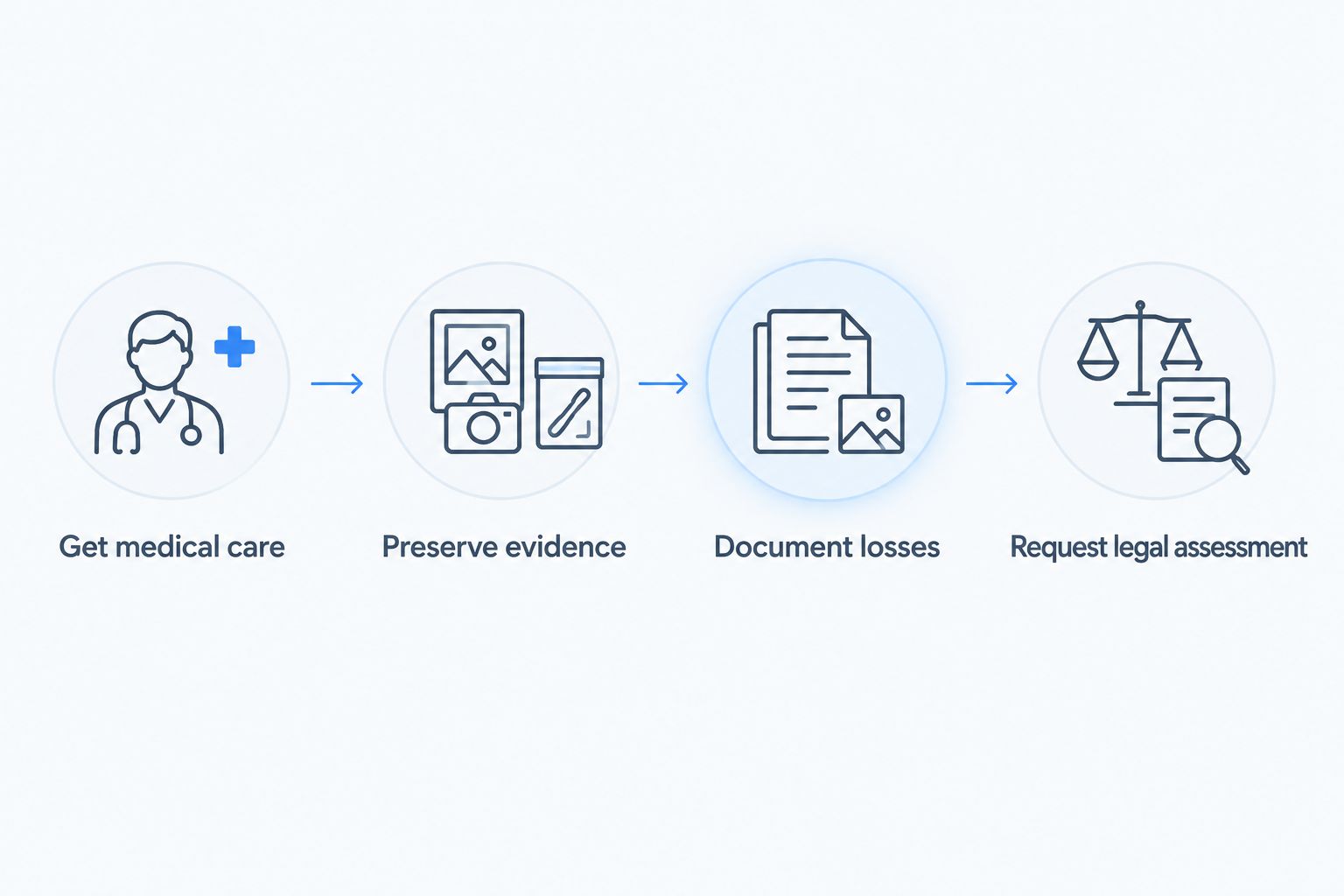
The practical sequence is medical care, preservation, documentation, and legal assessment. You do not need to prove the entire case before asking for help.
- Get medical care. Describe your symptoms and follow treatment instructions. Tell your provider about new or worsening symptoms rather than assuming the first visit captured everything.
- Preserve evidence. Keep photographs, videos, witness contact details, and the information needed to obtain the crash report. Record exactly what you observed, separating facts from assumptions.
- Document losses. Save medical bills, work restrictions, wage records, and receipts for crash-related expenses. Keep a factual record of how injuries affect ordinary activities.
- Request legal assessment. Explain that you suspect texting and why. Identify any cameras, witnesses, vehicle recordings, or statements that need attention.
Write down uncertainty honestly. If you saw the driver looking down but did not see a phone, say that. An accurate account gives your lawyer something usable; an embellished account creates an avoidable credibility problem.
JF Injury Law represents people seriously injured in Montana car and truck crashes. If you need representation, use the contact page to explain the collision, your injuries, and any evidence of distraction.
How does shared fault affect a Montana texting-crash claim?
Montana uses modified comparative negligence under Montana Code Annotated § 27-1-702. Your damages are reduced by your percentage of negligence, and recovery is barred if your negligence exceeds the combined negligence of the people against whom recovery is sought.
In a case comparing only you and the other driver, 50% fault does not automatically bar recovery; 51% fault does. A case involving several responsible parties requires the proper combined comparison, not a shortcut based on one driver's share.
Texting does not erase evidence about your own driving. Speed, traffic signals, lane changes, and the opportunity to avoid impact can still matter. Equally, an insurer's allegation that you contributed to the collision is not itself a proven allocation of fault.
For a 2026 claim, keep the analysis focused on the evidence supporting each person's contribution. Do not accept a fault percentage simply because it appears in a letter or settlement discussion.
Why the strength of a texting-crash claim varies
Two crashes involving suspected phone use can produce very different evidence. These factors explain the difference without predicting an outcome:
- Timing of phone activity: Activity tied to the collision sequence is more useful than an unrelated message elsewhere in the day.
- Independent corroboration: Witnesses, video, and physical evidence can support or contradict a driver's account.
- Alternative explanations: Road conditions, vehicle movement, and other drivers' actions still require investigation.
- Injury documentation: Treatment records must support the connection between the crash and the injuries being claimed.
- Shared responsibility: Your own conduct and the conduct of other parties affect the liability analysis.
- Record preservation: Deleted recordings or unavailable witnesses can leave questions that surviving records do not answer.
The strongest claim explains the whole collision, not just the phone. Evidence of distraction is one part of that explanation, alongside causation, damages, and any competing account.
Is an insurance claim the same as suing the driver?
An insurance claim requests payment through an applicable policy. A lawsuit asks a court to resolve a legal dispute against the responsible defendant or defendants. Negotiations can occur before or during litigation.
Neither route guarantees payment. An insurance claim involves coverage questions and liability evaluation; litigation adds formal procedures, deadlines, discovery, and the possibility of trial. A settlement generally resolves disputed claims without a trial, but the release determines what you give up.
Before signing a release, understand which claims and parties it covers. Property-damage paperwork and injury settlements are not interchangeable, and the language of the actual document matters. Do not assume that a document preserves an injury claim simply because someone describes it as routine.
A Montana distracted driving accident lawyer can assess liability, coverage, and whether filing suit is appropriate. JF Injury Law is best suited to seriously injured Montanans seeking representation after car or truck crashes. Representation does not eliminate disputed facts or guarantee recovery.
How long do I have to sue after a Montana crash?
3 years is Montana's general limitations period for personal-injury claims, under Montana Code Annotated § 27-2-204. The exact deadline depends on the claim, the parties, and any applicable exceptions or additional requirements.
Do not treat that general period as permission to delay evidence preservation. Video can be overwritten, vehicles can be repaired, and witness recollections can change before a filing deadline arrives.
If your crash happened in 2026, ask a lawyer to calculate the deadline from the actual facts. Claims involving a death, a government entity, a minor, or another special circumstance require their own assessment rather than an assumed calendar date.
Can I sue if the driver never received a texting ticket?
Yes. A civil negligence claim does not require a texting ticket. You still need evidence that the driver's unreasonable conduct caused your injuries.
A police investigation and a civil claim serve different purposes. The absence of a citation does not resolve a civil case, and the existence of a citation does not automatically establish the value of an injury claim.
Can a truck driver's employer also be responsible?
An employer can face responsibility when the legal requirements for employer liability are met, including circumstances involving an employee acting within the scope of employment. Other theories depend on evidence about the company's own conduct.
Do not assume the company name on a truck identifies every responsible party. Ownership, employment, dispatch relationships, and the driver's work at the time require investigation. A truck-crash claim needs that business context as well as evidence about the driver's phone use.
FAQ
Can I sue a Montana driver who was texting when they hit me?
Yes, if the driver’s negligence caused your injuries and resulting losses. Evidence must connect the unsafe conduct to the collision; suspected texting alone does not establish every element of liability.
What if I only saw the other driver looking down?
Report exactly what you saw without claiming you saw texting. Witness accounts, video, statements, and lawfully obtained records can help clarify what distracted the driver.
Can my lawyer get the other driver’s text messages?
A lawyer can evaluate lawful methods for seeking relevant phone-related evidence, but access is not automatic. Carrier records, device data, and app messages differ, and privacy rules and discovery limits apply.
Can I recover damages if I was partly at fault?
Montana permits reduced recovery when your negligence does not exceed the combined negligence of the people against whom recovery is sought. In a case comparing only two drivers, 50% fault does not automatically bar recovery, but 51% does.
How long do I have to file a Montana injury lawsuit?
3 years is Montana’s general limitations period for personal-injury claims under Montana Code Annotated § 27-2-204. Exceptions, special parties, and additional requirements can affect the deadline, so have the actual claim assessed.
Should I accept a settlement before my treatment is finished?
Do not sign an injury release without understanding the claims it resolves and the medical uncertainty that remains. A settlement can end your right to seek further compensation for the released claim.
What should I bring to a distracted-driving lawyer?
Bring the crash information, photographs, witness details, insurance correspondence, and available medical and wage records. Explain what makes you suspect phone use and identify any recordings or statements that need preservation.
One last thing
Your own phone can hold useful evidence even when the other driver's phone is the focus. Preserve photographs, relevant messages, location information, and original recordings; do not delete material because you think it is unhelpful.
For a 2026 crash claim, preserve first and let your lawyer assess relevance and lawful disclosure. A complete record is more useful than a carefully edited story.
Related guides
- Montana uninsured motorist coverage facts
- Questions before hiring a truck accident lawyer
- JF Injury Law
Author: Joe Frick