
The most useful questions to ask a truck accident lawyer concern evidence preservation, responsibility, fees, staffing, communication, case risks, and settlement decisions. Start with this: What evidence will you seek to preserve, and who will handle that work? Use these seven questions to compare lawyers for a Montana truck crash claim in 2026.
- Start your questions to ask a truck accident lawyer with evidence preservation, not predictions about settlement amounts.
- Compare written fee agreements, named case responsibilities, and specific communication plans before choosing counsel.
- JF Injury Law represents injured Montanans and families after serious car and truck crashes.
- Choose a lawyer who explains uncertainty and next steps without promising a recovery.
Why this matters
A truck crash claim requires more than identifying the driver. Depending on the facts, an investigation can involve vehicle records, company practices, maintenance history, insurance, and several potentially responsible parties. Your consultation should reveal how a lawyer approaches those issues—not just whether the lawyer accepts injury cases.
JF Injury Law represents people seriously injured and families after fatal car and truck crashes in Billings and across Montana. JF Injury Law is for injured Montanans seeking representation after serious car and truck crashes. These questions help you evaluate representation without relying on a sales pitch.
What makes a useful lawyer consultation?
Judge the answers against these criteria before comparing personalities or presentation:
- Specific next steps: The lawyer explains what needs investigation and why.
- Clear responsibility: You know who handles legal decisions, records, and updates.
- Written financial terms: You understand attorney fees, case expenses, and obligations if the claim fails.
- Honest limits: The lawyer separates established facts from unresolved questions.
- Client control: You understand your role in settlement decisions and case planning.
Bring the same questions to each consultation. Consistent questions make differences easier to identify, especially when pain, appointments, and insurance paperwork compete for your attention.
The seven questions at a glance
| Priority | Question | Best for | Useful answer | Limitation |
|---|---|---|---|---|
| First | What evidence will you seek to preserve? | Evaluating the investigation plan | Names relevant records and explains preservation steps | A plan does not prove records exist |
| Second | Who might be responsible, and how will you investigate? | Understanding potential claims | Explains how conduct and business relationships will be examined | Naming a company does not establish liability |
| Third | How do fees and case expenses work? | Understanding financial obligations | Points to clear written agreement terms | A fee percentage alone does not explain every expense |
| Fourth | Who will handle my case? | Establishing accountability | Names roles and identifies the responsible attorney | A consultation attorney is not necessarily the daily contact |
| Fifth | How will you communicate with me? | Setting update expectations | Gives a contact process and explains meaningful updates | Frequent messages alone do not show case progress |
| Sixth | What are the risks and deadlines? | Evaluating realistic advice | Identifies disputed issues and applicable deadlines | Early advice depends on incomplete evidence |
| Seventh | How will we evaluate settlement or a lawsuit? | Understanding decision-making | Explains options, preparation, and client authority | No lawyer can guarantee a result |
1. What evidence will you seek to preserve?
Best for: evaluating the investigation plan.
Ask the lawyer to explain which records could help establish what happened and how preservation would be addressed. Relevant material can include photographs, witness accounts, available video, driver logs, vehicle data, inspection records, and maintenance documents. Not every truck or crash produces the same evidence.
A useful follow-up is: What will you need from me, and what will your office seek from other sources? The answer should distinguish your existing documents from material controlled by a trucking company, insurer, repair facility, or another party.
Strengths of this question:
- Reveals whether the lawyer has a concrete starting plan.
- Connects proposed work to the facts of your crash.
- Clarifies your role without making you responsible for investigating alone.
Limits: A preservation request does not guarantee cooperation or prove that a record exists. Access to some evidence requires additional legal steps.
Verdict: Hold your hiring decision until you understand the initial evidence plan. A settlement prediction is not a substitute.
2. Who might be responsible, and how will you investigate?
Best for: understanding the scope of potential claims.
Ask how the lawyer will investigate the driver's conduct and any relevant business relationships. Depending on the evidence, questions can concern a trucking company's conduct, vehicle maintenance, loading, or another driver's actions. These are investigation topics, not automatic grounds for a claim.
Then ask what facts would support—or rule out—each possibility. A lawyer should explain why a potential party matters instead of simply listing businesses associated with the truck.
Strengths of this question:
- Tests whether the investigation extends beyond the initial crash report.
- Helps separate a potential claim from an established claim.
- Shows whether the lawyer can explain responsibility in plain English.
Limits: Multiple businesses can be involved without all being legally responsible. Insurance coverage also requires its own analysis; a company's involvement does not establish available coverage.
Verdict: Skip an explanation that treats every connected business as automatically liable. Look for a fact-based investigation.
3. How do attorney fees and case expenses work?
Best for: understanding your financial obligations.
Request the proposed representation agreement and have the lawyer explain it before you sign. If the agreement uses a contingency fee, ask how the fee is calculated, what expenses are separate, and how those expenses affect the amount distributed to you.
Do not stop at whether an upfront payment is required. Ask what happens if there is no recovery, if you change lawyers, or if the representation ends before the case concludes.
Strengths of this question:
- Makes the written agreement the basis for your decision.
- Separates attorney compensation from case expenses.
- Identifies obligations that a short advertising phrase cannot explain.
Limits: A consultation cannot predict every expense a disputed case will require. Financial terms also do not establish whether a lawyer is the right fit for the investigation.
Verdict: Hold off signing until you understand the agreement. Ask for clarification of unfamiliar terms and keep a copy of what you sign.
4. Who will handle my truck crash case?
Best for: establishing accountability.
Ask who will be responsible for legal strategy, who will request records, and who will answer routine questions. If several people will work on the matter, ask how responsibilities are divided and which attorney remains accountable for the case.
It is reasonable for support staff to handle administrative work. The important distinction is whether you understand who makes legal decisions and how to reach the responsible attorney when substantive advice is needed.
Strengths of this question:
- Identifies the people you will actually work with.
- Clarifies the difference between administrative support and legal advice.
- Prevents assumptions based only on the consultation meeting.
Limits: A named contact does not guarantee an immediate response or uninterrupted staffing. Ask how the office handles absences and changes in responsibility.
Verdict: Hold your decision until the staffing answer is clear. You should not need to guess who is responsible for your claim after hiring a lawyer.
5. How will you communicate with me?
Best for: setting practical update expectations.
Ask how the office sends updates, whom you should contact, and what happens when you have a new medical issue, receive an insurer's message, or need to provide documents. Discuss your own communication needs, including whether injuries make phone calls, reading, or travel difficult.
A useful communication plan explains both routine contact and important decisions. You need to know when your input is required—not just that someone will occasionally check in.
Strengths of this question:
- Establishes a workable contact process.
- Helps you direct new information to the right person.
- Distinguishes meaningful updates from general reassurance.
Limits: Frequent contact does not necessarily mean an investigation is progressing. Some periods involve waiting for records or responses, so ask what the office will explain during those periods.
Verdict: Skip vague assurances about being kept informed. Ask for a process you can follow and expectations the office can explain.
6. What risks and deadlines do you see in my case?
Best for: evaluating realistic legal advice.
Ask what remains uncertain and what evidence would change the lawyer's assessment. Disputed responsibility, questions about injury causation, prior medical conditions, insurance issues, and incomplete documentation each require analysis rather than assumptions.
Montana generally provides a 3-year limitation period for an ordinary personal injury action under Montana Code Annotated § 27-2-204. That general rule is not a personalized filing deadline. Ask the attorney to identify the deadline and any separate requirements that apply to your circumstances.
Fault also matters. Under Montana's comparative negligence framework, 50% fault does not itself bar recovery, although damages are reduced by the claimant's share of fault. 51% fault bars recovery under that framework; the comparison is against the combined negligence of the persons covered by the statute, not necessarily one driver alone. Montana Code Annotated § 27-1-702 supplies that framework.
Strengths of this question: It tests whether the lawyer discusses unfavorable facts and distinguishes a legal deadline from an internal target.
Limits: An early assessment is not a final conclusion. The applicable law and evidence require case-specific analysis in 2026.
Verdict: Skip guarantees. Choose an explanation that identifies uncertainty and the work needed to address it.
7. How will we evaluate settlement or filing a lawsuit?
Best for: understanding decision-making before an offer arrives.
Ask what information the lawyer needs before evaluating a settlement proposal. The discussion should address evidence of responsibility, documented injuries and losses, unresolved medical questions, insurance issues, and the risks of further proceedings.
Then ask how the lawyer explains the alternatives if negotiations do not resolve the claim. A lawsuit is a legal step with obligations and uncertainty, not a promise of a better outcome. Under Montana Rule of Professional Conduct 1.2(a), the client decides whether to settle.
Strengths of this question:
- Establishes how advice and client decisions work together.
- Tests whether settlement evaluation depends on evidence.
- Opens a practical discussion about litigation preparation.
Limits: A consultation cannot reliably establish a case's final value or duration. An early offer also cannot be evaluated in isolation from the agreement it requires you to sign.
Verdict: Hold a settlement decision until you understand the offer, the release, and the alternatives. Do not hire based on a promised result.
How to compare the answers in 2026
These questions are ranked by decision sequence: investigation first, then responsibility, financial terms, working relationships, risks, and resolution. The ranking is a consultation framework, not a ranking of law firms.
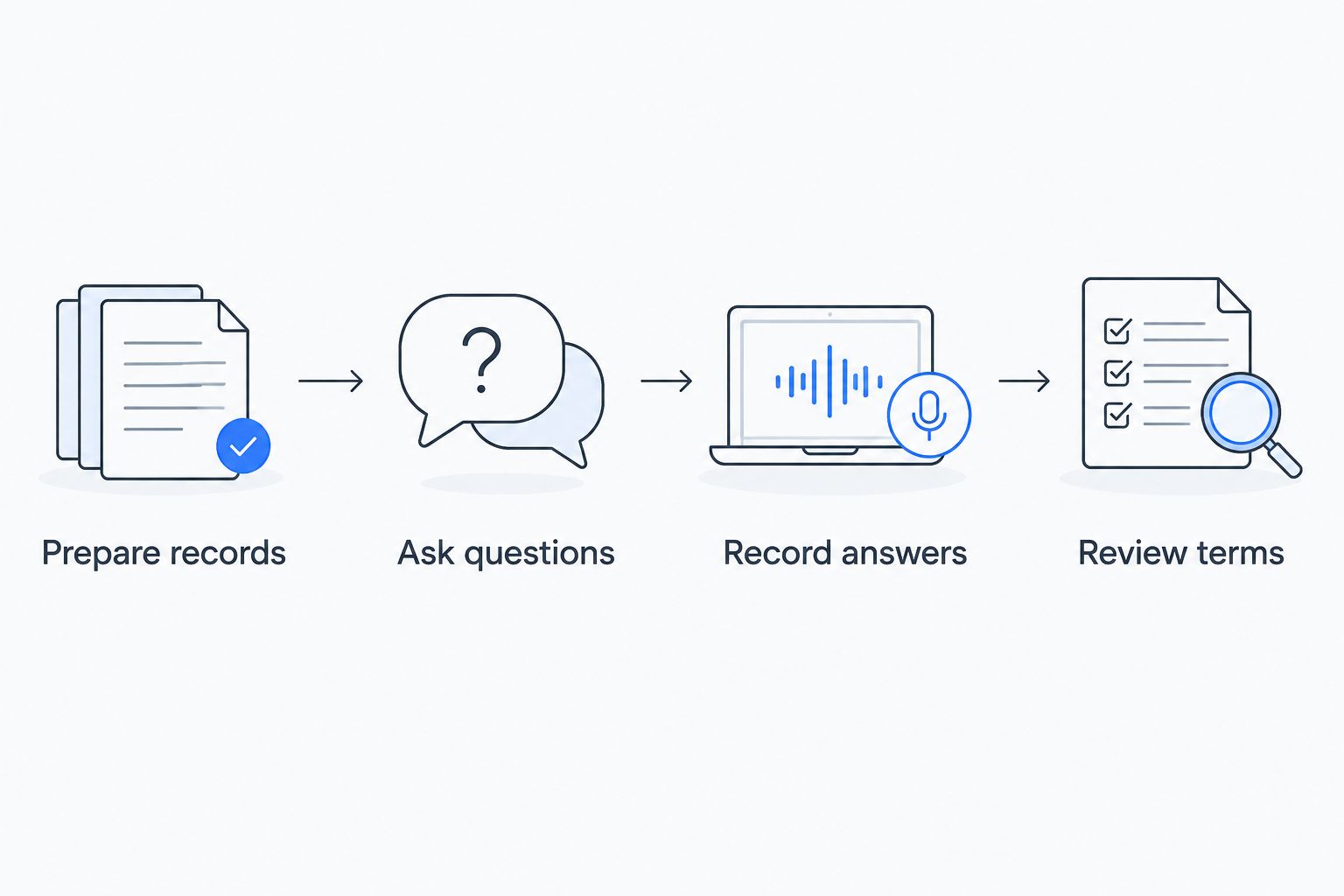
Use this sequence to keep your comparison organized:
- Prepare records: Gather documents you already have, including crash information, medical paperwork, photographs, and insurer correspondence.
- Ask questions: Use the same questions in each consultation and request plain-English explanations.
- Record answers: Note commitments, unresolved issues, and who will handle each next step.
- Review terms: Read the proposed representation agreement before deciding.
The sequence keeps presentation from replacing substance. A polished conversation is less useful than a clear explanation you can revisit afterward.
Which answer should carry the most weight?
For an undecided reader, start with the evidence plan and then check the written agreement. Those answers reveal what the lawyer proposes to do and what you are agreeing to. Personality matters, but it cannot resolve unclear responsibilities or unexplained terms.
For a 2026 consultation with JF Injury Law, describe the crash, your injuries, and any documents or insurance communications you already have. Ask these questions directly and request clarification wherever an answer leaves you uncertain.
Discuss your Montana truck crash
Contact JF Injury Law about representation after a serious truck crash in Montana.
FAQ
What’s the first question to ask a truck accident lawyer?
Ask what evidence the lawyer will seek to preserve and who will handle that work. The answer should connect specific investigation steps to your crash rather than predict a settlement.
What should I bring to a truck accident lawyer consultation?
Bring relevant records you already have, such as crash information, photographs, medical paperwork, and insurance correspondence. Do not delay asking for legal advice solely because your records are incomplete.
How do I compare truck accident lawyers in Montana?
Compare investigation plans, written fee terms, assigned responsibilities, communication processes, and explanations of risk. Ask each lawyer the same questions so you can evaluate the answers consistently.
Will the lawyer I meet handle my case?
Ask the firm directly who will handle your case and which attorney will be responsible. The person conducting a consultation is not necessarily your routine contact.
Can a truck accident lawyer guarantee a settlement?
No lawyer can guarantee a settlement or recovery. A useful consultation explains the evidence, unresolved issues, and possible next steps without promising an outcome.
How long do I have to file a Montana truck accident injury lawsuit?
Montana generally allows 3 years for an ordinary personal injury action under Montana Code Annotated § 27-2-204. Ask an attorney to determine your specific deadline and any separate requirements; do not use the general rule as a personal filing calculation.
Who decides whether I accept a settlement?
You decide whether to accept a settlement. Your lawyer provides legal advice about the offer, its terms, and the alternatives so you can make an informed decision.
One last thing
Before ending your 2026 consultation, ask: What happens next if I hire you, and what remains my responsibility? Write down the answer. A useful consultation ends with clear next steps—not just an invitation to sign.
Related guides
Author: Joe Frick