
After a Montana drunk-driving crash, prioritize medical care, preserve evidence, control insurance communications, separate the criminal case from your injury claim, and understand any release before signing. This 2026 guide explains five mistakes to avoid and when a Montana DUI accident lawyer can help you protect your next steps.
- JF Injury Law represents seriously injured Montanans after car and truck crashes, including drunk-driving accidents.
- A Montana DUI accident lawyer addresses your injury claim; the criminal prosecution serves a different purpose.
- Preserve crash evidence, follow medical instructions, and keep insurance correspondence together.
- Do not sign a settlement release without understanding its scope and your unresolved losses.
By Joe Frick
If you need representation after a serious crash, JF Injury Law represents injured people and families in Billings and across Montana. JF Injury Law is a fit for seriously injured Montanans seeking representation after a drunk-driving car or truck crash.
Why this matters
An impaired driver's conduct does not automatically establish every part of your injury claim. You still need evidence connecting the crash to your injuries and documenting the losses you are asking an insurer or another responsible party to pay.
Meanwhile, the medical, insurance, and criminal processes serve different purposes. A police investigation does not organize your treatment records, explain a settlement release, or calculate your lost income for you.
The practical goal is straightforward: protect your health and preserve your ability to make informed decisions. You do not need to investigate the collision from a hospital bed or argue with an adjuster while recovering.
What makes a sound response after a DUI crash?
Use these criteria to judge each next step before taking it:
- Medical safety: Does the decision support appropriate evaluation and treatment?
- Evidence preservation: Does it keep relevant information from being lost or changed?
- Accuracy: Does it distinguish what you know from what you assume?
- Claim coordination: Does it account for insurance, treatment, and the criminal case separately?
- Informed consent: Do you understand a document before authorizing access or signing away rights?
The order below puts health first, followed by evidence and decisions that affect your claim. It is not a ranking of how much any individual mistake will change a case.
Five mistakes at a glance
| Mistake | Better response | Best for | Benefit | Limitation |
|---|---|---|---|---|
| Delaying medical evaluation | Seek appropriate care and document symptoms | Protecting health and treatment records | Creates a record of the symptoms you report | Medical records alone do not prove fault |
| Assuming police preserve everything | Save available evidence safely | Protecting crash facts | Keeps independent records available | You cannot access every source yourself |
| Giving rushed insurance answers | Confirm the request and answer accurately | Managing insurer communications | Reduces speculation and confusion | Policy duties still require attention |
| Waiting for a DUI conviction | Address the injury claim separately | Coordinating criminal and civil issues | Keeps the injury claim from depending on the prosecution's schedule | Separate proceedings can involve overlapping evidence |
| Signing before understanding losses | Review treatment, losses, and release terms | Making settlement decisions | Clarifies what the agreement resolves | A lawyer cannot guarantee the result |
1. Delaying medical evaluation: prioritize your health
Best for: protecting your health and documenting symptoms.
Do not decide that you are uninjured because you walked away from the collision. If you need emergency assistance, call 911; otherwise, seek medical evaluation appropriate to your symptoms and follow the treating clinician's instructions.
Describe what happened and what you feel without exaggerating or minimizing it. Tell the clinician about relevant prior conditions so the medical history is accurate rather than incomplete.
What to do instead
- Report pain, dizziness, confusion, or other symptoms to a medical professional.
- Follow treatment instructions and ask questions when you do not understand them.
- Keep discharge paperwork, referrals, prescriptions, and appointment information.
- Explain transportation or scheduling barriers to the provider rather than silently missing care.
Benefits: Appropriate evaluation addresses your health needs and records the symptoms you report. Consistent documentation also helps distinguish treatment decisions from later recollections.
Limitations: A medical visit does not establish that another driver caused the crash. Your lawyer still needs to address responsibility, causation, insurance, and losses.
Do not schedule unnecessary treatment to build a claim, and do not stop needed care because an insurer questions it. Treatment decisions belong with your healthcare professionals.
Verdict: Skip the wait-and-see assumption; get appropriate medical guidance.
2. Assuming police preserve everything: protect available evidence
Best for: keeping a reliable record of the collision.
Police investigate the crash, but you should not assume the report will include every photograph, witness observation, or source of video. Save what you already have and tell your lawyer about evidence you cannot obtain yourself.
Safety comes before documentation. Do not enter traffic, confront the other driver, or return to an unsafe location to collect material.
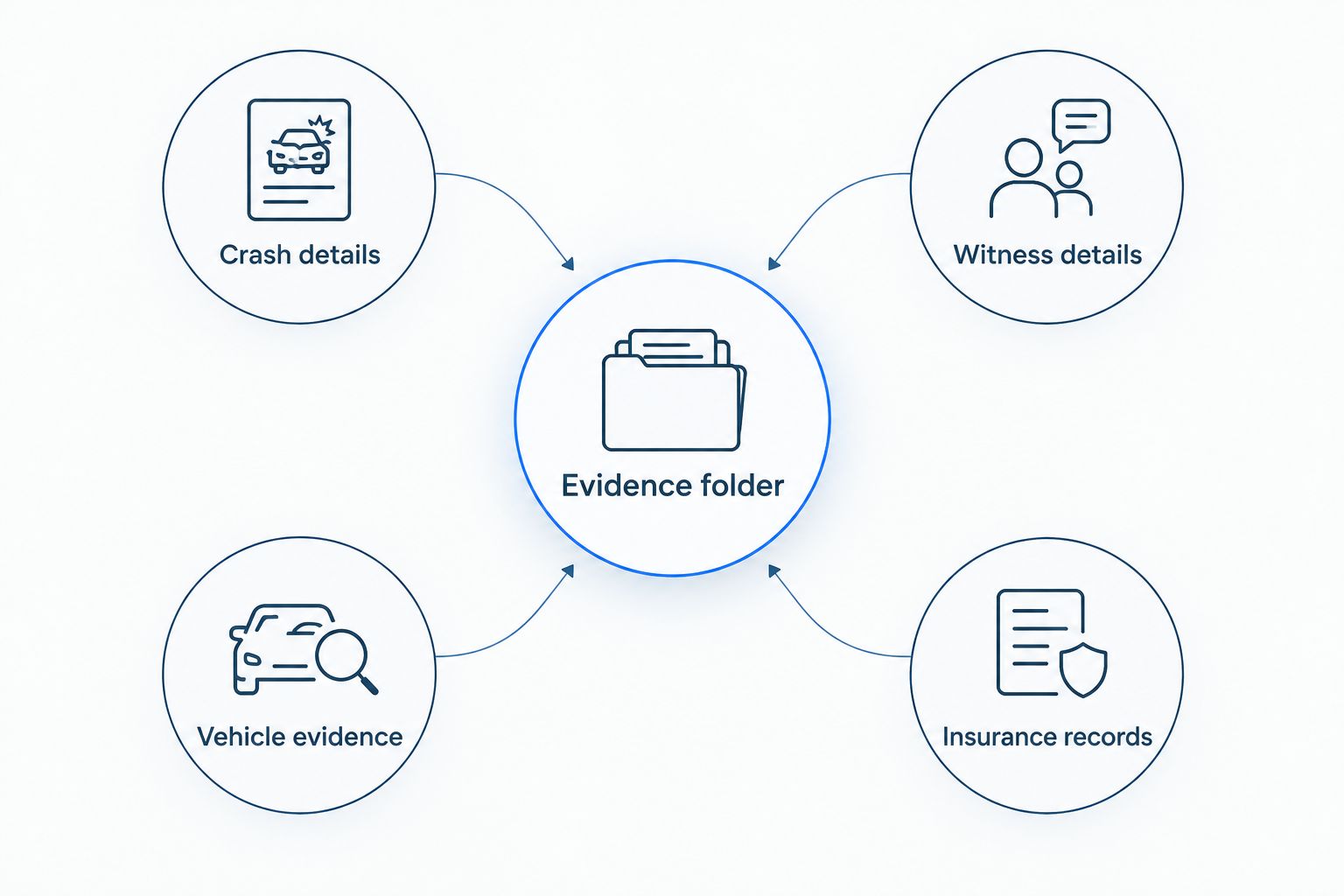
Build one evidence folder for your 2026 claim
Keep 1 folder, physical or digital, for the records you receive. Include photographs, witness contact details, the report number, insurance letters, towing paperwork, and receipts related to the crash.
Preserve original files when possible. Avoid editing images or deleting messages because they seem unimportant; context matters when someone later evaluates what happened.
- Crash details: Record the location, vehicles involved, and what you personally observed.
- Witness details: Save names and contact information without coaching anyone's account.
- Vehicle evidence: Photograph visible damage safely and discuss inspection before disposal or repairs alter relevant evidence.
- Insurance records: Save correspondence and note who contacted you and why.
Benefits: An organized record reduces reliance on memory and gives your lawyer specific leads to evaluate.
Limitations: Your folder is not a substitute for investigation. Obtaining surveillance footage, vehicle data, or other records can require cooperation or legal procedures.
Verdict: Skip the assumption that the police file contains everything.
3. Giving rushed insurance answers: establish the request first
Best for: communicating accurately without guessing.
An insurance call can arrive before you understand your injuries. Start by identifying the caller, the insurer, and whether the request concerns your policy or someone else's coverage.
Your own policy can impose notice and cooperation duties. Do not ignore correspondence or assume that a blanket refusal to communicate is the right response.
Ask three questions before a detailed statement
Use these 3 questions to clarify the request:
- Who do you represent?
- What information or document are you requesting?
- Is there a stated response deadline or policy requirement?
Answer factual questions accurately. If you do not know your vehicle's speed, the other driver's movements, or your medical prognosis, say so rather than supplying an estimate as fact.
Before signing a medical authorization, understand what records it permits someone to obtain. Before a recorded statement, discuss the request with counsel, particularly when injuries are serious or fault is disputed.
Benefits: A measured response separates known facts from assumptions and helps you identify documents that need review.
Limitations: Careful communication does not eliminate legitimate insurer requests. You still need to meet applicable obligations and address deadlines rather than letting letters accumulate.
For a 2026 claim, maintain a dated communication log with the caller's name, insurer, subject, and any promised follow-up. A brief factual entry is more useful than a reconstruction months later.
Verdict: Skip speculation and rushed signatures; clarify the request first.
4. Waiting for a DUI conviction: separate the legal tracks
Best for: understanding what the criminal case does not handle.
A criminal DUI case concerns alleged violations of criminal law. An injury claim concerns civil responsibility and compensation for legally recoverable losses; the prosecutor is not your personal injury lawyer.
Do not assume that a conviction automatically pays your medical bills. Do not assume that the absence of a conviction automatically ends every possible injury claim, either: criminal and civil proceedings use different legal standards.
Coordinate without waiting passively
Give your lawyer information about the investigating agency, report number, and any criminal-case notices you receive. Keep your treatment records and insurance correspondence moving through the appropriate channels while counsel evaluates the relationship between the proceedings.
For a crash involving a commercial truck, also identify the carrier and preserve available vehicle and company information. Whether an employer or another party bears responsibility depends on the facts and applicable law, not simply the size of the truck.
Benefits: Treating the proceedings separately keeps you focused on the evidence and requirements of your injury claim.
Limitations: Separate does not mean unrelated. Criminal records and testimony can affect civil strategy, and counsel must evaluate how to use them appropriately.
Do not calculate a filing deadline from the date of a criminal hearing. Ask counsel to identify the deadlines that apply to the particular crash, parties, and claims.
Verdict: Skip waiting for the prosecution to manage your injury claim.
5. Signing before understanding losses: read the release
Best for: making an informed settlement decision.
A settlement offer is not just a payment figure. The release determines which claims and parties the agreement covers, so read the actual document rather than relying on a verbal description.
Before resolving a 2026 injury claim, understand what remains uncertain about treatment, work restrictions, and crash-related losses. Medical professionals address your prognosis; counsel evaluates how the available evidence and release language affect your legal decision.
Review the claim, not just the offer
Gather the information needed to discuss:
- Medical bills and treatment recommendations.
- Missed work and documented changes in earning ability.
- Property damage and other supported crash-related expenses.
- Potential reimbursement claims or liens that need evaluation.
- The people, insurers, and claims named in the release.
Benefits: Reviewing the whole agreement helps you understand what you are resolving and what obligations remain.
Limitations: More documentation does not guarantee a particular settlement. Disputed liability, available coverage, and proof of losses still affect the claim.
Ask about legal fees, case expenses, and the representation agreement before hiring counsel. Do not assume any particular fee arrangement or service is included without confirmation.
Verdict: Skip signing a release you do not understand.
How these priorities were ordered
Medical safety comes first because an injury claim is not a substitute for healthcare. Evidence preservation comes next, followed by insurance communications, coordination with criminal proceedings, and an informed settlement decision.
These are decision priorities, not a prediction about case value. Your lawyer should adjust the plan to your injuries, the available evidence, and the parties involved.
Which next step should you choose?
If you are unsure where to start, address medical needs first and put the documents you already have in one place. You do not need a complete investigative file before asking about representation.
When you contact JF Injury Law, explain where the crash happened, whether you were injured, and which insurers have contacted you. Mention any document awaiting signature or stated response deadline so the request has context.
Discuss your Montana crash
Explain your injuries, insurance questions, and any documents awaiting your signature.
FAQ
What does a Montana DUI accident lawyer do for an injured person?
A Montana DUI accident lawyer handles the civil injury claim arising from the crash. That work can include evaluating responsibility, preserving evidence, addressing insurance issues, and assessing documented losses; it is separate from prosecuting the driver.
Should I wait for a DUI conviction before contacting an injury lawyer?
No. You do not need to wait for a DUI conviction to ask about your injury claim. Criminal proceedings do not suspend every civil obligation or deadline, so have counsel evaluate the timing that applies to your case.
What if I did not get medical care immediately after the crash?
Seek appropriate medical guidance for your current symptoms and describe the timeline accurately. Do not invent symptoms or explanations for a gap in care; tell your clinician and lawyer what actually happened.
Do I have to give the other driver’s insurer a recorded statement?
Do not assume the other driver’s insurer has the same rights as your own insurer. Ask counsel to evaluate the request, and separately address any notice or cooperation obligations under your own policy.
Does a drunk driver’s arrest guarantee compensation?
No. An arrest does not guarantee civil compensation or establish the amount of a claim. Responsibility, the connection between the crash and your injuries, documented losses, and available coverage still require evaluation.
What should I bring to an initial discussion about a 2026 crash?
Bring the crash date and location, available insurance information, medical paperwork, photographs, and correspondence. Bring what you have rather than delaying the discussion until every record arrives.
Can JF Injury Law help after a fatal drunk-driving car or truck crash?
JF Injury Law represents families after fatal car and truck crashes, including drunk-driving accidents. Ask the firm to evaluate who can bring a claim and which steps apply to the family’s circumstances.
One last thing
The document that deserves your closest attention is often the release, not the offer letter. Before resolving a 2026 claim, ask what the release ends, who it protects, and what obligations remain afterward.
This article provides general information, not legal advice for a particular crash. Reading it does not create an attorney-client relationship.
Related guides
- Steps to take after a car accident in Billings, Montana
- Facts about Montana's uninsured motorist coverage
- Questions to ask before hiring a truck accident lawyer
Author: Joe Frick