
The first priority after a teen driver crash is medical care; the next priorities are preserving evidence, checking insurance, separating fault from assumptions, and protecting your child's claim. This 2026 guide explains when to contact a Montana teen driver accident lawyer and what parents should do before discussing a settlement.
- Seek medical care after a teen driver crash; document symptoms and follow treatment instructions.
- Preserve crash evidence without deleting messages, editing photographs, or coaching your teen’s account.
- A Montana teen driver accident lawyer should examine fault, insurance, and whether the injured teen needs separate representation.
- JF Injury Law represents seriously injured crash victims and families in Billings and across Montana.
By Joe Frick
Why this matters
A teen's age does not establish who caused a crash. An injured teenager can be a driver or passenger, and the evidence—not assumptions about inexperience—must guide the claim.
JF Injury Law represents seriously injured people and families after fatal car and truck crashes in Billings and across Montana. For parents, the immediate task is to protect your child's health while keeping medical, insurance, and legal decisions separate.
You do not need to solve every issue at the roadside. You do need an accurate record and a clear understanding of whose interests each insurer or lawyer represents.
What makes a useful response after a teen driver crash?
Use these criteria to organize decisions rather than treating every request as equally urgent:
- Medical need: Does the action help identify or treat an injury?
- Evidence preservation: Does it protect information that can disappear or change?
- Coverage clarity: Does it identify the policies and reporting requirements involved?
- Independent judgment: Does it distinguish the teenager's interests from everyone else's?
- Lasting consequences: Does it prevent an uninformed release or missed deadline?
These are priorities, not competing services. A parent can arrange treatment while another trusted adult gathers documents and handles practical questions.
The 5 priorities at a glance
Use this 2026 checklist to distinguish an action's purpose from its limits.
| Priority | Best for | Main benefit | Limitation |
|---|---|---|---|
| Medical care | Protecting an injured teen's health | Identifies injuries and creates a treatment record | Medical records alone do not establish crash fault |
| Evidence preservation | Establishing what happened | Retains photographs, messages, witness details, and records | Parents cannot obtain every record themselves |
| Insurance review | Identifying potential coverage | Separates policy questions from fault questions | Coverage depends on the actual policy and facts |
| Fault and representation review | Addressing competing accounts or interests | Examines conduct and identifies conflicts | A preliminary account is not a final liability decision |
| Claim planning | Avoiding uninformed settlement decisions | Coordinates deadlines, records, and future needs | Legal planning does not guarantee recovery |
1. Medical care: best for protecting your teen's health
Get appropriate medical attention before trying to build a legal case. Call 911 for an emergency, follow emergency responders' instructions, and tell treating clinicians about symptoms and how the collision happened.
A teenager who seems composed at the scene can still need evaluation. Do not ask your child to minimize symptoms to avoid missing school, sports, or work; give clinicians accurate information and let them decide what care is appropriate.
What parents should do
Keep discharge instructions, appointment details, medication information, and referrals together. Record when symptoms appear or change, using your teen's own description rather than a diagnosis you have inferred.
Tell the treating clinician about relevant health history. Distinguishing an existing condition from a new injury or aggravation requires an accurate medical record, not an attempt to leave inconvenient facts out.
Medical care benefits:
- Gives clinicians the information needed to assess injuries.
- Creates a record of symptoms, treatment, and restrictions.
- Helps parents coordinate school and activity accommodations.
Medical care limits:
- An emergency visit does not necessarily complete treatment.
- A diagnosis does not establish which driver caused the crash.
Best for: Any teen with injuries or symptoms after a collision.
Verdict: Act on medical needs first; do not postpone care while waiting for an insurance decision.
2. Evidence preservation: best for establishing what happened
Crash evidence includes more than vehicle damage. Road conditions, traffic controls, witness observations, messages, and the sequence of events can help explain why a collision occurred.
Preserve evidence without changing it. Do not delete embarrassing messages, edit original photographs, or rehearse an account with your teenager.
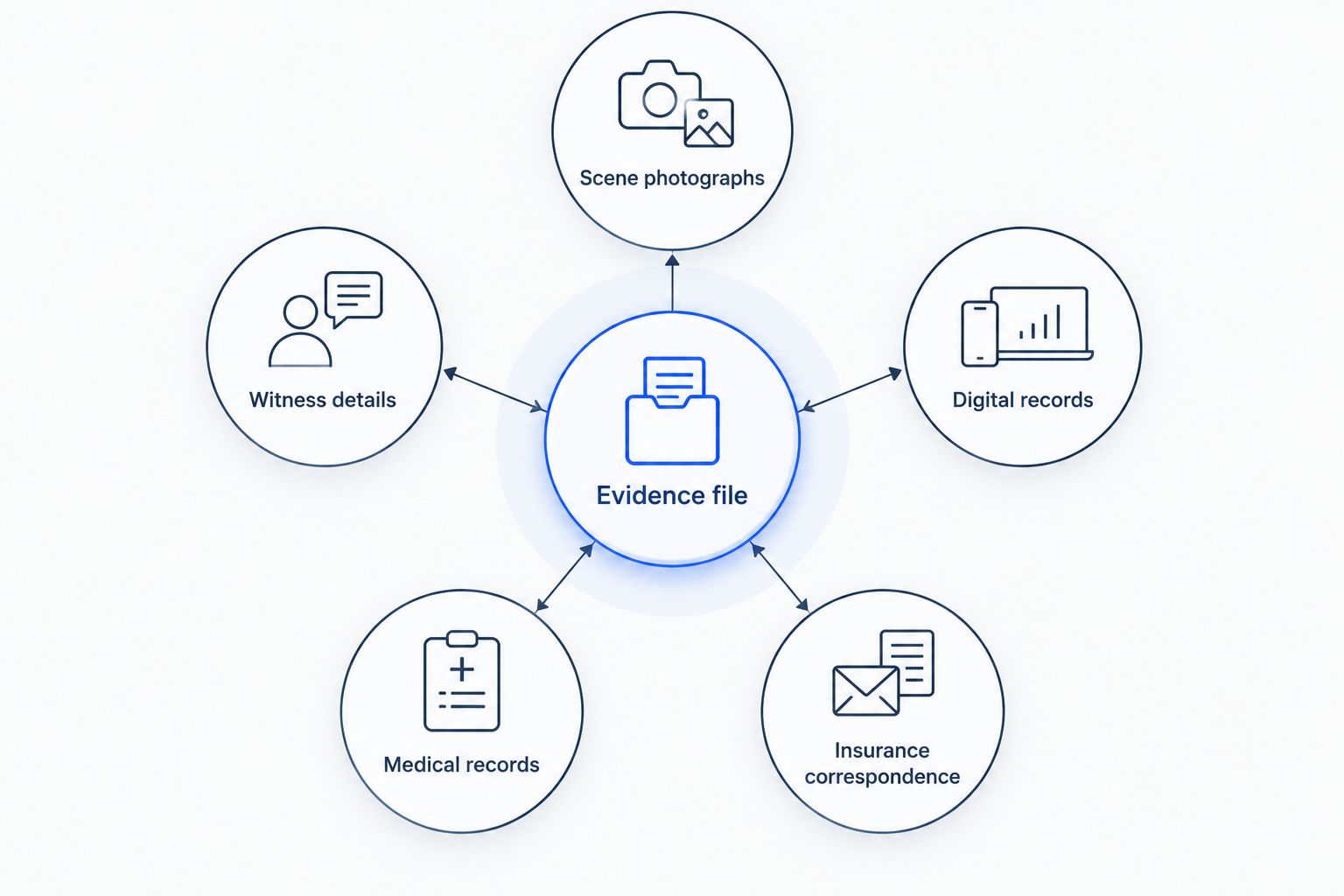
Build a clear evidence file
Organize information under these headings:
- Scene photographs: Save original images of vehicle positions, damage, signs, and road conditions when safely obtained.
- Witness details: Keep names, contact information, and what each person personally observed.
- Digital records: Retain relevant messages, photographs, and other existing electronic material without altering it.
- Medical records: Keep treatment instructions, referrals, bills, and symptom notes.
- Insurance correspondence: Save letters, emails, claim identifiers, and notes identifying who called.
Use those categories to make information retrievable, not to create a polished story. Separate your own observations from information someone else supplied.
If a commercial truck was involved, tell counsel promptly. Records held by a trucking business require a different preservation approach from saving photographs on a family phone.
Evidence preservation benefits:
- Retains details that are difficult to reconstruct later.
- Helps distinguish firsthand observations from assumptions.
- Gives counsel a clearer starting point for investigation.
Evidence preservation limits:
- Photographs capture only part of a collision's circumstances.
- Private records and third-party footage can require legal assistance to obtain.
Best for: Every family, especially when accounts conflict or distraction is suspected.
Verdict: Preserve original material; leave technical conclusions and record requests to qualified professionals.
3. Insurance review: best for understanding potential coverage
The vehicle's owner, the teen's household, and the drivers involved can affect which policies require review. Do not assume that a driver's age automatically removes coverage or that permission to drive resolves every insurance question.
For a crash in 2026, locate the policy documents that applied on the collision date. A current insurance card alone does not describe every coverage term, exclusion, or reporting obligation.
Separate notice from a detailed interview
Report the collision as required by applicable policy terms and provide accurate information. Distinguish your own insurer's contractual requirements from requests made by another driver's insurer.
Before giving a recorded statement, signing a broad medical authorization, or accepting a release, understand what the request covers. Do not guess about speed, distance, injuries, or who had the right of way; say when you do not know.
Ask these practical questions:
- Which insurer and policy does the caller represent?
- What information is being requested, and why?
- Does a document concern vehicle damage, bodily injury, or both?
- What reporting or cooperation requirements apply under your policy?
Insurance review benefits:
- Identifies coverage questions before settlement discussions.
- Keeps vehicle-damage issues distinct from injury issues.
- Creates a record of communications and requests.
Insurance review limits:
- A claim number is not confirmation that every loss is covered.
- An adjuster's explanation does not replace reading the policy.
Best for: Families receiving insurer calls, coverage questions, or settlement paperwork.
Verdict: Give accurate notice, keep records, and understand a document before signing it.
4. Fault and representation: best for avoiding assumptions
A teen driver's involvement does not make the teen responsible. Examine each driver's actions, traffic controls, sightlines, vehicle movements, and available evidence.
Montana's comparative-negligence rules can reduce damages for a claimant's share of responsibility and can bar recovery under the applicable threshold. Montana Code Annotated section 27-1-702 governs that comparison; applying it requires the actual facts and parties involved.
A citation does not answer every civil question
A traffic citation matters, but it does not independently resolve every issue in an injury claim. Likewise, a teenager's apology at the scene is not a substitute for investigating the collision.
Parents should describe facts rather than assign percentages of blame. Preserve any citation or report and have counsel explain its significance alongside the other evidence.
Check for competing interests
An injured passenger's claim can involve the teen driver, another driver, or both. When a parent owns the vehicle or faces a potential claim, the parent's interests and the injured child's interests also need separate attention.
Do not assume that a lawyer assigned to defend a claim represents every family member for every purpose. Ask who the client is and what the representation covers.
Fault and representation review benefits:
- Tests assumptions against evidence.
- Identifies potentially competing interests early.
- Clarifies who is protecting the injured teenager's claim.
Fault and representation review limits:
- Early opinions can change as evidence develops.
- One lawyer cannot represent conflicting interests simply because the people involved are family.
Best for: Disputed-fault crashes, injured passengers, and families with multiple people involved.
Verdict: Separate family relationships from legal interests, and investigate before accepting blame.
5. Claim planning: best for avoiding an uninformed settlement
A settlement decision should account for the injury's documented effects, not just bills already received. Ask treating clinicians about recommended follow-up and restrictions, and keep records of missed school, missed work, and help your teen needs because of the injury.
Do not treat a release as routine paperwork. Its terms can end claims even when a family later learns more about an injury.
Confirm deadlines and authority
Montana generally provides a 3-year limitations period for personal-injury actions under Montana Code Annotated section 27-2-204. Minority and other circumstances can affect the analysis, and separate notice requirements can apply to particular defendants.
Montana generally treats a person under 18 years old as a minor. Do not assume that being a parent gives you unrestricted authority to finalize an injured minor's settlement; ask counsel about the required process and any court involvement.
For a collision occurring in 2026, have counsel identify the relevant dates from the specific facts. Do not calculate a deadline from an online article or assume a child's age extends every claim or obligation.
Bring useful information to a consultation
Prepare the collision date, location, available report details, medical information, insurance correspondence, and any proposed release. Explain whether your teen was driving or riding and whether anyone else in the household was involved.
Claim planning benefits:
- Connects legal decisions to documented medical needs.
- Identifies deadlines and settlement-approval questions.
- Helps parents ask focused questions about representation.
Claim planning limits:
- No lawyer can promise an outcome or settlement amount.
- An initial consultation does not establish every fact or resolve every coverage issue.
Best for: Serious injuries, ongoing treatment, disputed liability, or settlement offers.
Verdict: Understand the medical picture, deadlines, and release before deciding whether to settle.
Discuss your teen’s crash
Contact JF Injury Law about representation after a serious Montana car or truck crash.
How these priorities are ordered
Medical needs come first because health decisions should not wait for a liability investigation. Evidence preservation follows because records support later insurance and legal decisions; coverage, fault, and settlement planning then require increasingly case-specific analysis.
This is an action sequence, not a ranking of law firms. JF Injury Law represents seriously injured Montana car and truck crash victims and families seeking representation.
Which action should parents take now?
Address immediate medical needs, then organize the records you already have. If an insurer has requested a statement or release, put that request with your claim documents and get advice about its scope before responding substantively.
Choose counsel based on the injury claim, relevant experience, and clarity about representation—not a promise of recovery. Ask who will represent your teen, how communication works, and how fees and expenses are handled.
FAQ
When should I contact a Montana teen driver accident lawyer?
Contact a Montana teen driver accident lawyer when your child has serious injuries, fault is disputed, or an insurer requests a release you do not understand. JF Injury Law represents seriously injured people and families after Montana car and truck crashes.
Is my teenager automatically at fault because they are a new driver?
No. Fault depends on the drivers’ conduct and the collision evidence, not simply the teenager’s age or driving experience.
Am I automatically responsible because my teen caused a crash?
No single rule makes every parent responsible for every crash involving a teenager. Vehicle ownership, permission, licensing-related obligations, insurance terms, and the specific conduct involved require individual legal analysis.
Should my teen give the other driver’s insurer a recorded statement?
Understand the request and obtain advice before agreeing to a recorded statement for another driver’s insurer. Your own policy can impose different reporting and cooperation duties, so do not treat all insurer requests as identical.
Can an injured teenage passenger bring a claim?
An injured teenage passenger can have a claim against a legally responsible driver. When a friend or family member was driving, ask counsel to identify potential conflicts and explain who represents the passenger.
How long do we have to bring a Montana injury claim in 2026?
Montana generally has a 3-year limitations period for personal-injury actions, but a minor’s age and other circumstances can change the analysis. Have counsel determine the applicable deadline and any separate notice requirements for the specific collision.
Can I accept a settlement for my child?
Do not assume parental status alone authorizes you to finalize a minor’s injury settlement. Ask counsel about settlement authority, any required court involvement, and the claims the release would end.
One last thing
Save the envelope as well as the letter. Keep insurer correspondence in its original form, including attachments and delivery details, so counsel can see exactly what was requested and when.
You do not need a perfect file before asking for help. Bring what you have and identify what remains uncertain.