
Your first priority after a Montana drunk-driving crash is protecting the injury claim—not waiting for the criminal case to finish. These six laws explain impairment, civil responsibility, shared fault, alcohol-provider liability, fatal-crash claims, and filing deadlines. JF Injury Law represents seriously injured people and families after fatal crashes in Billings and across Montana; this 2026 guide explains what to discuss with a Montana drunk driving accident lawyer.
- JF Injury Law represents injured Montanans and families after fatal car and truck crashes, including drunk-driving accidents.
- A Montana drunk driving accident lawyer addresses civil compensation separately from the driver’s criminal prosecution.
- Montana’s general personal-injury deadline is 3 years, but alcohol-provider claims have separate requirements.
- Preserve crash evidence and insurance correspondence before making settlement decisions.
Why this matters
A DUI prosecution and an injury claim serve different purposes. Prosecutors pursue criminal charges; an injured person seeks compensation through insurance negotiations or a civil lawsuit. A criminal case does not replace your injury claim or automatically resolve medical expenses, lost income, and other losses.
For a 2026 crash claim, start by organizing medical care, evidence, insurance information, and deadlines. The steps to take after a car accident in Billings provide a starting point while you arrange advice about your circumstances.
JF Injury Law represents people seeking legal help after serious Montana drunk-driving accidents. Whether representation fits your case requires a discussion of the crash, injuries, available evidence, and potential insurance coverage.
What matters most when applying these laws
The most useful legal analysis answers practical questions rather than listing criminal penalties. Use these criteria when discussing your claim:
- Responsibility: What evidence connects the driver's conduct to the collision?
- Injury documentation: Which records connect your injuries and losses to the crash?
- Potential defendants: Does the evidence support investigating anyone beyond the driver?
- Fault allocation: Is an insurer claiming your conduct contributed to the collision?
- Deadlines: Which filing and notice requirements apply to each potential claim?
The order below reflects those decisions. It is not a ranking of which statute carries the greatest legal importance.
Six Montana DUI accident laws at a glance
| Law or legal rule | Best for understanding | What it establishes | Key limitation |
|---|---|---|---|
| DUI law | Evidence of impairment | Prohibits impaired driving and specified alcohol concentrations | A charge alone does not establish the value of an injury claim |
| Civil negligence | Compensation claims | Requires analysis of responsibility, causation, and damages | A serious injury alone does not prove another person's liability |
| Comparative negligence | Shared-fault disputes | Reduces or bars recovery according to the applicable fault allocation | An insurer's proposed percentage is not a court ruling |
| Alcohol-provider liability | Investigating service of alcohol | Allows claims against providers under specified conditions | Serving alcohol before a crash does not automatically create liability |
| Wrongful death and survival | Fatal car and truck crashes | Provides distinct civil claims following a death | Claim ownership and recoverable losses require separate analysis |
| Limitation periods | Protecting the right to sue | Sets deadlines for commencing legal action | Different claims and exceptions require individual calculation |
1. Montana DUI law: understand what impairment evidence proves
Best for: Understanding the role of the driver's alcohol use.
Montana Code Annotated § 61-8-1002 prohibits driving under the influence and includes an alcohol-concentration threshold of 0.08% for the ordinary adult per se alcohol offense. Separate rules apply to commercial driving and drivers under the legal drinking age. Impairment also matters independently of whether a test reaches the ordinary adult threshold.
For your civil claim, useful evidence includes officer observations, witness accounts, available recordings, and lawfully obtained alcohol-testing records. Write down what you personally observed, but distinguish observation from assumption. Reporting that you smelled alcohol is different from claiming to know someone's blood-alcohol concentration.
What this helps establish: Evidence of alcohol impairment can support the explanation for unsafe driving.
What it does not establish: A DUI arrest does not automatically prove every disputed fact, identify all responsible parties, or calculate your damages.
A commercial-truck crash also requires attention to the driver's employment, vehicle ownership, and relevant business records. Do not treat a truck collision as only a criminal traffic matter.
Next move: Preserve what you know about impairment without guessing about test results.
2. Civil negligence: separate compensation from criminal punishment
Best for: Understanding why an injury claim proceeds separately.
Montana's general responsibility rule appears in MCA § 27-1-701. In a negligence claim, the central questions concern duty, breach, causation, and damages: what the defendant should have done, what happened instead, whether that conduct caused harm, and what losses resulted.
Civil negligence generally uses a preponderance-of-the-evidence standard, rather than the criminal standard of proof beyond a reasonable doubt. A conviction is therefore not a prerequisite to investigating or pursuing a civil injury claim. The civil evidence still needs to establish the claim.
For a 2026 claim, organize records by the question each record answers:
- Crash responsibility: Photographs, witness information, recordings, and the collision report.
- Injury connection: Treatment records, diagnoses, symptoms, and medical history relevant to the disputed injury.
- Financial loss: Bills, wage records, and documentation of other claimed expenses.
- Daily consequences: Specific changes to work, movement, sleep, and ordinary activities.
Strength: Civil proceedings address losses that a criminal prosecution does not automatically compensate.
Limitation: The driver's intoxication does not replace proof that the crash caused the losses claimed.
Next move: Document both how the collision happened and how the injuries affect your life.
3. Comparative negligence: challenge unsupported fault allegations
Best for: Understanding an insurer's argument that you share responsibility.
MCA § 27-1-702 governs Montana's modified comparative-negligence rule. An injured person's negligence reduces recoverable damages. Recovery is barred when that person's negligence exceeds the combined negligence of the people against whom recovery is sought.
In practical terms, 50% fault does not automatically bar recovery; more than 50% does under this rule. Applying the rule requires identifying the proper parties and determining how fault is allocated. The insurer's initial position is not the final legal answer.
An impaired driver can still dispute how a crash occurred. Claims about speed, lane position, following distance, or visibility require evidence rather than assumptions about either driver.
Strength: Montana law does not automatically eliminate a claim because an injured person bears some responsibility.
Limitation: A supported finding of comparative negligence reduces damages and can bar recovery.
Ask the insurer to explain the evidence behind any proposed allocation. Preserve communications and avoid agreeing to a percentage before understanding its effect on your claim.
Next move: Treat a fault percentage as a disputed issue to examine, not a number to accept without support.
4. Alcohol-provider liability: investigate more than the driver's conduct
Best for: Understanding whether serving alcohol creates another potential claim.
MCA § 27-1-710 addresses civil liability connected to furnishing alcohol. Montana generally distinguishes consuming alcohol from furnishing it, but the statute recognizes specified circumstances in which a provider can face liability, including certain situations involving underage or visibly intoxicated people.
A bar is not automatically responsible whenever a customer later causes a crash. The circumstances of service, the person's condition, the statutory requirements, and the connection to the injury all matter. The same caution applies before assuming that a private host is legally responsible.
Relevant evidence can include receipts, witness accounts, service records, and available video. Identify the establishment and approximate sequence of events if you know them; do not contact witnesses with a suggested version of what they should say.
Strength: The statute provides a basis to investigate alcohol service when the facts fit its requirements.
Limitation: Alcohol-provider claims have special requirements, including notice and filing provisions. Do not assume the general injury deadline controls every step.
In a 2026 case involving possible alcohol-provider liability, raise that issue during the first legal consultation rather than after negotiations with the driver stall.
Next move: Identify possible alcohol-service evidence and ask counsel to evaluate preservation and notice requirements.
5. Wrongful death and survival: distinguish the claims after a fatal crash
Best for: Families seeking answers after a fatal car or truck collision.
Montana recognizes wrongful-death claims under MCA § 27-1-513 and survival of claims under MCA § 27-1-501. These are related but distinct legal concepts. Wrongful-death claims address losses resulting from the death, while survival claims preserve qualifying claims the deceased person held.
The distinction affects who brings the action, which losses belong in each claim, and how estate administration intersects with litigation. Family relationships alone do not resolve every question about authority to act or entitlement to recovery.
Keep funeral expenses, medical records, employment information, and estate documents organized. A family member can also maintain a list of people who witnessed the collision or knew about its immediate aftermath.
Strength: Montana law provides civil remedies after a fatal collision rather than limiting the response to criminal prosecution.
Limitation: Wrongful-death and survival damages are not interchangeable, and the same loss cannot simply be counted twice.
Families facing a fatal drunk-driving crash should ask who has legal authority to retain counsel and bring each claim. That question deserves a clear answer before anyone signs a settlement release.
Next move: Clarify authority, claim ownership, and the documents needed to investigate the death.
6. Filing deadlines: calculate each claim separately
Best for: Protecting the ability to bring a lawsuit.
MCA § 27-2-204 generally provides a 3-year limitation period for personal-injury and wrongful-death actions. That general rule is a starting point, not a complete deadline calculation. Accrual rules, exceptions, defendant identity, and the type of claim affect the analysis.
An alcohol-provider claim has separate statutory requirements. Claims involving public entities or other special circumstances also require individual attention. Do not assume every potential defendant shares the same deadline.
An open insurance claim is not a filed lawsuit. Ongoing negotiations do not, by themselves, guarantee that the applicable limitation period has stopped running. The criminal court's schedule is also not your civil filing calendar.
Strength: Identifying deadlines early gives you a clear framework for decisions and evidence collection.
Limitation: A general deadline printed in an article cannot account for every fact in an individual case.
For a crash being evaluated in 2026, give counsel the exact collision date, any death date, and all correspondence containing deadline language. Include communications from insurers and potential defendants.
Next move: Obtain a claim-specific deadline assessment instead of counting from a general rule alone.
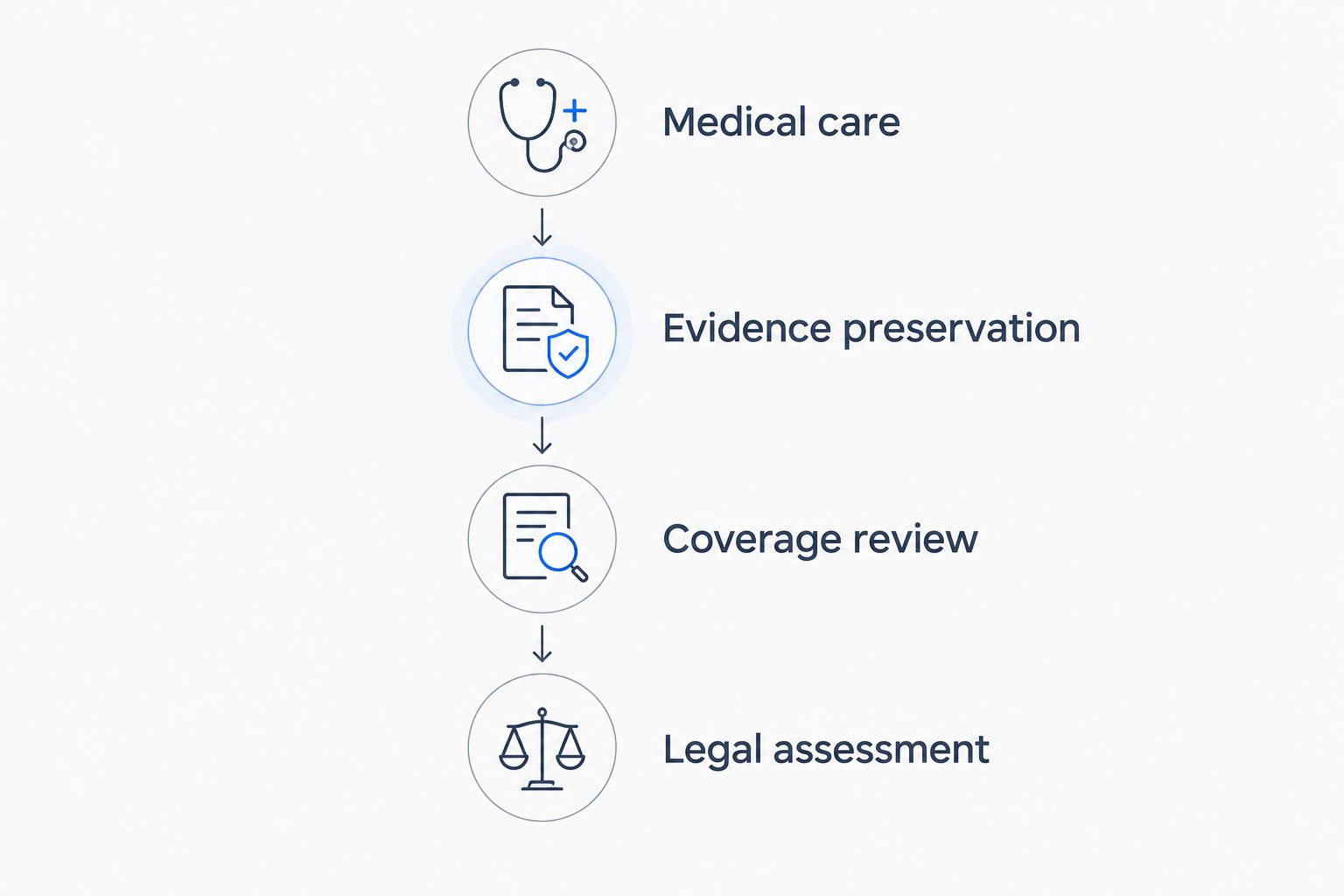
Turn these laws into a practical claim plan
You do not need to solve every legal issue before speaking with counsel. Bring enough information to explain the collision and identify the records that already exist.
- Medical care: Follow medical advice and keep records of symptoms and treatment.
- Evidence preservation: Save photographs, messages, witness details, and insurance correspondence in their original form.
- Coverage review: Gather applicable auto policies and claim numbers without assuming which coverage will pay.
- Legal assessment: Discuss responsibility, additional defendants, authority to act, and deadlines.
Keep property-damage paperwork separate from documents releasing an injury claim. Before signing, ask exactly which claims and parties the document releases.
A consultation with JF Injury Law can begin with the facts you already have. Explain whether the collision involved a car or commercial truck, what injuries occurred, and whether an insurer has requested a statement or signature.
Discuss your Montana crash
Contact JF Injury Law about representation after a serious car or truck crash.
How these six laws were prioritized
These six topics follow the decisions an injured person or family faces: establish what happened, understand the civil claim, address shared fault, investigate other responsible parties, identify fatal-crash claims, and protect filing rights. They are not an exhaustive statement of Montana law. A case-specific assessment must connect each rule to the evidence.
Which issue should you address first?
Start with medical needs, evidence preservation, and a deadline assessment. Do not wait for a DUI conviction before asking how to protect a civil claim. If someone died, clarify legal authority to act; if alcohol service is implicated, identify that issue immediately so counsel can assess its separate requirements.
FAQ
Do I need a Montana drunk driving accident lawyer if the driver was arrested?
An arrest does not resolve your civil injury claim. A Montana drunk driving accident lawyer can evaluate liability, damages, insurance, and deadlines separately from the prosecution.
Can I bring an injury claim before the DUI case ends?
A DUI conviction is not a prerequisite to pursuing a civil injury claim. The criminal and civil cases involve different purposes and proof standards, so discuss timing with counsel rather than waiting automatically.
What if the insurance company says I was partly at fault?
Partial fault does not automatically bar a Montana negligence claim. Under Montana’s modified comparative-negligence rule, recoverable damages are reduced by your negligence, and recovery is barred if your negligence exceeds the combined negligence of those against whom recovery is sought.
Can I sue the bar that served the drunk driver?
An alcohol-provider claim is possible only when the facts satisfy Montana’s statutory requirements. Serving alcohol before a crash is not enough by itself, and special notice and filing requirements apply.
How long do I have to sue after a Montana drunk-driving crash?
Montana generally provides a 3-year limitation period for personal-injury actions. Different claims, accrual rules, and exceptions affect the calculation, so obtain advice about your specific dates and potential defendants.
Who handles a claim when someone dies in a drunk-driving crash?
The authority to bring wrongful-death and survival claims depends on Montana law and the family’s estate circumstances. Counsel should identify the proper claimant or representative before settlement documents are signed.
What should I bring to a consultation about a drunk-driving crash?
Bring the collision date, available crash information, medical records or provider details, photographs, insurance correspondence, and any proposed release. Do not delay asking for advice solely because you lack a complete file.
One last thing
A release deserves as much attention as a settlement offer. The amount on the page does not explain which claims you are surrendering or which parties are being released. Before signing, ask how the document affects unresolved injuries, other potential defendants, and any related fatal-crash claims.
This article provides general legal information, not advice for your individual circumstances. Contact JF Injury Law to discuss representation after a serious Montana car or truck crash.
Related guides
- Mistakes to avoid after a drunk-driving accident in Montana
- Factors affecting a Montana semi-truck accident claim
- Rights after a Montana car accident
Author: Joe Frick