
After a pedestrian crash involving a car or truck in Montana, get emergency help, document what you safely can, and protect your medical and insurance records. This 2026 guide explains seven practical steps and when to contact a Montana pedestrian accident lawyer.
- Call 911 after a pedestrian crash with injuries; medical care comes before gathering evidence.
- Document the vehicle, crossing location, witnesses, and injuries without entering traffic or delaying treatment.
- Keep medical records and insurance communications together before discussing a final settlement.
- JF Injury Law represents seriously injured people after car and truck crashes in Billings, Montana.
Why these steps matter
A pedestrian crash creates two immediate problems: you need medical care, and evidence about the collision needs preserving. You do not have to solve both at the scene. If your injuries prevent you from taking photographs or speaking with witnesses, focus on treatment and ask someone you trust to help later.
JF Injury Law is for seriously injured people seeking representation after car and truck crashes in Billings, Montana. You can learn about JF Injury Law while using the steps below to organize your next decisions.
These are priorities, not a test you must pass to pursue a claim. Missing a photograph or leaving by ambulance does not answer who was responsible for the crash.
What matters most after a pedestrian crash
Use these criteria to decide what deserves your attention first:
- Safety: Nothing you collect is worth another collision or delayed emergency care.
- Accuracy: Record what you observed, not assumptions about speed, distraction, or fault.
- Preservation: Keep original photographs, messages, documents, and damaged belongings.
- Medical continuity: Follow treatment instructions and report changing symptoms.
- Informed decisions: Understand a document before signing it or accepting a settlement.
The seven steps at a glance
The order below puts health before paperwork. Some tasks overlap, and a family member can help with administrative work while you recover.
| Step | Best for | Main benefit | Important limitation |
|---|---|---|---|
| 1. Get emergency help | Immediate safety and treatment | Brings medical and emergency assistance | A call alone does not preserve every detail |
| 2. Document the scene | Recording conditions and vehicle information | Captures details before the scene changes | Never delay treatment to collect evidence |
| 3. Identify witnesses | Preserving independent observations | Gives investigators people to contact | A witness might have seen only part of the event |
| 4. Continue medical care | Documenting injuries and recovery | Connects symptoms, treatment, and restrictions | Medical records do not establish fault alone |
| 5. Organize your records | Tracking losses and communications | Makes documents easier to locate | A folder cannot determine claim value |
| 6. Handle insurance carefully | Preventing avoidable misunderstandings | Keeps requests and responses clear | Your own policy can impose cooperation duties |
| 7. Discuss legal representation | Assessing responsibility and next steps | Provides advice specific to your circumstances | No lawyer can guarantee a recovery |
1. Get emergency help before collecting evidence
Best for: protecting your health immediately after impact. Call 911 if someone is injured or there is an immediate danger. Give the location, describe the collision, and follow the dispatcher's instructions.
Do not stand in a traffic lane to photograph the vehicle or argue with the driver. If you cannot move safely, tell the dispatcher where you are and what hazards surround you. Let emergency personnel direct the response.
Tell medical personnel what happened and describe your symptoms accurately. Include whether you struck your head, lost consciousness, or have difficulty remembering the collision; do not guess when you are unsure.
- Benefit: Emergency assessment addresses immediate medical needs and creates a record of the response.
- Limitation: The first examination is not a substitute for following discharge instructions or reporting new symptoms.
Your next move: prioritize care, even when that means leaving evidence collection to someone else.
2. Document the scene without putting yourself at risk
Best for: preserving visible details before vehicles and people leave. If you are safe and medically able, photograph the vehicle, license plate, crossing location, traffic signals, signs, and surrounding roadway. Take both wider views and closer images so the photographs show context as well as damage.
Record the driver's name, contact information, and insurance information when available. Do not chase a departing vehicle. Give any identifying details you remember to law enforcement instead.
Keep original files from your phone rather than retaining only edited screenshots. For a crash in 2026, label your folder with the actual crash date and location so later appointments and correspondence stay connected to the correct event.
- Benefit: Photographs preserve conditions that a written description can miss.
- Limitation: A photograph captures one view; it does not necessarily establish vehicle speed, signal timing, or fault.
Your next move: preserve what you have, without trying to reconstruct missing details yourself.
3. Identify witnesses and possible video sources
Best for: finding independent information about the collision. Ask willing witnesses for their names and a reliable way to contact them. Note where each person stood and whether they saw the impact, the moments before it, or only the aftermath.
Do not coach anyone or ask them to agree with your version. A short, accurate note about what someone actually observed is more useful than an argument about who should be blamed.
Write down nearby businesses, homes, buses, or vehicles that appeared to have cameras. Tell your lawyer about these possible sources promptly; a camera's presence does not establish that footage exists or that you can obtain it.
If distraction is a concern, distinguish what you saw from what you suspect. The guide to texting and distracted-driving claims in Montana addresses that issue separately.
- Benefit: Independent observations can help clarify a disputed sequence of events.
- Limitation: Witness memories and camera coverage can be incomplete.
Your next move: save contact details and camera locations for follow-up.
4. Continue medical care and document recovery
Best for: keeping your treatment and recovery history accurate. Follow the instructions you receive from treating providers. If a symptom develops or worsens, contact an appropriate medical professional rather than waiting for an insurance discussion to resolve it.
Explain how your injuries affect ordinary activities, including walking, sleeping, lifting, driving, and working. Be specific without exaggerating. If a recommended appointment is difficult because of transportation or another obstacle, tell the provider rather than silently missing it.
Keep appointment summaries, treatment instructions, prescriptions, and work restrictions. In your 2026 recovery notes, separate what you experienced from what a clinician diagnosed; your personal notes support your recollection but do not replace medical records.
- Benefit: Consistent records help explain the course of your injuries and treatment.
- Limitation: A diagnosis documents a medical condition, not every legal issue in an injury claim.
Your next move: follow the treatment plan and make sure providers know about meaningful changes.
5. Organize records of expenses and daily limitations
Best for: keeping the claim's paperwork manageable. Create 3 folders: medical records, expenses and work records, and crash communications. Paper folders or digital folders both work; choose the system you can maintain during recovery.
Save bills, receipts, appointment information, employer correspondence, and written insurance communications. Keep damaged clothing or personal belongings when practical, and photograph their condition before repair or disposal.
Use a dated note to describe limitations in plain language. Recording that you needed help getting to an appointment is more useful than assigning an unsupported dollar value to that inconvenience.
For documents received in 2026, keep the date received alongside any response date stated in the document. Ask for clarification when a request is unclear.
- Benefit: Organized records make it easier to explain expenses, missed work, and practical consequences.
- Limitation: Adding receipts together does not determine the value of an injury claim.
Your next move: preserve the documents now; leave legal valuation for an informed assessment.
6. Handle insurance requests carefully
Best for: understanding what an insurer is asking before you respond. Identify the company, the person contacting you, and whether the company insures you or another party. Ask for the claim number and written confirmation of requests you do not understand.
Give accurate information. Do not guess about distances, vehicle speeds, medical diagnoses, or how long recovery will take. Before providing a recorded statement or signing an authorization, understand its purpose and scope; your own insurance policy can require notice and cooperation.
A settlement release is different from routine claim paperwork. Read it and obtain advice about its effect before signing, especially while treatment or future medical needs remain unresolved.
- Benefit: Clear communication reduces confusion about requests, responses, and outstanding documents.
- Limitation: Avoiding every insurer contact is not a substitute for checking your policy obligations.
Your next move: save the request and seek advice about anything you do not understand.
7. Discuss your case with a Montana pedestrian accident lawyer
Best for: getting advice tailored to the collision and your injuries. A legal consultation should address responsibility, evidence preservation, insurance coverage, applicable deadlines, and the practical work needed to investigate the crash.
Bring the records you already have. You do not need a finished evidence file before asking for help, and you should not postpone medical treatment to assemble one.
JF Injury Law represents seriously injured people and families after fatal car and truck crashes in Billings, Montana. When contacting the firm about a pedestrian collision, explain which vehicle struck you, where the crash happened, and what treatment you have received.
- Benefit: Individual legal advice connects the facts of your collision with the decisions ahead.
- Limitation: Representation cannot guarantee fault findings, insurance coverage, settlement terms, or a recovery.
Your next move: ask who will handle your case, what the agreement requires, and what information is needed first.
Discuss your Montana crash
Tell JF Injury Law where the collision happened, your injuries, and the questions you need answered.
How to use these priorities
These steps are ordered by safety, evidence preservation, and informed decisions—not by how easy each task is to finish. Medical care stays first even when the scene offers an opportunity to collect photographs.
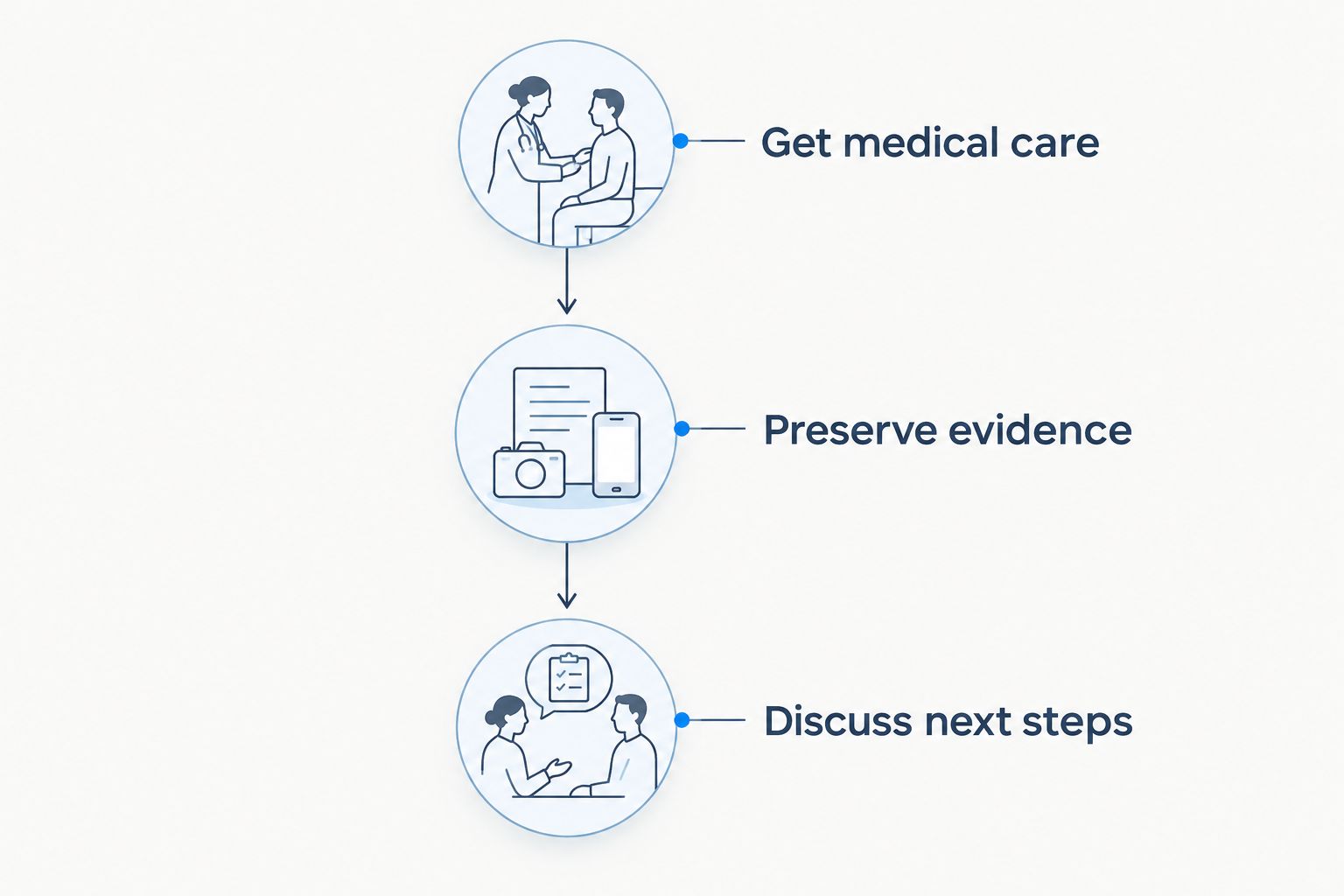
For your 2026 crash file, use this sequence to divide work rather than carry everything yourself:
- Get medical care: Follow emergency and treating-provider instructions.
- Preserve evidence: Ask a trusted person to help save records and contact information.
- Discuss next steps: Bring unresolved questions to an appropriate lawyer.
What should you do first?
Get medical help first, then delegate the paperwork you cannot manage. If the crash has already happened and you missed some steps, start with the records and information still available. Do not fill gaps with guesses.
Choose legal representation based on relevant crash experience, clear communication, and an agreement you understand. A confident prediction about a payout is not a substitute for explaining the evidence and unresolved issues.
FAQ
What should I do first after a pedestrian accident in Montana?
Get to safety if you can and call 911 when someone is injured or there is immediate danger. Follow emergency instructions and do not delay medical care to take photographs.
Do I need a Montana pedestrian accident lawyer if the driver admits fault?
An admission does not resolve every issue in an injury claim. Legal advice can help you assess evidence, insurance coverage, medical documentation, and any settlement documents.
Can I still ask for legal help if I did not take pictures?
Yes. Photographs are only one potential source of evidence; witness information, medical records, reports, and other available materials also deserve attention.
What if I was not in a marked crosswalk?
Being outside a marked crosswalk does not by itself answer every question about responsibility. A lawyer needs to examine the location, signals, movements, and other facts before advising you.
Should I give the driver’s insurance company a recorded statement?
Understand the request and obtain advice before agreeing to a recorded statement. Distinguish the other driver’s insurer from your own insurer, because your policy can impose notice and cooperation obligations.
What should I bring to a pedestrian accident consultation?
Bring available photographs, insurance correspondence, medical information, witness contacts, and any crash report details. Do not delay seeking advice because some documents are missing.
How much does a Montana pedestrian accident lawyer charge?
Ask the lawyer to explain the written fee agreement, responsibility for case expenses, and what happens if there is no recovery. Confirm the terms before signing rather than assuming every firm uses the same arrangement.
One last thing
Keep a separate list of what you do not remember. After a frightening collision, pressure to give a complete account can lead you to fill gaps unintentionally. An honest statement that you did not see the signal change is more accurate than a confident guess.
When you speak with a lawyer, bring that list alongside your documents. Clear limits on your recollection help keep the discussion grounded in evidence.
Related guides
- Steps after a car accident in Billings, Montana
- Montana uninsured motorist coverage
- Questions before hiring a truck accident lawyer
Author: Joe Frick, JF Injury Law.
This article provides general information, not legal advice. Advice about your claim depends on its specific facts.