
The five factors that shape a semi-truck accident claim are fault, preserved evidence, documented injuries, responsible parties and insurance, and legal deadlines. A Montana truck accident lawyer at JF Injury Law can help injured people and families assess those issues after a serious crash in Billings or elsewhere in Montana.
- A Montana truck accident lawyer assesses fault, evidence, injuries, insurance, and deadlines—not just the crash report.
- JF Injury Law represents seriously injured people and families after fatal car and truck crashes in Montana.
- Preserve trucking records early; some federal recordkeeping requirements last only six months.
- Document treatment and work restrictions before considering a final settlement.
Why these factors matter
A semi-truck crash claim involves more than deciding which driver caused the collision. You also need evidence connecting the collision to your injuries, an accurate account of your losses, and a clear picture of who bears legal responsibility.
JF Injury Law is a fit for injured Montanans seeking representation after serious car and truck crashes. Choosing representation should involve questions about evidence preservation, case responsibility, communication, and how the lawyer will evaluate your particular circumstances.
For a crash in 2026, start with the records and decisions you can control. Keep medical appointments, save documents, and get advice before signing a release.
What makes a strong truck accident claim?
Use these criteria to assess the claim, rather than treating vehicle damage or an insurer's initial response as the whole story:
- Provable fault: Evidence identifies the conduct that caused the collision.
- Preserved records: Relevant electronic data, photographs, and trucking documents remain accessible.
- Documented harm: Medical records and employment records support the injuries and losses claimed.
- Identified responsibility: The investigation examines the driver, carrier, and any other potentially responsible parties.
- Protected deadlines: Filing dates and separate notice requirements receive attention before negotiations consume time.
These criteria overlap. A serious injury does not establish another party's fault, and proof of careless driving does not establish the full extent of your losses.
Five claim factors at a glance
The order below is a practical review sequence, not a prediction of which issue will control your case. Evidence preservation and deadline checks should happen alongside the fault investigation.
| Factor | Best for answering | Strongest supporting material | Key limitation |
|---|---|---|---|
| Fault | Who caused the crash? | Scene evidence, witness accounts, vehicle data | An initial report can leave disputed facts unresolved |
| Evidence preservation | What can establish what happened? | Trucking records, video, electronic data | Records have different retention periods |
| Injuries and losses | What harm resulted from the crash? | Treatment records, medical opinions, work documentation | Early records do not always establish future needs |
| Responsible parties and insurance | Who bears responsibility and what coverage applies? | Contracts, ownership records, insurance documents | A business connection alone does not establish liability |
| Deadlines and settlement timing | What action protects the claim? | Incident dates, filing rules, release language | Negotiations do not automatically pause filing deadlines |
1. Fault: best for establishing legal responsibility
A truck accident claim requires evidence of responsibility, not simply evidence that a truck was involved. Investigators examine driving conduct, road conditions, vehicle condition, and the sequence leading to impact.
The truck driver's actions matter, but so do the actions of other motorists. A lane-change collision, for example, requires attention to lane position, signaling, sight lines, and timing—not an assumption that one vehicle's size decides fault.
How Montana's fault rule affects your claim
Under Montana Code Annotated § 27-1-702, an injured person's negligence does not bar recovery if it is not greater than the combined negligence of the people against whom recovery is sought. Recoverable damages are reduced in proportion to the injured person's negligence.
That means 50% fault does not automatically bar recovery under this rule, but greater fault does. Applying the rule requires identifying the proper parties and proving the allocation of responsibility; an insurer's allegation is not a final legal determination.
Fault evidence strengths:
- Independent witnesses can clarify disputed movements.
- Photographs can establish roadway layout and vehicle positions.
- Video or vehicle data can help test competing accounts.
Fault evidence limitations:
- Witnesses do not necessarily see the entire collision.
- A crash report does not replace a full investigation or decide every legal issue.
Best for: Determining whether the evidence supports a claim against another party.
Verdict: Prioritize evidence over assumptions about who caused the crash.
2. Evidence preservation: best for preventing avoidable gaps
Truck accident evidence extends beyond the police report. Relevant material can include driver logs, dispatch communications, inspection records, maintenance documents, onboard video, and electronic vehicle data.
Not every truck has every type of recording system, and not every record will matter to your case. A preservation request should identify the vehicles, parties, records, and time periods connected to the collision.
Why retention periods matter
Federal regulation 49 CFR § 395.8(k)(1) generally requires motor carriers to retain drivers' records of duty status and supporting documents for six months. That retention requirement is not a promise that every useful trucking record remains accessible for the same period.
For a 2026 crash, do not treat an ordinary records-retention period as your investigation schedule. A lawyer can assess preservation requests and the legal steps needed to seek records from the people or businesses controlling them.
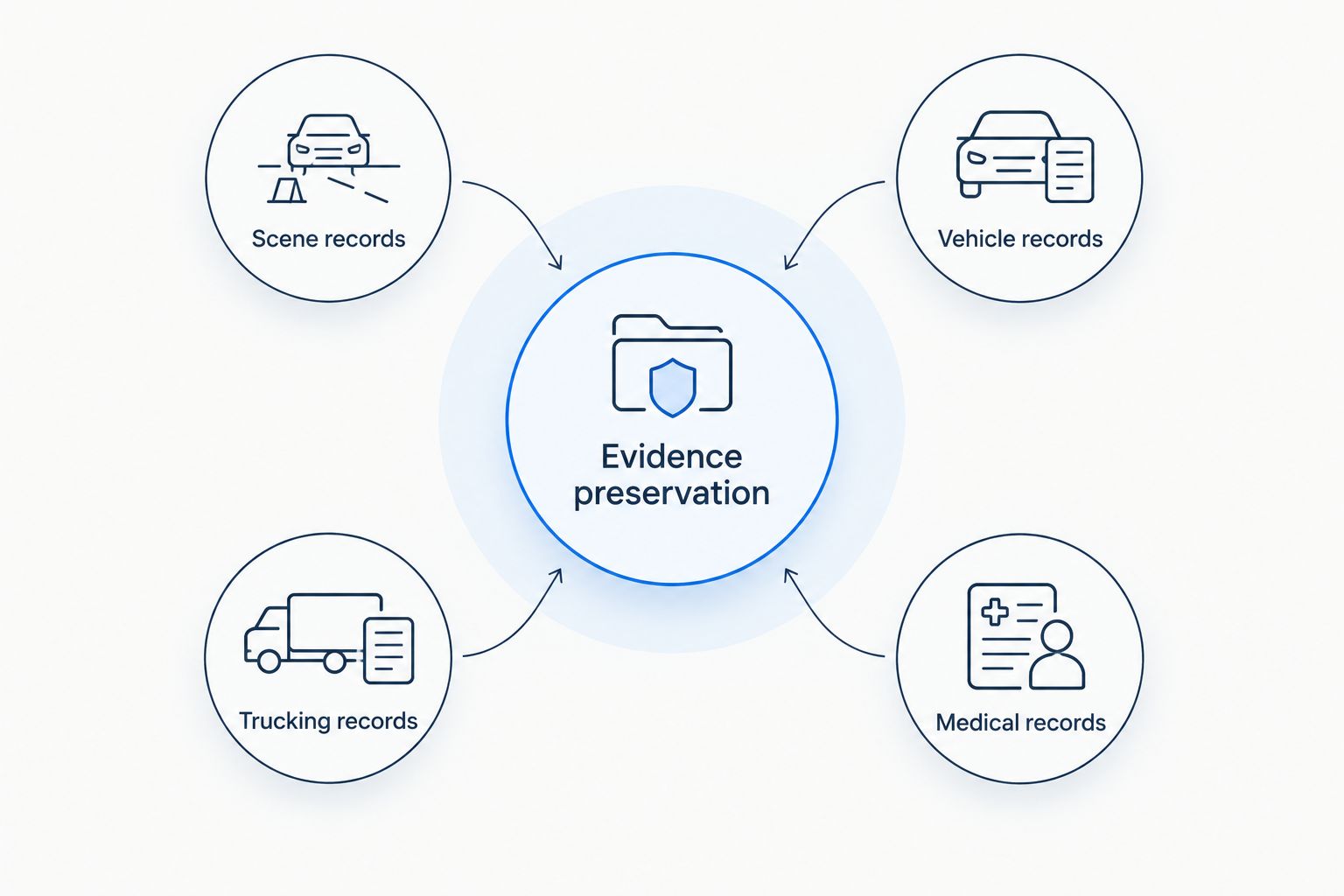
Organize your own material into these categories:
- Scene records: Photographs, witness details, and the crash-report information.
- Vehicle records: Repair estimates, damage photographs, and the vehicle's location.
- Trucking records: Driver, carrier, trailer, and identifying information available to you.
- Medical records: Visit summaries, discharge instructions, bills, and work restrictions.
Evidence preservation strengths:
- Contemporaneous records help distinguish documented facts from later recollections.
- Trucking records can reveal issues not apparent at the roadside.
- Organized records give your lawyer a clearer starting point.
Evidence preservation limitations:
- A preservation letter does not itself give you access to private records.
- Missing footage does not automatically establish what happened.
Best for: Protecting the factual foundation of a disputed truck accident claim.
Verdict: Preserve records early rather than waiting for a fault dispute.
3. Injuries and losses: best for documenting the claim's scope
Medical documentation connects your physical condition to the collision and records how treatment progresses. Keep the distinction clear: a diagnosis identifies an injury, while evidence about restrictions, treatment, and prognosis helps explain its consequences.
Tell treating providers accurately when symptoms started, what has changed, and what activities you cannot perform. Do not exaggerate symptoms or minimize them to make an appointment easier.
Document the effect on ordinary life
Save medical bills and explanations of benefits, but do not stop there. Keep records of missed work, written restrictions, transportation expenses related to treatment, and assistance you need because of the injury.
Future treatment and future earning losses require support. Your own concern about returning to work is important information, but medical and employment evidence must establish the basis for a claim.
A useful 2026 claim file separates paid bills, unpaid bills, wage records, and medical restrictions. That organization helps prevent a payment record from being mistaken for a complete account of your losses.
Injury documentation strengths:
- Treatment records establish symptoms, findings, and care over time.
- Employer records can support missed earnings and job requirements.
- Medical opinions can address prognosis and future treatment needs.
Injury documentation limitations:
- A bill alone does not establish that every charge resulted from the crash.
- Early treatment records do not necessarily establish a final prognosis.
Best for: Explaining the full effect of the collision without guessing at a settlement amount.
Verdict: Document the injury's consequences before evaluating a final release.
4. Responsible parties and insurance: best for mapping the claim
The driver and the trucking company are not interchangeable. Determining responsibility requires examining what each party did, the driver's working relationship, and the conduct connected to the collision.
Depending on the evidence, the investigation can also examine maintenance work, cargo loading, or an allegedly defective vehicle component. None of those possibilities establishes liability without supporting facts.
Separate liability from coverage
Liability asks who is legally responsible. Insurance coverage asks whether a particular policy applies to a particular claim.
A company name on a trailer does not, by itself, answer either question. Ownership, operating arrangements, contracts, policy language, and the facts of the collision need separate examination.
The conduct underlying the collision also shapes the investigation. If phone use is part of the evidence, the guide to suing a distracted driver for texting in a Montana crash explains that related issue.
Party and coverage investigation strengths:
- Ownership and operating records help identify the businesses involved.
- Contracts can clarify responsibilities between trucking participants.
- Policy review distinguishes available coverage from assumptions.
Party and coverage investigation limitations:
- Multiple businesses do not automatically mean multiple valid claims.
- Policy limits do not establish the amount a claimant will recover.
Best for: Identifying legally supported claims and the insurance questions attached to them.
Verdict: Investigate responsibility and coverage separately; do not assume either.
5. Deadlines and settlement timing: best for protecting decisions
A claim needs a deadline review even when an insurer is communicating regularly. Settlement discussions and a lawsuit are different processes.
Montana Code Annotated § 27-2-204 generally provides a three-year limitation period for personal injury actions. The correct deadline depends on the claim and circumstances, including any applicable exceptions or separate requirements.
Check deadlines before relying on negotiations
Do not calculate a deadline from a general article alone. Claims involving government entities, a death, a minor, or other special circumstances require their own legal analysis.
For a collision in 2026, have a lawyer identify the applicable filing and notice requirements from the actual facts. An adjuster's request for more documents does not, by itself, extend a legal deadline.
Settlement timing needs a separate review. A final release can surrender claims described in the agreement, so understand the parties covered, the claims released, and any unresolved medical-payment or reimbursement issues before signing.
Deadline and release review strengths:
- A documented calendar makes filing requirements visible.
- Release review identifies what the agreement actually resolves.
- Treatment information helps inform settlement decisions.
Deadline and release review limitations:
- Waiting for treatment to finish does not automatically extend the filing period.
- Filing a lawsuit does not guarantee recovery.
Best for: Avoiding procedural mistakes and uninformed settlement decisions.
Verdict: Check deadlines now and evaluate settlement terms separately.
How these factors are prioritized
The five factors follow the claim's core questions: responsibility, proof, harm, coverage, and procedure. They are not a scoring system, and no factor establishes a settlement amount by itself.
JF Injury Law's Montana truck accident lawyer services address representation after serious truck crashes. When discussing your case, ask which evidence needs preservation, which deadlines apply, and what information is needed before evaluating your options.
Discuss your Montana truck crash
Contact JF Injury Law about representation after a serious truck crash in Montana.
Which factor should you address first?
Start with medical care, evidence preservation, and a deadline check—not a settlement estimate. Those actions protect your health and your ability to make informed decisions while the investigation develops.
Bring the crash date, location, report information, photographs, insurer correspondence, and treatment details to your first conversation. If you do not have every record, explain what you have and where other records might be found.
FAQ
What does a Montana truck accident lawyer investigate?
A Montana truck accident lawyer investigates fault, relevant trucking evidence, injuries, responsible parties, insurance, and deadlines. The investigation should follow the facts rather than assume the truck driver is the only potentially responsible party.
Can I recover damages if I was partly at fault?
Montana’s comparative negligence rule permits recovery when your negligence is not greater than the combined negligence of the people against whom recovery is sought. Your recoverable damages are reduced in proportion to your negligence under Montana Code Annotated § 27-1-702.
How long do I have to file a Montana truck accident lawsuit?
Montana generally provides three years for personal injury actions under Montana Code Annotated § 27-2-204. Exceptions, separate notice requirements, and the type of claim require an individual deadline review.
What evidence should I keep after a semi-truck crash?
Keep photographs, witness information, crash-report details, medical records, bills, work restrictions, and insurer correspondence. A lawyer can separately assess preservation requests for trucking records and electronic data you do not control.
Is the trucking company automatically responsible for its driver’s crash?
The trucking company’s responsibility requires analysis of the driver’s relationship with the company and the facts of the collision. Company involvement alone does not establish every element of liability.
Should I accept a settlement before treatment is finished?
Evaluate a final settlement only after understanding the release and the medical information available about your injuries. Ongoing treatment creates questions about future needs, but it does not automatically extend filing deadlines.
Who does JF Injury Law represent?
JF Injury Law represents seriously injured people and families after fatal car and truck crashes in Billings and across Montana. Contact the firm to discuss representation for your circumstances.
One last thing
Your damaged vehicle is evidence, not just a repair problem. Before authorizing disposal or a repair that changes crash-related components, ask your lawyer whether inspection or additional documentation is needed; also address storage charges and insurer requirements rather than leaving the vehicle unattended indefinitely.
Related guides
- Questions to ask before hiring a truck accident lawyer
- Steps to take after a car accident in Billings
- Facts about wrongful death claims in Montana
Author: Joe Frick
This article provides general information, not legal advice. Your claim requires an assessment of its facts and applicable law.