
The 5 things to document after a distracted driving crash are the scene, witness accounts, evidence of distraction, medical care, and financial losses. A Montana distracted driving accident lawyer needs records that connect what happened to your injuries—not just a photograph of someone holding a phone.
- Document the scene, witnesses, suspected distraction, medical care, and financial losses after a Montana crash.
- Preserve original photos and messages; separate firsthand observations from assumptions about texting or phone use.
- JF Injury Law represents seriously injured Montanans after car and truck crashes.
- A Montana distracted driving accident lawyer can assess evidence gaps and requests for records you cannot obtain yourself.
For your 2026 crash file, start with what you can safely preserve. JF Injury Law represents seriously injured people and families after fatal car and truck crashes in Billings and across Montana.
Why this matters
Distracted driving is not limited to texting. Looking at a navigation screen, reaching for an object, or turning toward a passenger can take attention away from driving. Your documentation should describe the conduct you observed rather than assign a cause you cannot prove.
JF Injury Law represents people seeking legal help after serious Montana car and truck crashes, including crashes involving suspected distraction. No single photograph or witness statement establishes every part of a claim; the records need to fit together.
Medical care and safety come first. Do not remain in traffic, confront another driver, or delay treatment to gather evidence. If you cannot document the scene, tell your lawyer what you remember and who might have additional information.
What makes useful crash documentation
Use these criteria to organize your 2026 evidence file before deciding what a record proves:
- Source: Identify who created the record and how you obtained it.
- Timing: Preserve the original date, time, and sequence when available.
- Specificity: Record observable details instead of conclusions such as “obviously texting.”
- Completeness: Keep the surrounding context, not only the image or message that supports your account.
- Connection: Explain whether the record concerns the collision, your injuries, or your losses.
These categories are ranked by documentation priority, not legal importance. Scene evidence deserves early attention because conditions change; medical treatment still takes priority over every evidence task.
The documentation checklist at a glance
| Priority | Record category | Best for | Main strength | Key limitation |
|---|---|---|---|---|
| 1 | Scene photos and video | Preserving physical conditions | Shows positions, damage, and surroundings | Usually does not show where a driver was looking |
| 2 | Witness information | Preserving independent observations | Identifies people who saw relevant conduct | A witness might have seen only part of the event |
| 3 | Distraction evidence | Investigating what diverted attention | Connects specific observations with the crash timeline | Phone activity alone does not establish fault |
| 4 | Medical records | Documenting injury and treatment | Creates a treatment history | Records depend on accurate reporting and clinical findings |
| 5 | Loss records | Documenting financial and daily-life effects | Organizes expenses and work disruption | Estimates are not the same as verified losses |
1. Scene photos and video: best for physical conditions
Photograph the overall scene before focusing on individual dents or broken parts, but only from a safe location. Wide views help explain the relationship between vehicles, lanes, signs, and nearby intersections. Close views preserve details that are harder to identify later.
What to record
- Vehicle positions: Where the vehicles stopped, if you can photograph them safely before they move.
- Road conditions: Lane markings, traffic controls, visibility, weather, and obstructions.
- Vehicle damage: Multiple angles showing both the damaged area and the vehicle around it.
- Nearby cameras: The location of businesses, homes, or vehicles with cameras that might face the roadway.
Keep original files rather than relying only on screenshots or social-media copies. For a 2026 crash, preserve the original capture information and note any mismatch between a camera's displayed time and the actual time.
Scene-photo strengths: Images preserve visible details and help others understand the layout without relying entirely on memory.
Scene-photo limitations: A still image does not establish speed, attention, or the sequence of impact by itself. Vehicles photographed after being moved need that context.
Best for: Showing physical conditions and identifying questions for further investigation.
Verdict: Keep originals, and record whether anything moved before you photographed it.
2. Witness information: best for independent observations
A useful witness record starts with contact information and a clear account of what the person actually saw. Someone who noticed a driver looking down before impact offers different information from someone who arrived after the collision.
Ask for a name, telephone number, and preferred way to be contacted. If the person agrees, write down the account in their words without suggesting an answer.
Questions that preserve useful detail
- Where were you when you first noticed the vehicles?
- What did you see before the impact?
- Did anything block your view?
- Did you see a phone or another object, or only the driver's head position?
- Do you have a recording that includes the approach or collision?
Avoid turning a conversation into an argument about blame. Your goal is to preserve an account, not recruit someone to your position. Tell your lawyer if a witness is a passenger, relative, coworker, or someone you had not met before.
Witness-record strengths: Witnesses can describe events outside your field of view and identify recordings you did not know existed.
Witness-record limitations: Memory is incomplete, viewing angles differ, and confidence does not guarantee accuracy. Preserve uncertainty instead of editing it away.
Best for: Establishing who observed relevant events and what each person actually perceived.
Verdict: Keep contact details and firsthand observations together, with assumptions clearly separated.
3. Distraction evidence: best for investigating diverted attention
Write a factual account of suspected distraction as soon as your condition allows. “I saw the driver looking down with a rectangular object in their hand” is more precise than “the driver was definitely texting.”
Preserve any messages, photographs, recordings, or statements already lawfully available to you. If the other driver said something relevant, record the words you remember, who heard them, and when the conversation occurred. Do not present a paraphrase as an exact quotation.
Build a sequence, not a conclusion
Use 2 timelines: one for the events surrounding the collision and one for medical care and recovery. In the collision timeline, distinguish the moment you noticed the other vehicle, the impact, and any later conversation. Mark uncertain times as estimates.
A lawyer can assess whether phone records, vehicle data, business recordings, or commercial-driver records are relevant and what legal process applies. Do not enter another person's accounts, take a phone, impersonate its owner, or assume that a carrier will release records to you.
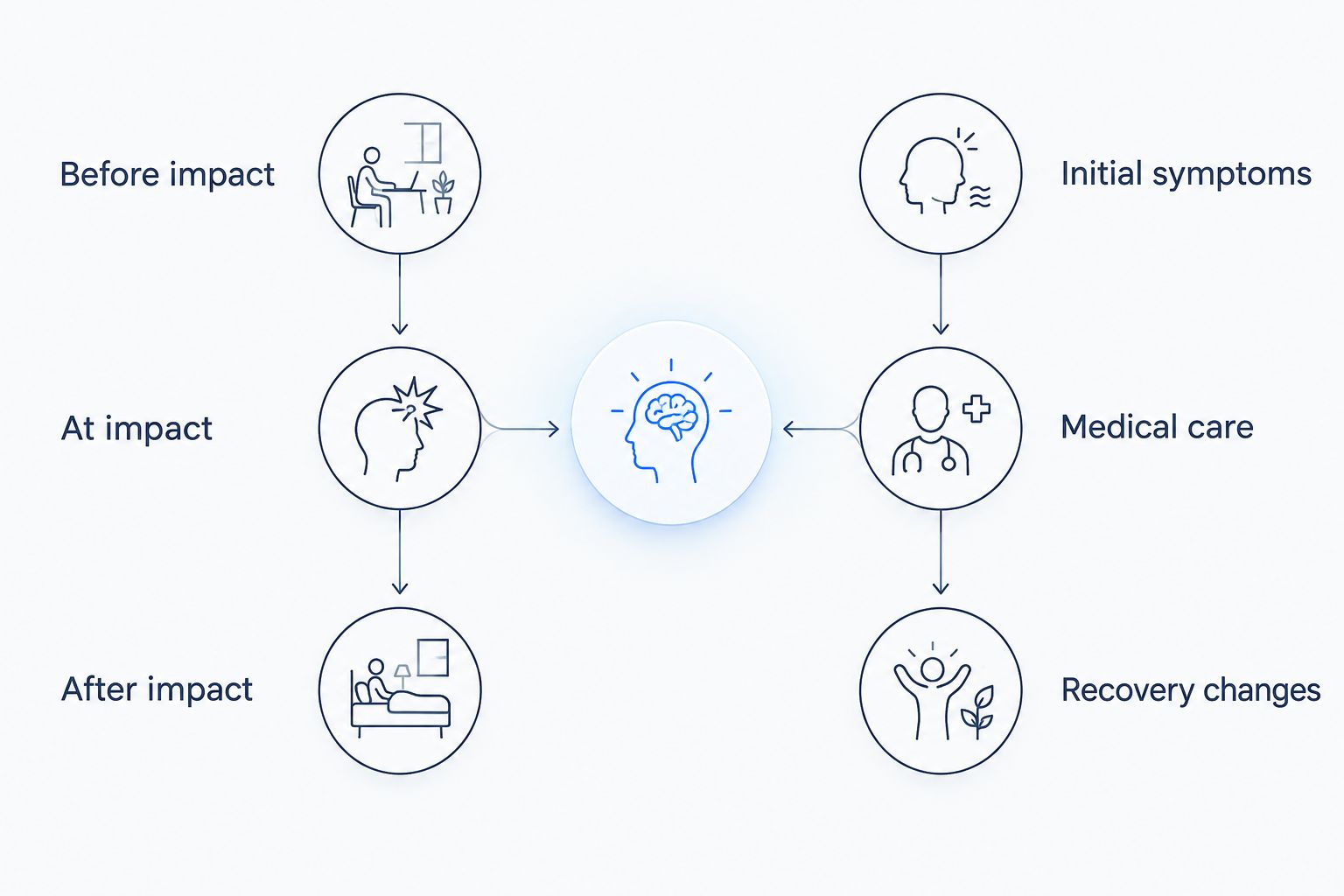
Label your collision notes Before impact, At impact, and After impact. Label your recovery notes Initial symptoms, Medical care, and Recovery changes. This separation helps prevent later information from becoming part of your original recollection.
Distraction-evidence strengths: Specific observations help identify which records and witnesses deserve attention.
Distraction-evidence limitations: A phone record does not necessarily identify the person using a device or explain how the collision happened. Distraction, fault, and injury causation require separate analysis.
The question can I sue a distracted driver for texting in a Montana crash? requires more than showing that a phone was present. Explain the driving conduct, the collision, and the resulting harm.
Best for: Directing an investigation without overstating what you know.
Verdict: Keep specific observations; leave unsupported conclusions out of your evidence file.
4. Medical records: best for documenting injury and treatment
Tell your medical providers what happened and describe your symptoms accurately. Include symptoms that began later, preexisting conditions affecting the same area, and changes in your ability to work, sleep, walk, or perform ordinary tasks.
Keep discharge instructions, appointment information, treatment recommendations, and correspondence about follow-up care. Organize your 2026 medical records by treatment date, not the date an insurer or billing office mailed a document.
Make recovery notes practical
A short dated entry can identify the activity affected, the symptom, and what you did next. Describe an interrupted task rather than assigning yourself a medical diagnosis. Bring new or worsening symptoms to a healthcare professional instead of treating a claim journal as medical advice.
Medical-record strengths: Treatment records document clinical findings, reported symptoms, recommendations, and the course of care.
Medical-record limitations: A bill alone does not explain an injury, and a personal journal is not a substitute for medical evaluation. Missing appointments or treatment barriers need accurate context, not an invented explanation.
Best for: Connecting your reported symptoms and functional limitations with your treatment history.
Verdict: Keep treatment documents and accurate recovery notes; let clinicians diagnose your condition.
5. Loss records: best for showing the crash's practical effects
Create 1 master folder with separate sections for medical paperwork, work records, vehicle expenses, correspondence, and recovery notes. Keep receipts and supporting documents together so a total can be traced back to its source.
Record missed work dates, schedule changes, transportation expenses, and assistance you needed because of your injuries. Explain the reason for each entry without assuming that every expense will be recoverable.
Preserve the source behind each loss
The discipline of collecting evidence after an accident includes preserving the source behind each claimed loss, not merely writing down a total. For a Montana car or truck crash, that means keeping the receipt, employer communication, appointment record, or other document that explains the entry.
If you are self-employed, preserve the business records that support a claimed interruption. Do not treat gross revenue, profit, and personal income as interchangeable. Your lawyer can identify what additional documentation is needed.
Loss-record strengths: Source documents make expenses and work disruption easier to explain and verify.
Loss-record limitations: A spreadsheet is an organizational tool, not independent proof. Estimates, duplicate bills, and unrelated expenses need to be identified.
Best for: Showing documented expenses and the practical effects of your injuries.
Verdict: Keep the supporting record for every entry, and distinguish estimates from paid expenses.
How to use this priority order
The checklist puts changing scene conditions first, followed by witnesses and potential distraction evidence. Medical care and loss records continue throughout recovery. You do not need to finish one category before starting another, and treatment always takes precedence.
For an initial conversation with JF Injury Law, bring what you have: the crash date and location, involved parties, report information, treatment details, photographs, and insurer correspondence. Identify missing records rather than trying to obtain everything yourself.
Discuss your Montana crash
Explain what happened, your injuries, and the records you already have.
FAQ
What should I document first after a distracted driving crash?
Prioritize medical care and safety, then document the scene if you can do so safely. Preserve original photographs, witness contact details, and a factual account of what you observed.
Can I prove distracted driving without a photo of the driver’s phone?
A photograph of a phone is not the only possible evidence of distraction. Witness observations, recordings, statements, and lawfully obtained records can contribute to an investigation; their significance depends on the facts.
Should I ask the other driver to show me their phone?
Do not take, search, or access another person’s phone without lawful authority. Record what you observed and let your lawyer assess appropriate requests for relevant evidence.
What if I was too injured to take pictures?
Tell your lawyer that your injuries prevented you from documenting the scene. Witnesses, investigating officers, involved vehicles, and nearby cameras are possible sources to investigate.
Does a phone record automatically prove the other driver caused the crash?
No. Phone activity must be evaluated alongside evidence about who used the device, the timing, the driving conduct, and how the collision occurred.
What should I bring to a Montana distracted driving accident lawyer?
Bring the records you already have, including photographs, witness details, report information, medical paperwork, and insurer correspondence. Identify missing items without delaying the conversation to build a complete file.
What extra records matter after a distracted truck driver crash?
Potentially relevant records include commercial-driver communications, vehicle data, camera footage, and company records tied to the collision. Their existence and availability require investigation; do not assume every truck captured the same information.
One last thing
Preserve inconvenient evidence too. A photograph showing an obstruction, a witness who is uncertain, or a message that complicates your recollection belongs in your 2026 crash file. Your lawyer needs an accurate record, not a selectively edited version.
Related guides
- Steps to take after a car accident in Billings, Montana
- Factors that affect a semi-truck accident claim in Montana
- Rights injured drivers have after a Montana car accident
Author: Joe Frick | JF Injury Law