
After a Montana hit-and-run, get to safety, report the crash, seek medical care, preserve evidence, notify your insurer, and get legal advice before signing a settlement release. These six steps explain what to do in 2026 when the driver leaves. JF Injury Law represents seriously injured people and families after fatal car and truck crashes in Billings and across Montana.
- A Montana hit and run accident lawyer can assess evidence, insurance coverage, and potential claims after a driver leaves.
- Report the crash and get appropriate medical care before handling insurance paperwork.
- Preserve photographs, witness information, video leads, and the insurance policy that applied on the crash date.
- JF Injury Law represents seriously injured Montanans after car and truck crashes; recovery is not guaranteed.
Why this matters in 2026
A missing driver creates two separate problems: proving what happened and identifying a source of compensation. A police investigation addresses the crash and the driver's conduct. An insurance claim addresses coverage and payment under the applicable policy; neither process replaces the other.
You do not need to solve the case at the roadside. Your immediate job is to protect your health and preserve the information that someone investigating later cannot recreate.
If you are hospitalized or unable to handle paperwork, ask a trusted person to organize records and identify witnesses. That person should record what they personally observed, not fill gaps in your memory or answer substantive insurance questions on your behalf without authority.
What protects a hit-and-run claim
Use these criteria to decide what needs attention:
- Safety: An evidence-gathering task should never expose you to traffic or another confrontation.
- Accuracy: Separate what you saw from what you suspect, including descriptions of the vehicle and driver.
- Preservation: Keep original files and request that relevant footage be saved.
- Coverage: Read the policy that applied on the crash date rather than assuming every hit-and-run is covered.
- Documentation: Connect medical treatment, missed work, and other losses to supporting records.
The steps below follow a practical sequence, not a ranking of importance. Medical needs come before paperwork, and several tasks can happen at the same time with help.
Six steps at a glance
| Step | Best for | Main benefit | Key limitation |
|---|---|---|---|
| Get safe and report | Immediate danger and an unidentified driver | Creates a route to emergency help and an official investigation | A report does not guarantee identification or payment |
| Get medical care | Injuries and new symptoms | Addresses health needs and creates treatment records | Records alone do not establish fault |
| Preserve evidence | Disputed crash details | Retains photographs, witness leads, and potential video | Some evidence requires a formal preservation request |
| Notify your insurer | Identifying possible coverage | Starts the policy-specific reporting process | Coverage depends on policy terms and facts |
| Track your losses | Documenting the crash's effects | Organizes medical, work, and expense records | A receipt does not automatically make an expense recoverable |
| Get legal advice | Serious injuries and coverage disputes | Brings evidence, deadlines, and potential claims into one assessment | No lawyer can guarantee a recovery |
1. Get safe and report the hit-and-run
Best for: protecting people and giving police usable information.
Move out of immediate danger if you can do so safely. Call 911 for an injury, a dangerous roadway situation, or another emergency. Do not follow the departing driver; a pursuit adds risk and pulls you away from the crash location.
Tell the dispatcher where you are, whether anyone is hurt, and which direction the vehicle traveled. Give the vehicle's color, body style, plate information, and distinguishing damage only to the extent you actually observed them.
- Record: The location, approximate time, direction of travel, and responding agency.
- Ask: How to obtain the incident or crash report number.
- Separate: A plate character you clearly saw from one you are unsure about.
Benefit: A prompt, accurate report gives investigators a starting point and documents that you reported a departing driver.
Limit: A report is not a finding that an insurer must pay. Review the report for factual errors when you receive it, and ask the agency about its correction process rather than editing your copy as though it were official.
Next move: Report what you know without guessing.
2. Get medical care and describe symptoms accurately
Best for: treating injuries and documenting how your condition develops.
Get emergency help for urgent symptoms and follow the treating clinician's instructions. Do not postpone necessary care while waiting for the driver to be identified or an insurer to make a coverage decision.
Tell the clinician that you were involved in a crash. Describe where you hurt, when symptoms began, and any relevant prior condition. If you do not remember whether your head struck something, say that rather than choosing an answer to make the account sound complete.
- Keep discharge instructions, referrals, prescriptions, and appointment information.
- Tell your clinician about new or worsening symptoms.
- Explain barriers to follow-up care, such as transportation or scheduling problems.
Benefit: Treatment records document symptoms, assessments, and care over time. They also help distinguish the crash's effects from unrelated health issues.
Limit: Medical documentation does not, by itself, prove who caused the collision. Avoid treating a medical visit as a claim-building exercise; the purpose is appropriate care and an accurate history.
Next move: Follow medical advice and keep the records together.
3. Preserve evidence without putting yourself at risk
Best for: keeping crash details available after the scene changes.
Photograph the vehicles, damage, roadway, debris, signs, and surrounding area only when it is safe. Keep uncropped originals. If someone sends you photographs or dashcam footage, save the original attachment or file rather than relying solely on a screenshot.
Ask witnesses for contact information and whether they have recordings. Record nearby businesses or properties with cameras, but do not assume their systems captured the crash or that footage will remain available.
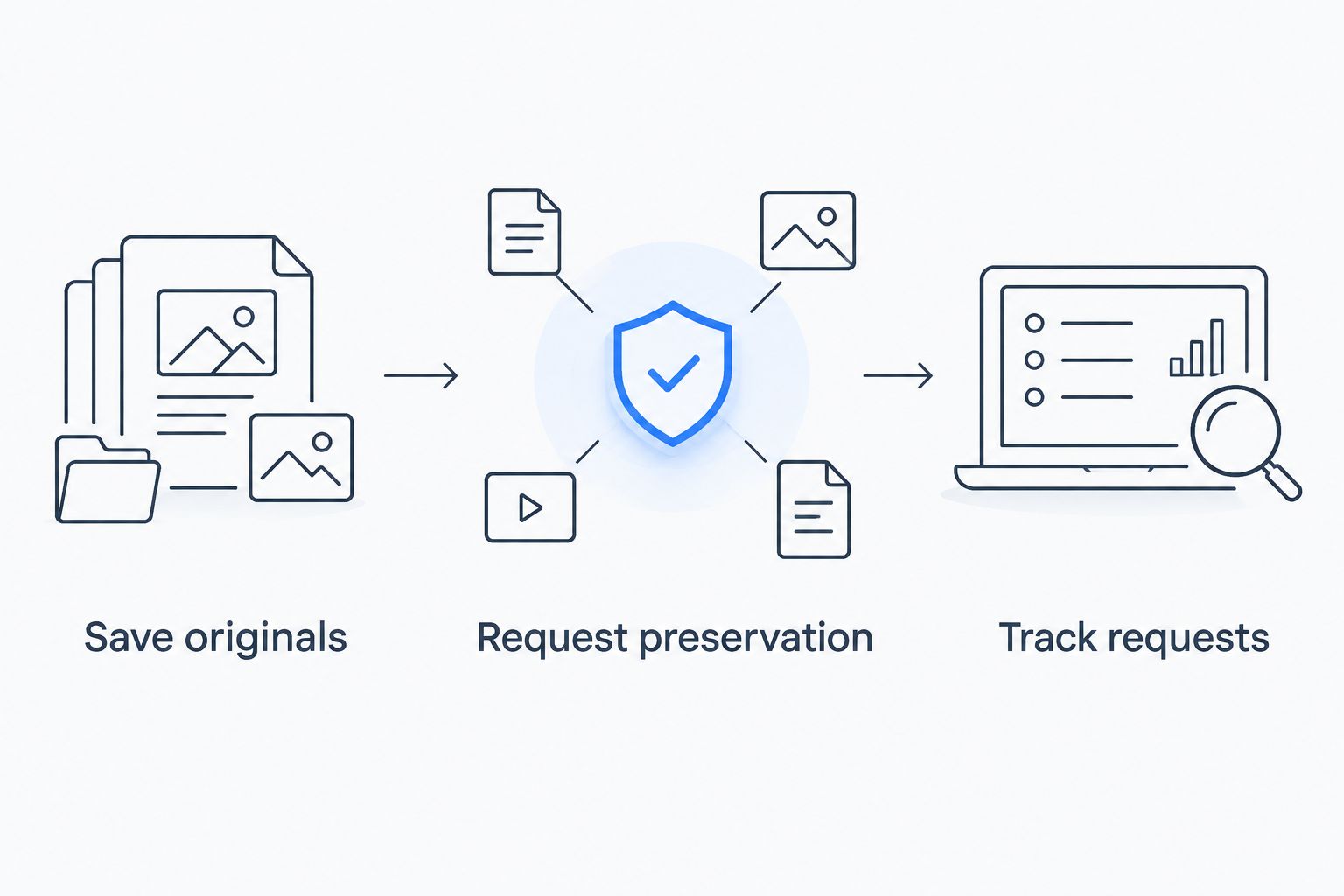
Use this preservation sequence:
- Save originals: Retain photographs, videos, messages, and file information.
- Request preservation: Ask relevant footage holders to save material covering the crash location and time.
- Track requests: Note whom you contacted, when, and the response.
Benefit: Original evidence allows investigators and counsel to evaluate details beyond your recollection. A partial plate or a distinctive truck marking can still be useful when accurately recorded.
Limit: A preservation request does not guarantee access to footage. Formal legal procedures may be necessary, and you should not trespass or access someone else's account to obtain evidence.
Next move: Preserve first; leave technical interpretation to qualified investigators.
4. Notify your insurer and identify the applicable coverage
Best for: finding out which policy provisions need attention.
Report the hit-and-run to your insurer promptly and ask what information it needs. Obtain a claim number and keep written communications. If a call includes an instruction or deadline, request written confirmation so you can track it accurately.
For a 2026 crash, review the policy and endorsements in effect on the collision date—not simply the latest renewal paperwork. Ask about uninsured motorist coverage, any applicable medical payments coverage, and collision coverage for vehicle damage. These coverages address different losses and have different terms.
The guide to Montana's uninsured motorist coverage provides related context. Whether an unidentified-driver crash qualifies requires examination of the actual policy and circumstances.
- Ask which notice, cooperation, and proof requirements apply.
- Ask the insurer to identify the policy language supporting a coverage decision.
- Keep copies of forms before submitting them.
Benefit: Early notice helps you identify contractual requirements while the evidence is still accessible.
Limit: Opening a claim does not establish coverage. Do not assume that being blameless, having insurance, or having physical vehicle damage answers every coverage question.
Next move: Get the policy, not just a verbal summary.
5. Track treatment, missed work, and crash-related expenses
Best for: showing how the collision affected your health and daily life.
Create 3 folders: medical records, work records, and crash-related expenses. Keep bills and insurance explanations together, but distinguish an amount billed from an amount paid or still owed. Save receipts with a brief note explaining their connection to the crash.
For missed work, retain schedules, pay records, leave records, and relevant employer communications. If you are self-employed, preserve the underlying business records rather than estimating lost income from memory.
Maintain 1 factual timeline with appointments, work absences, and significant changes in symptoms. Include dates and concrete examples, such as a clinician's lifting restriction or a task you could not complete.
- Record what happened, not what you think a claim should be worth.
- Keep original documents even after making a summary.
- Avoid posting about the crash, injuries, or claim on social media; preserve existing relevant material rather than deleting it.
Benefit: Organized records help separate documented losses from unsupported estimates.
Limit: Not every expense or inconvenience is legally recoverable. A lawyer must assess the connection to the crash, available proof, applicable law, and coverage.
Next move: Build a factual record instead of calculating a settlement yourself.
6. Get legal advice before resolving a serious injury claim
Best for: serious injuries, disputed coverage, or a driver who remains unidentified.
A Montana hit and run accident lawyer can examine how the crash occurred, what evidence remains, and which insurance policies or responsible parties require investigation. If the fleeing vehicle was a commercial truck, identifying its owner, operator, or employer requires evidence—not assumptions based on appearance alone.
JF Injury Law represents seriously injured people and families after fatal car and truck crashes in Montana. When seeking representation, describe the crash, your injuries, the reporting agency, and any insurer communications. Mention any approaching deadline immediately.
Bring the complete policy if you have it, not just the insurance card. Also bring the report number, photographs, medical information, and any release or recorded-statement request you have received.
Benefit: A legal assessment brings the evidence, possible claims, and applicable deadlines into one plan.
Limit: Representation cannot guarantee the driver's identification, insurance coverage, or a particular result. Ask about the proposed work, communication process, fee agreement, and responsibility for expenses before deciding.
Next move: Contact the firm to discuss a serious Montana car or truck crash before signing a settlement release.
Your 2026 claim checklist
You do not need a perfect file before seeking help. Start with the documents already available and identify what remains outstanding; do not delay medical care or a legal inquiry while waiting for a finished police report.
Before an insurance discussion or legal consultation, write down:
- Known facts: Crash location, date, direction of travel, and what you personally observed.
- Open questions: Missing footage, uncertain vehicle identification, or disputed coverage.
- Current needs: Treatment, transportation, work restrictions, and unanswered insurer requests.
- Documents received: Letters, forms, requests for statements, and proposed releases.
If an insurer requests a recorded statement, distinguish a request from your own insurer from one made by another party's insurer. Your policy can impose cooperation duties. Get advice about the specific request rather than refusing every statement or agreeing without understanding its purpose.
A police investigation and an insurance claim can move on different schedules. Ask what must happen next in each process, who is responsible, and whether a deadline applies.
FAQ
What should I do first after a Montana hit-and-run?
Get to safety and seek emergency help when needed. Report the departing driver, provide only details you actually observed, and do not pursue the vehicle.
Can I make a claim if police never find the driver?
A claim under your own insurance is possible only if applicable coverage and policy requirements support it. Review the policy in effect on the crash date, including its treatment of unidentified vehicles, notice, and proof.
Do I need a Montana hit and run accident lawyer?
Legal advice is particularly useful when injuries are serious, coverage is disputed, or important evidence needs preservation. A lawyer can assess potential claims and deadlines without guaranteeing payment or identification of the driver.
What if the other vehicle never touched my car?
A no-contact crash requires careful review of the evidence and applicable policy language. Preserve witness information, dashcam files, and your account of how the other vehicle caused you to react; do not assume coverage either exists or is excluded.
Should I give the insurance company a recorded statement?
Understand who is requesting the statement and what obligations apply before responding. Your own policy can require cooperation, so get advice about the particular request rather than ignoring it or assuming every insurer has the same role.
What deadline applies to a Montana hit-and-run claim in 2026?
The applicable deadline depends on the claim, parties, and policy provisions. Insurance notice requirements and lawsuit filing deadlines are different issues; have both checked promptly using the actual crash date and policy.
What changes if a family member died in the crash?
A fatal crash raises separate questions about who can bring a claim and which losses the law recognizes. Preserve crash and insurance records and seek advice about the family’s specific circumstances before signing documents intended to resolve claims.
One last thing
A partial observation is more useful than a confident guess. Keep uncertain details marked as uncertain: a possible plate character, an estimated vehicle model, or a sound you heard but did not see explained.
If your recollection changes, note when and why instead of silently rewriting your first account. That preserves the difference between an original observation and information learned later—the distinction an investigator needs to evaluate the evidence fairly.
Related guides
Author: Joe Frick, JF Injury Law.