
Before hiring a Montana rideshare accident lawyer in 2026, ask who will investigate insurance coverage, prove fault, document your losses, preserve trip records, explain the agreement, and handle your case. Start with coverage and evidence—not a promised settlement amount.
- Choose a Montana rideshare accident lawyer who explains coverage, evidence preservation, and responsibility for your case.
- JF Injury Law represents seriously injured crash victims and families in Billings and across Montana.
- Ask how the driver’s app status affects the insurance investigation; do not assume one policy covers everything.
- Get the representation agreement in writing, and reject guaranteed recovery claims.
By Joe Frick
Why this matters
A rideshare crash adds questions beyond who caused the collision. You need to establish whether the driver was using the app, whether a ride had been accepted, and which insurance policies apply to the facts.
JF Injury Law represents seriously injured Montanans and families after fatal car and truck crashes. If you are considering JF Injury Law, use the questions below to evaluate the proposed approach rather than relying on general assurances.
For a 2026 hiring decision, separate a clear investigation plan from a prediction about results. A lawyer can explain what needs investigation without promising what an insurer, judge, or jury will decide.
What makes a strong rideshare accident lawyer?
Evaluate the consultation against these criteria before comparing personalities or presentations:
- Coverage analysis: The lawyer distinguishes driver activity, policy terms, and potentially responsible parties.
- Evidence planning: The lawyer identifies records to preserve and explains who will request them.
- Injury documentation: The lawyer connects medical evidence and work limitations to the claim.
- Written terms: The agreement explains representation, fees, expenses, and your responsibilities.
- Accountability: You know who handles decisions, communications, and unresolved issues.
These are hiring criteria, not a ranking of law firms. The strongest answer identifies a next step and the information needed to take it.
The six hiring questions at a glance
The questions below are ranked by the issue they help you examine. Each serves a different purpose; a strong answer to one does not replace the others.
| Priority | Question | Best for | What a strong answer includes | Key limitation |
|---|---|---|---|---|
| 1 | Which insurance policies will you investigate? | Understanding coverage | Driver status, policy requests, and coverage questions | Coverage cannot be confirmed from an app screenshot alone |
| 2 | How will you investigate fault? | Testing liability | Collision evidence and competing accounts | A traffic citation does not resolve every civil issue |
| 3 | How will you document my losses? | Evaluating injury consequences | Treatment records, work effects, and future needs | Early records do not establish every future loss |
| 4 | Which trip records need preservation? | Protecting digital evidence | Specific records, holders, and preservation steps | Your phone does not contain every relevant record |
| 5 | What does the representation agreement require? | Understanding obligations | Written fee, expense, and termination terms | A short verbal summary is not the agreement |
| 6 | Who will handle my case? | Establishing accountability | Named roles and a communication process | A familiar name does not explain daily responsibility |
1. Which insurance policies will you investigate?
Best for: understanding the coverage investigation. Ask the lawyer to explain which policies need review and what facts determine their relevance. A rideshare company’s name does not, by itself, establish who must pay your claim.
For a 2026 consultation, organize the discussion around 3 trip phases: waiting for a request, traveling to an accepted pickup, and transporting a passenger. Also establish whether the driver was offline. These distinctions guide questions; they do not substitute for reading applicable policies and Montana law.
Ask how the lawyer will obtain coverage information and address conflicting accounts of the driver’s status. Your own auto policy also deserves review where its terms are relevant.
A strong answer:
- Identifies the facts needed to determine driver status.
- Separates investigating coverage from confirming coverage.
- Explains how policy documents will be requested and reviewed.
Limitations to recognize:
- A trip receipt does not disclose every policy term.
- An insurer’s initial position does not settle a disputed coverage issue.
Skip a lawyer who guarantees insurance coverage before reviewing the facts and policies.
2. How will you investigate who caused the crash?
Best for: testing the liability plan. Ask what evidence the lawyer needs beyond your account and the crash report. A useful answer connects disputed facts to records, witnesses, photographs, or other available evidence.
The investigation should address the conduct that caused the collision, not simply the fact that a rideshare vehicle was involved. Depending on the circumstances, that includes another driver’s actions, lane movements, traffic signals, visibility, and the sequence of impacts.
Bring what you already have, but do not put yourself at risk collecting more. The steps to take after a car accident in Billings provide a separate starting point for organizing immediate post-crash tasks.
A strong answer:
- Identifies the central disagreement about the collision.
- Explains which evidence would help resolve it.
- Addresses evidence that supports or challenges your account.
Limitations to recognize:
- A crash report is part of the evidence, not the entire case.
- A citation and a civil injury claim answer different legal questions.
Skip a lawyer who declares fault settled without discussing the evidence.
3. How will you document my injuries and losses?
Best for: evaluating the consequences of a serious injury. Ask how the lawyer will document treatment, missed work, physical restrictions, and changes to your daily life. The answer should address your actual circumstances rather than a generic settlement estimate.
Describe what has changed in concrete terms: tasks you cannot perform, appointments you attend, assistance you need, and work you have missed. Keep records accurate. Do not exaggerate symptoms or treat a personal journal as a substitute for medical care.
For ongoing injuries, ask how unresolved medical questions affect the timing of settlement discussions. A lawyer handles the legal claim; qualified healthcare professionals address diagnosis, treatment, and prognosis.
A strong answer:
- Distinguishes documented losses from unresolved future needs.
- Explains which medical and employment records matter.
- Addresses how evidence will connect the collision to the claimed harm.
Limitations to recognize:
- Medical bills alone do not describe every injury consequence.
- An early consultation cannot establish an unknown medical prognosis.
Skip a lawyer who assigns a guaranteed recovery before understanding your injuries and evidence.
4. Which trip records need preservation, and who will obtain them?
Best for: protecting digital evidence. Ask the lawyer to name the records being sought, who controls them, and how preservation and access will be addressed. “We will investigate” is not a complete answer to this question.
Start by preserving material already available to you: the trip receipt, booking confirmation, app messages, driver information, and relevant photographs. Keep original files when possible. Do not edit an image to make it more persuasive or delete a message because it seems unhelpful.
A practical evidence sequence
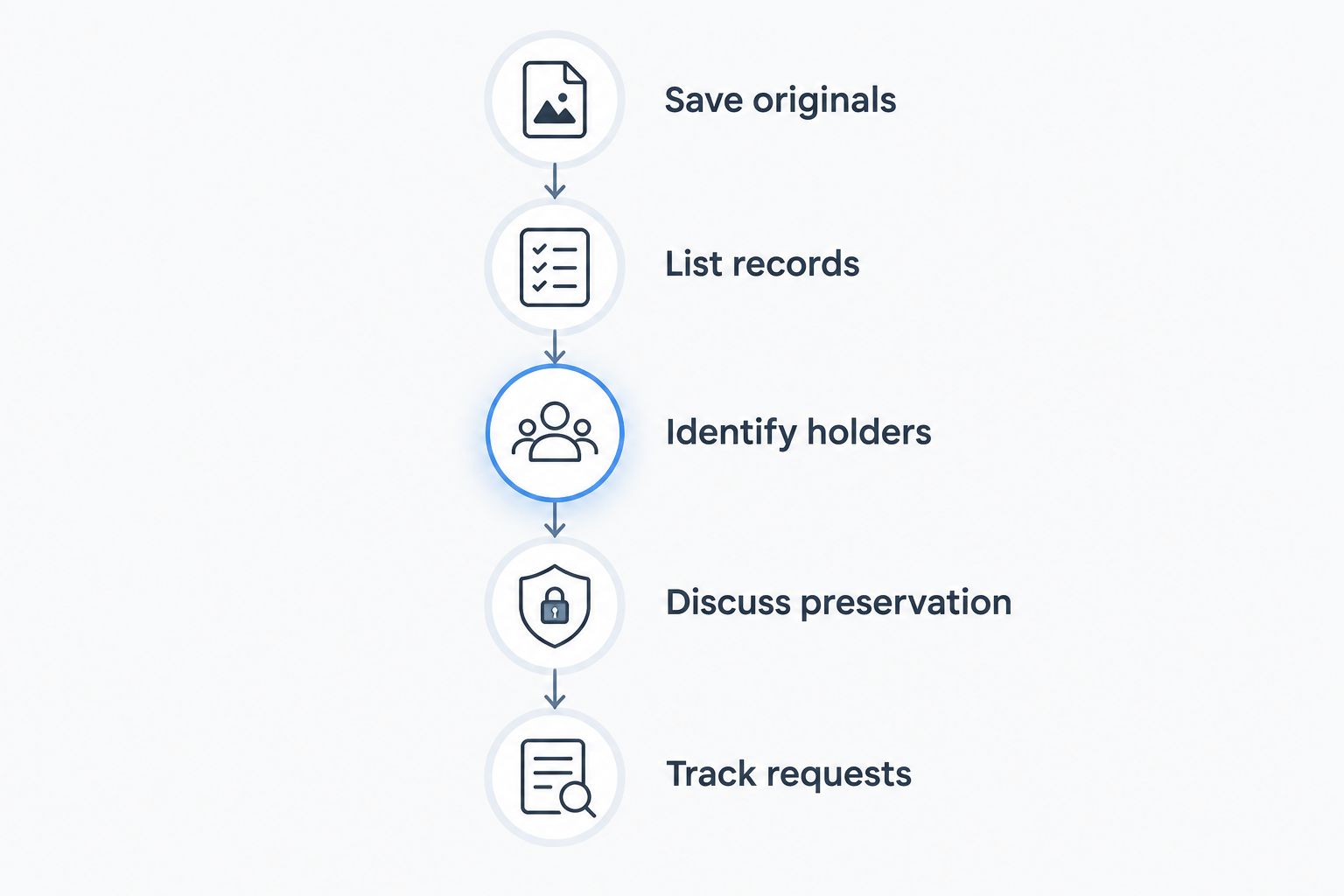
Use this sequence to organize your side of the record collection without confusing personal access with a lawyer’s formal requests:
- Save originals: Keep existing receipts, messages, photographs, and files.
- List records: Identify what you have and what appears to be missing.
- Identify holders: Note whether a record is with you, an insurer, a business, or the platform.
- Discuss preservation: Ask counsel what notices or other steps are appropriate.
- Track requests: Keep correspondence organized so outstanding requests remain visible.
Your own records are only one part of the investigation. Platform-held information requires a separate discussion about relevance, access, and the legal process available to obtain it.
The evidentiary distinction behind trip records after a rideshare crash is straightforward: a passenger receipt documents a trip, while determining driver activity at the collision requires examining timing and other relevant records. A Seattle discussion does not establish Montana insurance requirements or filing rules.
A strong answer:
- Separates records you can save from records held by others.
- Identifies preservation steps without promising every requested record exists.
- Explains how timestamps and trip activity relate to disputed facts.
Limitations to recognize:
- Screenshots do not necessarily contain the underlying data.
- A preservation request is not the same as receiving the records.
Skip a lawyer who treats your app receipt as the complete digital evidence file.
5. What does the written representation agreement require?
Best for: understanding your obligations before signing. Ask for the agreement and read it before authorizing representation. A verbal explanation helps, but the written terms deserve their own review.
Ask how attorney compensation and case expenses are handled, what happens if representation ends, and what responsibilities you retain. Request clarification of language you do not understand rather than relying on an assumption about how injury claims usually work.
For your 2026 hiring file, request 2 written documents: the representation agreement and a copy of your signed version. Keep any written clarification with them so you can refer to the actual terms later.
A strong answer:
- Explains compensation and expenses as separate subjects.
- Addresses the scope and ending of representation.
- Gives you an opportunity to understand the agreement.
Limitations to recognize:
- An advertising statement does not replace contract terms.
- Your understanding of another person’s case does not establish your obligations.
Skip signing until the written agreement and the explanation make sense to you.
6. Who will handle my case and communicate with me?
Best for: establishing day-to-day accountability. Ask who makes legal decisions, who handles routine updates, and how you raise an unresolved concern. Working with a team is different from not knowing who is responsible.
Ask what information the team needs from you when treatment changes, an insurer contacts you, or your work restrictions change. Also ask how the firm communicates important decisions and seeks your instructions.
If you are considering JF Injury Law as your Montana rideshare accident lawyer, bring these questions to the conversation. Use the answers to assess the proposed working relationship—not to infer a guaranteed result.
A strong answer:
- Identifies the attorney’s role and other team responsibilities.
- Explains how to submit documents and ask questions.
- Describes how important decisions reach you.
Limitations to recognize:
- Frequent updates do not replace meaningful legal explanations.
- Access to an intake representative does not establish who handles the claim.
Skip a firm that leaves responsibility for your case unclear.
Discuss your Montana crash
Ask JF Injury Law about your crash, available evidence, and the proposed representation agreement.
How these questions are ranked
Coverage and fault come first because they frame who is involved and what must be proved. Injury documentation and evidence preservation follow because the claim needs support. Written terms and accountability determine whether you understand the working relationship.
The order is a consultation framework, not a reason to delay preserving evidence or obtaining medical care. Several tasks need attention together.
Which lawyer should you choose?
Choose the lawyer who explains the investigation, acknowledges unresolved questions, and puts the representation terms in writing. You do not need a predicted settlement to make a sound hiring decision in 2026.
Before deciding, check whether you can explain the proposed next steps in your own words. If the answer remains only “the firm will handle everything,” ask more questions.
FAQ
What should I ask a Montana rideshare accident lawyer first?
Ask which insurance policies the lawyer will investigate and what evidence establishes the driver’s activity at the time of the collision. Then ask how fault, injuries, and digital records will be investigated.
Does being a rideshare passenger automatically prove my claim?
No. Your passenger status does not by itself establish fault, applicable coverage, or the extent of your losses. Those issues require evidence and analysis.
Should I save my rideshare receipt and app messages?
Yes. Preserve existing receipts, messages, booking details, and original photographs. Ask your lawyer about records held by the platform or other parties.
Can a lawyer guarantee my rideshare accident settlement?
No. Do not treat a guaranteed settlement or recovery as a reliable hiring criterion. Ask for an explanation of the evidence, legal issues, and unresolved questions instead.
What if another driver caused the rideshare crash?
The investigation should address the other driver’s conduct and applicable insurance. Being inside a rideshare vehicle does not make the rideshare driver automatically responsible.
What should I read before signing with a lawyer in 2026?
Read the representation agreement before signing. Ask about the scope of representation, compensation, expenses, your responsibilities, and what happens if representation ends.
Who should answer questions about my medical treatment?
Qualified healthcare professionals should answer questions about diagnosis and treatment. Your lawyer should explain how medical records and injury consequences relate to the legal claim.
One last thing
After a consultation, write down the next action, who owns it, and what information is still needed. A clear assignment tells you more about the proposed process than a confident prediction.
This article provides general information, not legal advice about your circumstances.